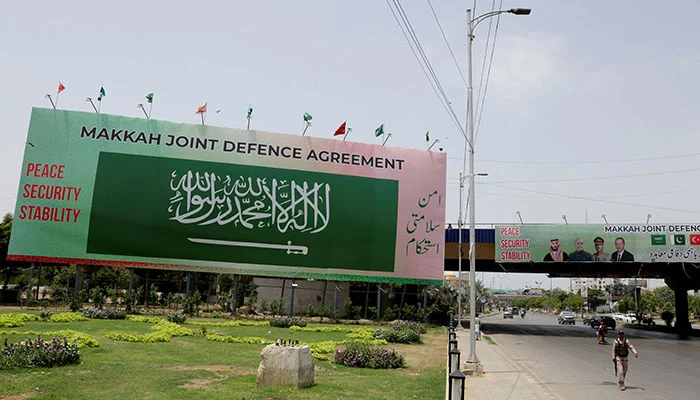
Deputy Prime Minister and Foreign Minister Ishaq Dar said Sunday that the Makkah Joint Defence Agreement remains open to countries willing to uphold its core principles, stressing that the pact is purely defensive and is not aimed at any particular country.
His remarks came two days after Pakistan, Saudi Arabia and Turkiye signed the landmark defence agreement in Makkah, establishing a collective security framework under which an armed attack against one member would be considered an attack against all three.
Dar explains purpose of Makkah Accord
In a statement posted on X, Dar said the agreement reflected the longstanding brotherly ties between Pakistan, Saudi Arabia and Turkiye and was the result of years of consultations and strategic coordination.
According to the foreign minister, the accord is intended to strengthen cooperation in dealing with common peace and security challenges while contributing to regional stability and prosperity.
Dar also clarified that the agreement does not cancel or replace any existing bilateral or multilateral arrangements involving the three countries.
He said the pact is consistent with Article 51 of the United Nations Charter, which recognises the inherent right of states to individual and collective self-defence.
Under the agreement, an armed attack against any one of the three signatories would be treated as an attack against all members, triggering their commitment to collective security.
Pact open to other countries
Dar emphasised that the agreement is not directed against any country and is instead focused on strengthening regional peace, stability and prosperity.
He added that the framework could remain open to other countries in the region that are prepared to respect its fundamental principles and settle disputes through mutual respect, cooperation and peaceful means.
The statement comes as regional countries seek closer security coordination amid heightened tensions in the Middle East. The ongoing conflict involving the United States, Israel and Iran has had wider consequences for the region, including disruptions to maritime traffic through the strategically important Strait of Hormuz.
Beyond Defence: Can the Makkah Pact Transform Pakistan’s Economic Prospects?
Pakistan, Saudi Arabia and Turkiye deepen cooperation
The agreement was signed at the Makkah Al-Mukarramah Summit for Joint Defence, attended by Saudi Crown Prince and Prime Minister Mohammed bin Salman, Turkish President Recep Tayyip Erdoğan and Prime Minister Shehbaz Sharif.
The three countries already maintain close political, economic and defence relations, and the new agreement is expected to provide a broader framework for cooperation in the security sector.
The Turkish military is one of the largest within NATO, while Saudi Arabia remains a major regional power and one of the world’s leading oil exporters. Pakistan, meanwhile, is the only nuclear-armed Muslim-majority state.
Following the signing, Turkish Foreign Minister Hakan Fidan said President Erdoğan wanted the alliance to expand, with Egypt among the countries that could potentially join the arrangement.
In the light of ongoing discussion and interest surrounding the “Makkah Joint Defence Agreement” (The Makkah Accord) over the past two days, the following context and clarity on this Agreement may be useful for everyone to note:
• The Makkah Joint Defence Agreement, jointly…
— Ishaq Dar (@MIshaqDar50) August 9, 2026
Pakistan reaffirms collective security commitment
Dar said the agreement was fully consistent with Pakistan’s foreign policy objectives and reaffirmed Islamabad’s commitment to working with regional partners to resolve conflicts peacefully and promote a more secure and prosperous future.
Pakistan’s Foreign Office also said the pact reflected the three countries’ shared commitment to collective security, peace and stability in the region and beyond.
The agreement is designed to strengthen collective deterrence against aggression and provides for enhanced defence cooperation among the three countries.
The new arrangement also builds on Pakistan and Saudi Arabia’s existing security relationship. A year earlier, the two countries signed a mutual defence agreement under which aggression against either country would be considered an attack against both.
With the Makkah pact, Islamabad, Riyadh and Ankara have now established a wider trilateral framework that could shape their future defence and strategic cooperation while leaving the door open for other countries willing to subscribe to its principles.