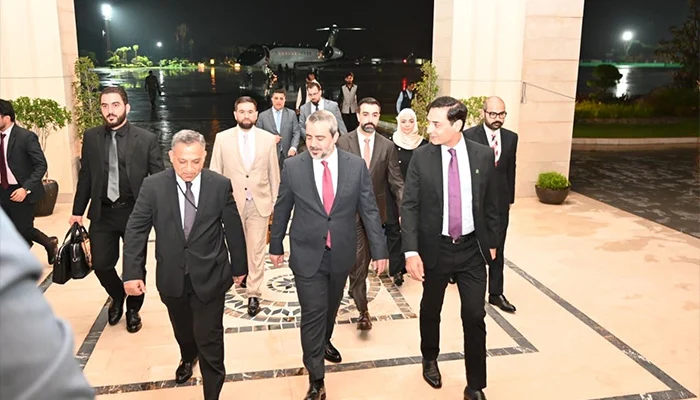
ISLAMABAD: Syrian Foreign Minister Asaad Hassan al-Shaibani arrived in Islamabad on Wednesday for an official two-day visit to Pakistan, with talks expected to focus on bilateral relations, expanded cooperation and developments affecting the region.
According to Pakistan’s Foreign Office, al-Shaibani is visiting Pakistan from August 19 to 20 at the invitation of Deputy Prime Minister and Foreign Minister Senator Ishaq Dar.
The Syrian foreign minister arrived in Islamabad accompanied by a high-level official delegation. He was received at the airport by the Additional Secretary for Middle East Affairs at Pakistan’s Ministry of Foreign Affairs.
Pakistan and Syria to Review Bilateral Relations
During the visit, Pakistani and Syrian officials are expected to hold detailed discussions covering the full range of bilateral relations.
The Foreign Office said the two sides would review opportunities to further strengthen cooperation between Pakistan and Syria and explore areas where bilateral ties can be expanded.
The discussions are expected to provide an opportunity for both countries to assess their existing relationship and identify potential areas for greater engagement.
The visit comes as Pakistan continues to maintain diplomatic engagement with Syria and other countries in the region amid significant political and security developments across the Middle East.
H.E. Mr. Asaad Hassan Al-Shaibani, Minister of Foreign Affairs of the Syrian Arab Republic, arrived in Islamabad today on an official visit to Pakistan at the invitation of Deputy Prime Minister/Foreign Minister Senator Mohammad Ishaq Dar @MIshaqDar50.
Upon arrival, the… pic.twitter.com/95YAJPUJ4r
— Ministry of Foreign Affairs – Pakistan (@ForeignOfficePk) August 19, 2026
Regional and International Developments on Agenda
In addition to bilateral matters, the two sides will exchange views on regional and international developments, according to the Foreign Office.
Syria remains an important focus of regional diplomacy, particularly as neighbouring and other regional powers continue to engage with Damascus on political, security and economic matters.
For Pakistan, discussions with the Syrian leadership also provide an opportunity to share views on regional stability and broader issues affecting the Muslim world.
The talks are therefore expected to go beyond bilateral relations and cover developments of mutual interest at the regional and international levels.
Pakistan Strongly Condemns Israeli Attack on Syrian Airbase
High-Level Syrian Delegation Accompanies FM
Al-Shaibani’s visit is being accompanied by a high-level Syrian delegation, underscoring the importance attached to the discussions by Damascus.
The Syrian foreign minister is also expected to hold meetings with Pakistan’s senior leadership during his stay in Islamabad.
These meetings are likely to provide an opportunity for both sides to discuss political relations as well as prospects for expanding cooperation between their two countries.
The Foreign Office described the visit as an important step toward further strengthening Pakistan-Syria relations and advancing cooperation.
A Step Toward Closer Pakistan-Syria Ties
The visit marks another high-level diplomatic engagement between Pakistan and Syria at a time when regional developments continue to influence the foreign policies and security priorities of countries across the Middle East and South Asia.
For Islamabad, maintaining engagement with Syria provides an avenue for discussing regional challenges directly with the Syrian government while exploring opportunities for closer bilateral cooperation.
For Damascus, stronger relations with Pakistan could provide additional diplomatic engagement with a major South Asian country and an important member of the Muslim world.
The outcome of the meetings in Islamabad is expected to provide further direction on future Pakistan-Syria cooperation, particularly in areas identified by both sides as mutually beneficial.
Asad Hassan al-Shaibani’s two-day visit is thus being viewed by Pakistan’s Foreign Office as an important opportunity to deepen bilateral relations while exchanging perspectives on the rapidly evolving regional and international environment.