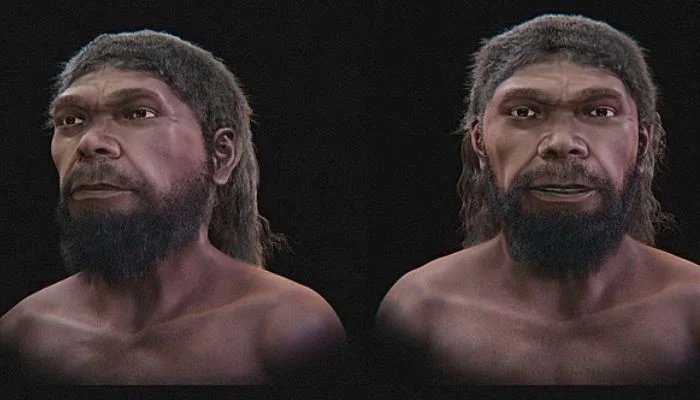
Scientists have reconstructed the face of one of the earliest known members of our species, offering a striking glimpse of what humans may have looked like around 315,000 years ago.
The reconstruction is based on ancient Homo sapiens fossils discovered at Jebel Irhoud in Morocco, an archaeological site that transformed scientific understanding of when and where our species emerged.
Ancient fossils reveal surprisingly familiar features
Researchers used a three-dimensional composite skull, based primarily on a fossil known as Irhoud 1, to reconstruct the face using forensic techniques.
The result depicts a man with a broad face and prominent brow region. Despite being more than 300,000 years old, some of his facial characteristics appear surprisingly familiar when compared with modern humans.
However, scientists stress that the reconstruction should not be viewed as an exact representation of the individual who lived at Jebel Irhoud.
The skull used in the reconstruction combines fossil material, while features that cannot be determined from bones, including skin colour, hair and other soft-tissue characteristics, require artistic interpretation.
Jebel Irhoud fossils provide clues to human evolution
While some aspects of the reconstruction remain uncertain, scientists can examine the underlying anatomy of the fossils with much greater confidence.
The Jebel Irhoud remains have faces, jaws and teeth that share several important characteristics with modern Homo sapiens. However, their skulls were longer and less rounded than those of present-day humans.
This combination of ancient and modern traits has made the fossils particularly important in understanding how our species evolved.
70 Million Year Old Dinosaur Egg Found Intact in Argentina
When researchers established the age of the Jebel Irhoud fossils in 2017, the findings pushed the known history of Homo sapiens back to roughly 300,000 years ago.
The discovery also challenged the long-standing idea that modern humans emerged suddenly in one small region of Africa.
Instead, the evidence suggests that early Homo sapiens may have developed across different parts of Africa over a much longer period, with various populations gradually acquiring characteristics associated with modern humans.
The newly reconstructed face provides another visual way to understand this complex stage of human evolution, while the fossils themselves continue to offer scientists important evidence about the appearance and development of some of our earliest known ancestors.