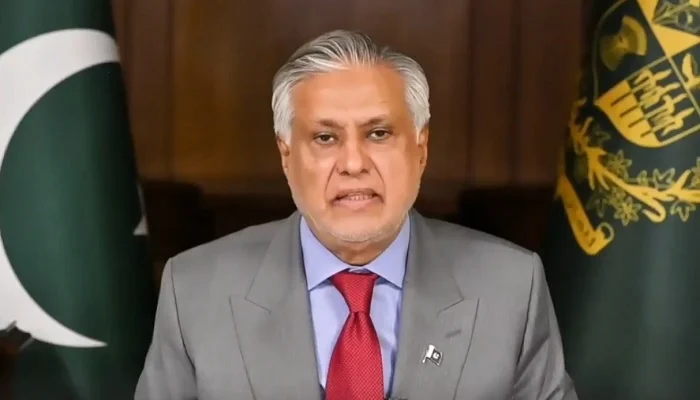
Pakistan’s Deputy Prime Minister and Foreign Minister Ishaq Dar has warned that any attempt to deprive Pakistan of its treaty-allocated share of water could have serious consequences for regional peace and security.
Speaking at the International Water Symposium organised by the Embassy of Pakistan in Austria in collaboration with the Diplomatic Academy of Vienna, Dar said there should be no doubt about Islamabad’s determination to protect its rights under the Indus Waters Treaty (IWT) and international law.
“Any attempt to deprive Pakistan of the waters rightfully allocated to it would have serious implications for regional peace and security,” Dar said.
Pakistan rejects unilateral suspension of water rights
The Indus Waters Treaty has remained a major point of contention between Pakistan and India since New Delhi announced in April 2025 that it was placing the agreement in abeyance.
The move followed the killing of 26 tourists in an attack in Pahalgam, Indian Illegally Occupied Jammu and Kashmir (IIOJK), which India blamed on Pakistan. Islamabad rejected the allegation and denied involvement.
Dar said the IWT contains no provision allowing either country to suspend the agreement unilaterally. He accused India of continuing what he described as “intransigent behaviour and illegal actions”.
Signed in 1960 after years of negotiations, the treaty established a framework for managing the shared river system and resolving disputes between the two countries.
Dar highlights water security concerns
Dar said water security was directly linked to Pakistan’s food security, agriculture, energy production and economic development.
The Indus River System supports the livelihoods of more than 250 million people in Pakistan, he said, stressing that any disruption to the country’s water rights would have consequences extending beyond the bilateral relationship.
“The fundamental question, therefore, is whether shared waters will be governed through cooperation and agreed legal frameworks, or become instruments of political pressure and confrontation,” Dar said.
He also warned that using water as a tool of political pressure could create a dangerous precedent for other countries that share transboundary river systems.
Video of the keynote address by Deputy Prime Minister/Foreign Minister Senator Mohammad Ishaq Dar @MIshaqDar50 at the “International Water Symposium” organized by the Diplomatic Academy of Vienna, Austria, on 6 October 2026 https://t.co/7Z58nRMuvx
— Ministry of Foreign Affairs – Pakistan (@ForeignOfficePk) October 6, 2026
Pakistan cites arbitration ruling
Dar referred to a unanimous decision issued by the Permanent Court of Arbitration (PCA) on August 31 concerning the status of the Indus Waters Treaty.
According to Dar, the ruling reaffirmed that the treaty remains in force and that India continues to be bound by its obligations under the agreement. He said the decision also placed restrictions on India’s work on a hydropower project.
“This is an important reaffirmation of Pakistan’s position, as well as a fundamental principle of international law,” Dar said, invoking the principle that agreements must be honoured.
Pakistan has continued to participate in the Neutral Expert proceedings under the treaty and in dispute-resolution processes administered through the PCA’s Vienna office, according to Dar.
India has rejected the arbitration ruling and said it does not recognise the court’s authority in the matter.
Hague Court Orders India to Uphold Indus Waters Treaty With Pakistan
Pakistan calls for dialogue and treaty-based cooperation
Dar said Pakistan remained committed to resolving differences with India through dialogue, diplomacy and the dispute-resolution mechanisms established under the IWT.
He outlined three principles for moving forward: implementation of the treaty in letter and spirit, resolution of disputes through the mechanisms provided under the agreement, and greater technical engagement, transparency and data-sharing between the two countries.
“Our preference remains clear: cooperation over coercion, dialogue over confrontation, and the rule of law over unilateralism,” Dar said.
Under the IWT, India has rights over the eastern rivers, including the Ravi, Beas and Sutlej, while the western rivers, including the Indus, Jhelum and Chenab, are largely allocated to Pakistan.
The long-running dispute over the treaty has added another layer of tension to relations between the nuclear-armed neighbours, with Islamabad maintaining that any disruption to its treaty-allocated water supplies would have serious consequences.