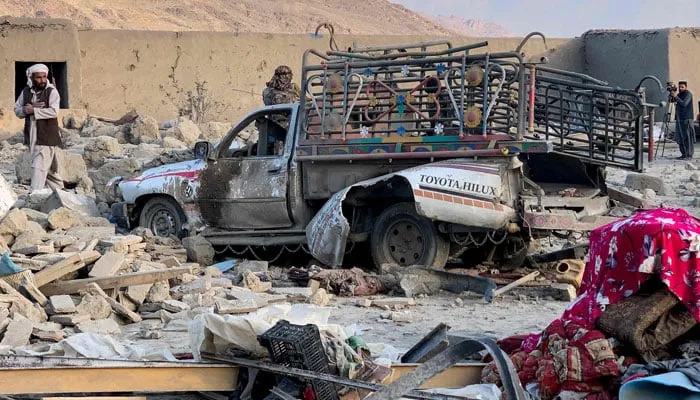
Islamabad: Pakistan carried out intelligence-based strikes on seven terrorist camps and hideouts along the Pakistan-Afghanistan border, targeting Fitna al-Khawarij (FAK), its affiliates, and Daesh-Khorasan, following recent suicide attacks. According to the Ministry of Information, the operation was conducted “with precision and accuracy” during the holy month of Ramadan in response to attacks in Islamabad, Bajaur, and Bannu.
Details of the Suicide Attacks
The ministry stated that the attacks were orchestrated by khawarij under the guidance of Afghanistan-based leadership and handlers. Responsibility was also claimed by the Afghanistan-based Tehreek-e-Taliban Pakistan (TTP), linked to FAK and Daesh. Despite repeated requests urging the Afghan Taliban authorities to prevent the use of Afghan territory by terrorist groups and foreign proxies, the ministry said no substantial measures were taken.
Pakistan’s Focus on Citizen Security
The government emphasized that Pakistan has always worked for regional peace and stability, but “the safety and security of our citizens remains the top priority.” Pakistan expects the interim Afghan government to fulfill its responsibilities and stop terrorist groups from using Afghan soil to carry out attacks inside Pakistan. The Ministry also called on the international community to encourage Afghan authorities to honor commitments under the Doha Agreement to prevent their territory from being used against other countries—a step it described as crucial for regional and global peace.
Airstrikes and Ground Operations
Sources reported that an airstrike targeted a militant hideout in the Barmal area of Paktika province in Afghanistan, destroying militant infrastructure. Subsequent airstrikes were conducted in Nangarhar’s Khogyani district, as well as in Ghani Khel, Behsud, and Argoon. Afghan media could not confirm the exact number of militant casualties.
Meanwhile, in Khyber Pakhtunkhwa’s Bannu district, an intelligence-based operation by security forces resulted in the killing of five India-backed FAK militants. However, two soldiers, including a lieutenant colonel, were martyred when militants targeted their convoy. Security forces had intercepted a vehicle-borne suicide bomber, preventing a potential large-scale attack on civilians or law enforcement.
Afghan Taliban’s Failure and Pakistan’s Response
The Inter-Services Public Relations (ISPR) noted that the Afghan Taliban once again failed to prevent militants from using Afghan soil for terrorist activities, even during Ramadan. The military warned that Pakistan would “not exercise restraint” and that operations against perpetrators would continue regardless of their location.
Federal Minister for Parliamentary Affairs Dr. Tariq Fazal Chaudhry highlighted that Pakistan’s response sent a clear message: the country is not weak but strengthened by the blood of its martyrs. He described the airstrikes as justice for innocent lives lost to terrorism, defending the aspirations of children and families for a safe Pakistan.
Press Release
21 February, 2026In the aftermath of recent suicide bombing incidents in Pakistan, including Imam Bargah at Islamabad, one each in Bajaur and Bannu followed by another incident today in Bannu during the holy month of Ramzan, Pakistan has conclusive evidence that…
— Ministry of Information & Broadcasting (@MoIB_Official) February 21, 2026
Border Tensions and Historical Context
These strikes come after Defence Minister Khawaja Asif warned that Pakistan was prepared to carry out further operations if Kabul failed to provide credible assurances of peace. In October 2025, border clashes occurred between Pakistan and the Afghan Taliban following unprovoked attacks, resulting in over 200 Taliban and allied militants killed and 23 Pakistani soldiers martyred. Pakistan had also conducted deep “precision strikes” in Kandahar and Kabul, but repeated talks failed to secure a ceasefire due to the Taliban’s reluctance to act against terrorist groups.
Counterterrorism Efforts Across Pakistan
Since the Taliban regained control of Afghanistan in 2021, cross-border terrorist activity has increased, particularly in Khyber Pakhtunkhwa and Balochistan. A terrorist attack in Bajaur on February 17, carried out by Indian proxies, killed 11 security personnel, while 12 militants were neutralized by security forces.
ISPR Director General Lt. Gen. Ahmed Sharif Chaudhry stated that in 2025, Pakistan conducted 75,175 intelligence-based operations nationwide. Khyber Pakhtunkhwa accounted for 14,658, Balochistan for 58,778, and the remaining 1,739 across other regions. During these operations, 2,597 terrorists were eliminated, and a total of 5,397 terrorist incidents occurred across Pakistan, mostly concentrated in Khyber Pakhtunkhwa and Balochistan, many involving militants operating from Afghan soil.
These measures demonstrate Pakistan’s ongoing commitment to protecting its citizens while pursuing regional stability and security.