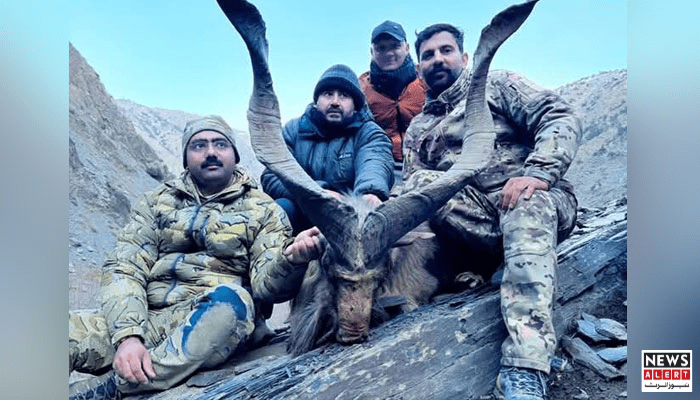
An American hunter has successfully hunted a rare Kashmiri markhor in Pakistan’s northern district of Chitral, officials from the Wildlife Department confirmed. Authorities carried out the hunt under strict supervision, following all legal and conservation guidelines.
The development has again brought Pakistan’s trophy hunting programme into the international spotlight. Supporters argue that the system funds conservation and benefits local communities. Meanwhile, critics continue to raise ethical concerns.
Strict Oversight by Wildlife Authorities
The provincial Wildlife Department closely monitored the entire hunting operation. Officials stated that rangers remained present throughout the process to ensure compliance with regulations.
The hunter secured an official trophy hunting permit worth 270,000 US dollars. In Pakistani currency, the amount equals approximately 75.6 million rupees.
Also Read: Russian Hunter Pays $68,000 to Hunt Kashmir Markhor in Northern Pakistan
Moreover, authorities emphasized that the department issues only a limited number of permits each year. This restriction, they said, helps maintain ecological balance. In addition, officials allow hunting only during a defined season.
As a result, wildlife experts believe the programme prevents uncontrolled or illegal hunting.
Details of the Markhor and the Hunt
According to the Wildlife Department, the hunted animal was a mature Kashmiri markhor, a subspecies famous for its long, twisted horns.
Officials reported that the markhor had horns measuring 52 inches. They described the animal as fully grown and past its prime breeding age. Therefore, authorities concluded that the hunt would not harm population growth.
The hunter targeted the animal from a distance of 510 metres, officials said. Such long-range shots require skill and strict adherence to safety standards.
Meanwhile, wildlife officers selected the animal carefully before granting approval for the hunt.
Revenue and Community Development
Importantly, Pakistan’s trophy hunting programme follows a revenue-sharing model. Under this system, 80 percent of the permit fee goes directly to local communities.
Local leaders often use these funds for development projects. These projects typically include schools, clinics, clean water schemes, and road repairs.
As a result, many residents now view wildlife as a valuable asset rather than a threat. Consequently, communities actively help protect markhor habitats and report illegal activities.
Officials say this approach has significantly reduced poaching in several northern regions.
Hunter Chooses to Remain Anonymous
The American hunter involved in the hunt requested anonymity. The Wildlife Department respected this decision and did not release personal details.
However, officials confirmed that the hunter travelled to Pakistan specifically for trophy hunting. Each year, several foreign hunters apply for permits through official channels.
Because of high permit costs, Pakistan’s programme ranks among the world’s most expensive. Nevertheless, authorities argue that high prices discourage excessive hunting.
Markhor Conservation Background
The markhor holds special importance as Pakistan’s national animal. It lives mainly in mountainous regions such as Chitral, Gilgit-Baltistan, and parts of Balochistan.
In the past, illegal hunting and habitat loss pushed markhor populations to dangerous levels. However, conservation efforts have shown measurable success.
According to the International Union for Conservation of Nature (IUCN), the markhor now carries a Near Threatened status. Previously, the species appeared on the endangered list.
Experts estimate that several thousand markhor now live in the wild. Even so, climate change and human expansion continue to pose risks.
Ongoing Debate Over Trophy Hunting
Despite conservation gains, trophy hunting remains controversial. Conservation groups argue that regulated hunting supports long-term protection.
They point to rising markhor numbers and improved community incomes as evidence. Furthermore, they stress that controlled hunting targets only a few older animals.
On the other hand, animal rights activists strongly oppose the practice. They argue that killing rare animals cannot justify financial benefits.
Nevertheless, Pakistani authorities continue to defend the policy. They insist that science-based quotas ensure sustainability.
Ultimately, the Chitral hunt reflects a broader global debate. It shows how conservation, economics, and ethics often intersect in complex ways.