US-based credit rating agency Fitch Ratings has reaffirmed Pakistan’s long-term foreign currency issuer default rating at ‘B-’ with a “stable outlook,” citing progress in fiscal consolidation and macroeconomic stability.
In its latest statement, Fitch noted that Pakistan’s economic performance remains broadly aligned with its programme under the International Monetary Fund (IMF), which continues to support the country’s funding capacity and policy direction.
Economic Stability and IMF Support
The agency highlighted that Pakistan recently reached a staff-level agreement with the IMF in March, unlocking approximately $1.2 billion in funding. This programme is expected to act as a key policy anchor, helping strengthen fiscal discipline and attract further multilateral and bilateral financial support.
Fitch also pointed out that foreign exchange reserves have improved over the past year, providing a buffer against external shocks, including the ongoing conflict in the Middle East. Additionally, Pakistan’s diplomatic role in brokering a ceasefire was noted as a factor that could bring indirect economic benefits.
Energy Dependence Remains a Key Risk
Despite positive indicators, Fitch warned that Pakistan’s heavy reliance on imported energy remains a major vulnerability. The country sources nearly 90% of its oil from Gulf nations and has limited storage capacity, making it highly exposed to disruptions in supply routes such as the Strait of Hormuz.
The agency cautioned that any sharp rise in global energy prices could strain foreign exchange reserves and increase fiscal pressure.
Inflation and Monetary Policy Outlook
Fitch expects inflation to rise moderately in the coming months due to higher global energy prices and adjustments in subsidy policies. Inflation is projected to average 7.9% in fiscal year 2026, higher than the previous year but significantly lower than the 23.4% recorded in FY2024.
Meanwhile, the State Bank of Pakistan (SBP) reduced its policy rate to 10.5% by the end of 2025, down from 22% in mid-2024, helping ease borrowing costs and support economic activity.
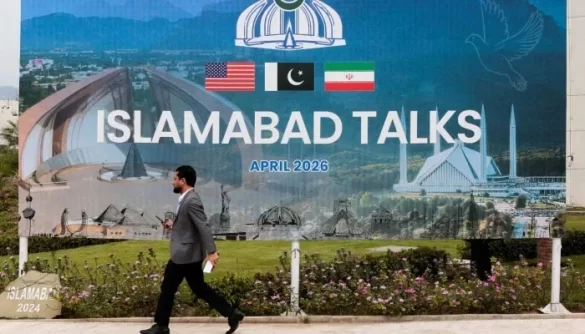
Pakistan Pushes for Fresh US-Iran Talks Before Ceasefire Deadline
Growth and Debt Outlook
The agency forecasts Pakistan’s GDP growth at 3.1% in FY2026, slightly higher than 3.0% in FY2025, driven by improved business confidence and lower interest rates. However, energy supply constraints could limit stronger expansion.
On the external front, Pakistan’s debt repayments are expected to increase to $12.8 billion in FY2026, up from nearly $8 billion in the previous year. A $3.5 billion deposit repayment to the United Arab Emirates has already been made, while additional bilateral loans are expected to be rolled over.
Fitch noted that future financing will largely depend on IMF support, along with inflows from other multilateral and bilateral partners. The government is also planning to issue a panda bond during the current fiscal year.
Fitch’s decision to maintain Pakistan’s ‘B-’ rating with a stable outlook reflects cautious optimism about the country’s economic direction. While progress in reforms and external support provide stability, risks linked to energy dependence and global uncertainties continue to pose significant challenges.