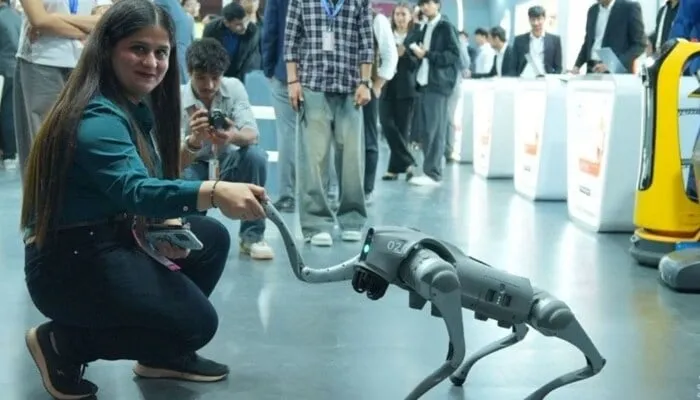
An Indian university came under scrutiny after a staff member attempted to present a commercially available Chinese robot dog as an original creation at the India AI Impact Summit in New Delhi. According to government sources, the university was asked to vacate its stall following the incident.
During the summit, Neha Singh, a communications professor at Galgotias University, told state-run broadcaster DD News, “You need to meet Orion. This has been developed by the Centre of Excellence at Galgotias University.” The remarks went viral online.
However, social media users quickly identified the robot as the Unitree Go2, sold by China’s Unitree Robotics for around $2,800 and widely used in research and education worldwide.
Public Reaction and Official Response
The episode drew criticism and cast a spotlight on India’s AI ambitions. Ashwini Vaishnaw, India’s IT Minister, amplified the controversy by sharing the clip on his official social media account, which was later deleted.
Following the backlash, Galgotias University and Professor Singh clarified that the robot was not developed by the university and that they had never claimed it was an original creation. A representative at the booth noted that no official communication had been received regarding removal from the summit.
Uber Eats launches AI “Cart Assistant” for faster grocery shopping
Summit Context and Wider Issues
The India AI Impact Summit, held at Bharat Mandapam, is billed as the first major AI gathering in the Global South. Notable speakers include Narendra Modi, Sundar Pichai, Sam Altman, and Dario Amodei.
The event has faced organisational challenges such as overcrowding and logistical issues, though over $100 billion in AI investments has been pledged, including commitments from the Adani Group, Microsoft, and Yotta.
India’s main opposition party, Congress Party, expressed outrage on social media, stating, “The Modi government has made a laughing stock of India globally with regard to AI,” referring to the robot incident.
This controversy has sparked a wider debate about authenticity and innovation in India’s rapidly growing AI sector.