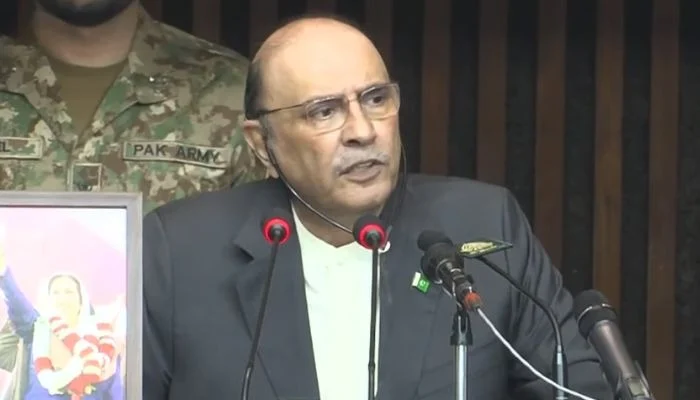
President Asif Ali Zardari on Monday reaffirmed that Pakistan would not permit any entity to use neighbouring territory to undermine its peace and stability, warning that the country is fully prepared to defend itself if required.
Addressing a joint sitting of parliament at the start of the new parliamentary year, the president described war as a “last resort” and urged India to move from confrontation toward meaningful negotiations. “Make no mistake. We are ready for you,” he said, cautioning that any aggression would be met with a decisive response.
The session was co-chaired by Senate Chairman Syed Yousuf Raza Gilani and National Assembly Speaker Sardar Ayaz Sadiq, and attended by Prime Minister Shehbaz Sharif, lawmakers, provincial leaders, and members of the diplomatic corps. Opposition members staged a protest during the address.
Kashmir and Regional Security
President Zardari reiterated Pakistan’s diplomatic and moral support for the people of Jammu and Kashmir, stating that lasting peace in South Asia is not possible without resolving the longstanding dispute. He also criticised India’s alleged violations of the Indus Waters Treaty, describing any attempt to manipulate river flows as unacceptable under international law.
Responding to statements from Indian leaders about preparing for further conflict, he said Pakistan remains committed to regional peace but is equally determined to defend its sovereignty. He emphasised that Pakistan is a responsible nuclear state that acts with restraint but responds decisively when required.
Middle East Crisis and Iran
The president condemned the war against Iran and expressed condolences over the martyrdom of Ayatollah Ali Khamenei. He reaffirmed Pakistan’s support for Iran’s sovereignty and territorial integrity.
At the same time, he condemned subsequent attacks on Saudi Arabia, the UAE, Bahrain, Jordan, Kuwait and Qatar, urging maximum restraint and adherence to international law. He called for negotiated solutions to prevent the region from sliding into deeper crisis.
Operation Ghazab lil-Haq and Counterterrorism
Referring to Operation Ghazab lil-Haq, President Zardari said Pakistan had exhausted diplomatic channels before resorting to military responses to cross-border terrorist incursions. He alleged that militant groups, including Al-Qaeda, BLA and TTP, continue to find sanctuaries in Afghanistan despite prior commitments.
“Pakistan’s soil is sacred,” he declared. “We will not allow any domestic or foreign entity to use neighbouring territory to destabilise our peace.”
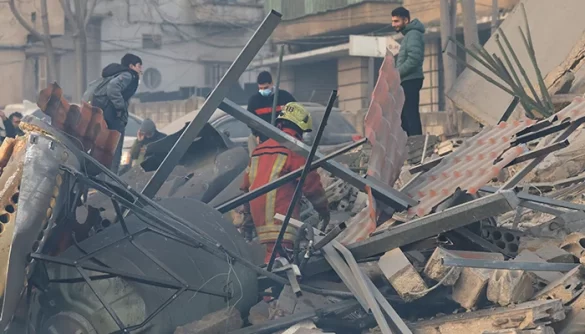
Pakistan Conducts Precision Strikes on Militant Hideouts Along Afghan Border
Foreign Policy and Strategic Partnerships
The president highlighted improving ties with the United States and praised efforts to de-escalate recent tensions with India. He also underscored Pakistan’s “ironclad” relationship with China, particularly under the China-Pakistan Economic Corridor (CPEC) 2.0, and appreciated support from Gulf countries, Azerbaijan and Turkiye.
Reaffirming Pakistan’s stance on Palestine, he called for the establishment of an independent state based on pre-1967 borders with Al-Quds Al Sharif as its capital.
Economic Outlook and Governance
Turning to domestic matters, President Zardari acknowledged recent economic stabilisation but stressed that the next phase must prioritise inclusive growth, job creation and relief for vulnerable groups. He called for tax reforms, energy sector restructuring, climate-resilient agriculture, and expansion of the Benazir Income Support Programme (BISP).
Emphasising provincial autonomy under the 18th Amendment, he described the presidency as a symbol of federal unity and constitutional continuity.
Concluding his address, the president urged lawmakers to safeguard sovereignty, eliminate terrorism and translate macroeconomic gains into tangible relief for citizens, while preserving national unity in challenging times.