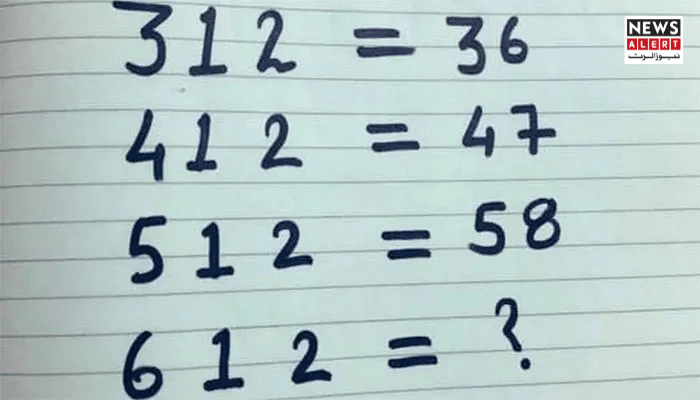
A short and seemingly easy maths puzzle is circulating widely online, yet many users say it left them puzzled. The riddle presents a sequence of numbers followed by an unknown answer:
312 = 36
412 = 47
512 = 58
612 = ?
Although the puzzle looks simple at first glance, people have offered dozens of different interpretations. Eventually, mathematics enthusiasts highlighted a clear pattern that explains the logic behind each answer.
How the Puzzle Works
According to experts who analysed the sequence, the answer lies in a combination of two simple steps:
take the first digit, and then add all digits together. Finally, place the first digit next to the sum to form the final number.
This creates a two-digit result, even though the numbers being added belong to a three-digit combination.
Breaking Down the Pattern
To understand the mechanism, consider each example:
-
312 →
-
First digit: 3
-
Sum of digits: 3 + 1 + 2 = 6
-
Final answer: 36
-
-
412 →
-
First digit: 4
-
Sum: 4 + 1 + 2 = 7
-
Final answer: 47
-
-
512 →
-
First digit: 5
-
Sum: 5 + 1 + 2 = 8
-
Final answer: 58
-
Following the same pattern:
-
612 →
-
First digit: 6
-
Sum: 6 + 1 + 2 = 9
-
Final answer: 69
-
The structure is simple once revealed. However, many online users admitted that they struggled to see the logic at first.
Why Such Puzzles Go Viral
Short, surprising problems often spread rapidly on platforms like Facebook, X, TikTok and Instagram. These puzzles encourage people to comment, argue and share their own solutions. As a result, they generate high engagement within hours.
Maths puzzles in particular tend to attract attention because they offer a quick challenge. They also allow people to feel accomplished when they discover the answer. In this case, hashtag activity related to the puzzle grew quickly as users posted videos explaining their interpretations.
A Useful Exercise for the Brain
Education specialists say that these seemingly minor challenges play an important role in mental development.
They argue that number-based puzzles stimulate logical reasoning, pattern recognition, and short-term memory.
Studies have shown that even brief problem-solving tasks can strengthen cognitive abilities. According to psychologists, such puzzles help both children and adults sharpen their minds. They also promote a sense of curiosity, which is essential for lifelong learning.
Teachers often incorporate similar activities to make maths more engaging. When puzzles appear on social media, they reach a wider audience and transform mathematics into a fun, accessible game.
Social Media Reactions
Users across platforms expressed delight — and some frustration — after attempting the puzzle. Many commented that the solution seemed obvious only after they saw the explanation. Others proposed alternative interpretations before agreeing on the correct pattern.
Some people took the opportunity to create new puzzles using the same logic, challenging friends and followers to solve them. Several influencers also used the viral moment to demonstrate how patterns work in basic arithmetic.
A Simple Puzzle With a Lasting Appeal
Although the puzzle is straightforward, its popularity highlights the enduring appeal of brain teasers.
In an era dominated by fast-scrolling content, small mental challenges offer a refreshing pause.
For now, the riddle has provided a moment of collective curiosity — and reminded many social media users that even simple numbers can hide surprising patterns.