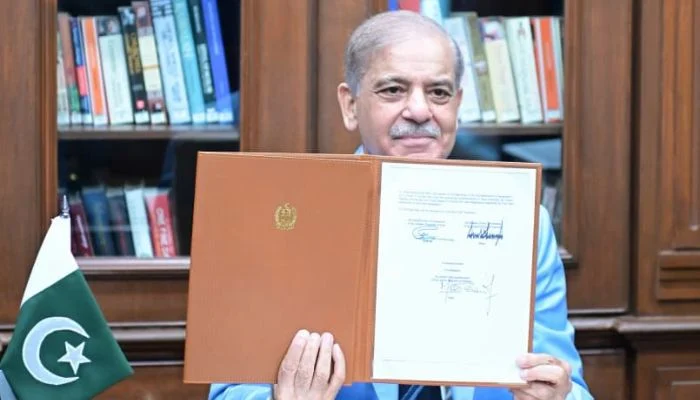
The agreement marks a major diplomatic development, with Pakistan playing a key mediating role between Washington and Tehran.
Prime Minister Shehbaz Sharif has formally signed the Islamabad Memorandum of Understanding (MoU) as a mediator, helping finalize a landmark peace agreement between the United States and Iran aimed at ending months of conflict in the Middle East.
According to a statement issued by the Prime Minister’s Office, the agreement was electronically signed by US President Donald Trump and Iranian President Masoud Pezeshkian, while Prime Minister Shehbaz endorsed the document in his capacity as mediator.
Agreement Comes Into Immediate Effect
Announcing the development, Prime Minister Shehbaz said the Islamabad MoU had entered into force immediately after being signed at the highest governmental level.
As part of the first phase of the agreement, Iran has agreed to reopen the Strait of Hormuz, a strategically vital global shipping route, while the United States will immediately lift its naval blockade on Iranian ports.
The Strait of Hormuz is one of the world’s most important energy corridors, through which a significant share of global oil exports passes. Its closure during the conflict had contributed to volatility in international energy markets and raised concerns about global supply disruptions.
Pakistan’s Diplomatic Role Highlighted
The prime minister described the agreement as a major diplomatic achievement and congratulated both the United States and Iran for choosing dialogue over continued confrontation.
He praised President Trump for pursuing a diplomatic solution and acknowledged the efforts of the American negotiating team, including Vice President JD Vance, Special Envoy Steve Witkoff and Jared Kushner.
PM Shehbaz also expressed appreciation for Iranian Supreme Leader Ayatollah Mojtaba Khamenei, President Masoud Pezeshkian, Foreign Minister Abbas Araghchi, Parliament Speaker Mohammad Bagher Ghalibaf and other Iranian officials involved in the negotiations.
Regional Countries Also Credited
The premier noted that several regional countries played an important role in facilitating dialogue and reducing tensions. He specifically acknowledged the contributions of Qatar, Saudi Arabia, Türkiye and Egypt in supporting peace efforts.
In addition, Prime Minister Shehbaz paid tribute to Pakistan’s Chief of Defence Forces, Field Marshal Asim Munir, stating that his continuous engagement and efforts were instrumental in helping bridge differences between the two sides and advancing regional stability.
Switzerland to Host US–Iran Talks After Ceasefire Deal, Pakistan and Qatar to Mediate
Economic Relief and Reconstruction Plans
Under the terms of the agreement, Washington has committed to waiving oil-related sanctions that have heavily impacted Iran’s economy.
The document also outlines a framework under which the United States will facilitate the establishment of a $300 billion reconstruction fund, supported by regional partners, once a comprehensive agreement on Iran’s nuclear programme is reached.
Negotiations on nuclear issues are expected to continue in the coming weeks and months, with both sides seeking a broader and more permanent settlement.
A Potential Turning Point for the Region
The conflict began on February 28 following US-Israeli military strikes on Iran, which triggered retaliatory missile and drone attacks by Tehran and led to escalating tensions across the Middle East.
With the signing of the Islamabad MoU, attention now shifts to the implementation of the agreement and upcoming negotiations on Iran’s nuclear programme. If successful, the accord could become a significant step toward long-term stability, economic recovery and improved diplomatic relations across the region.