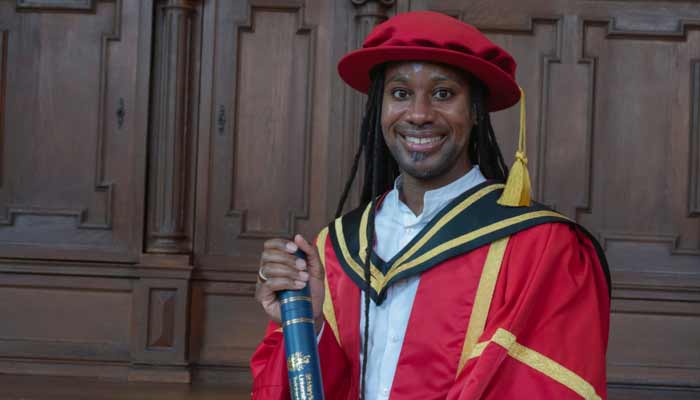
Former University of Cambridge professor Jason Arday has died at the age of 41, shortly after stepping down from his academic positions amid a high-profile controversy over allegations of plagiarism and questions surrounding aspects of his professional and personal claims.
Arday was found unresponsive at a property in Battersea, south London, on Friday afternoon, according to London’s Metropolitan Police. Officers said a 41-year-old man was pronounced dead at the scene. Police described the death as unexpected but said it was not believed to be suspicious. A report will be prepared for the coroner.
Cambridge University Vice-Chancellor Deborah Prentice expressed deep sadness over the news, while Education Secretary Lucy Powell also described the death as deeply shocking and urged the public to respect Arday’s family’s privacy.
Arday’s Rise to Cambridge
Arday became widely known after being appointed to a professorship at Cambridge in 2023 at the age of 37, making him the university’s youngest Black professor.
His academic journey had attracted significant attention because of the challenges he had reportedly overcome earlier in life. He went on to earn a doctorate in education from Liverpool John Moores University and build an academic career focused on education, race and inequality. Cambridge’s Faculty of Education had listed him as a professor of education.
His rise to one of Britain’s most prestigious universities was subsequently presented as an inspirational story, particularly because of the barriers he said he had faced during his childhood and education.
Plagiarism Allegations Triggered Investigation
The controversy surrounding Arday intensified in July after claims were published alleging that sections of his 2015 doctoral thesis closely resembled earlier academic work.
Reports also raised questions about some of his published research and statements concerning aspects of his personal and professional achievements. One analysis cited by Retraction Watch identified extensive similarities between parts of Arday’s doctoral dissertation and an earlier dissertation.
Arday denied deliberately engaging in plagiarism. In interviews, however, he acknowledged that there had been academic mistakes and argued that he was being unfairly portrayed as a liar and academic fraud.
He also said that the campaign against him was, in his view, partly racially motivated.
Historic First: Two Pakistani-Americans Elected Mayor and Deputy Mayor in Cambridge
Resignation From Cambridge
On August 5, Arday announced that he was resigning from both his professorship at Cambridge and his fellowship at Jesus College.
In a letter published online, he described his resignation as the only way to bring an extremely difficult period to an end. At the same time, he stressed that his decision should not be interpreted as accepting the allegations or wider narratives surrounding the controversy.
Cambridge had launched investigations into the allegations, including questions about the circumstances surrounding his appointment and his work while at the university. The university had pledged that the process would be thorough and transparent.
Family Criticises ‘Campaign of Harassment’
Following Arday’s death, his family criticised what they described as a sustained campaign of misinformation and harassment.
In a statement released through his publisher, Simon & Schuster, the family said the campaign had placed enormous pressure on Arday and described him as a gentle person who always tried to see the best in others.
However, the circumstances surrounding his death remain under investigation. Police have specifically said that the death is not currently considered suspicious, and no official cause of death has been announced.
Controversy Divided Academic Community
The allegations had generated sharply divided reactions within Cambridge and the wider academic community. Some academics called for an independent investigation into Arday’s appointment and academic record, while others defended him and warned against allowing the controversy to become a broader attack on Black academics.
Cambridge’s leadership had also cautioned against using the case to cast suspicion on other academics from ethnic minority backgrounds.
Arday’s death came just as his memoir, Great and Unfortunate Things, was being published in the United States, with its British release planned for later in August. The book, which chronicles his life and academic journey, had itself attracted scrutiny amid the wider controversy.
With investigations into the allegations still unresolved, Arday’s death has added a tragic and deeply sensitive dimension to a controversy that had already sparked intense debate over academic integrity, institutional accountability, race and the treatment of scholars in the public eye.