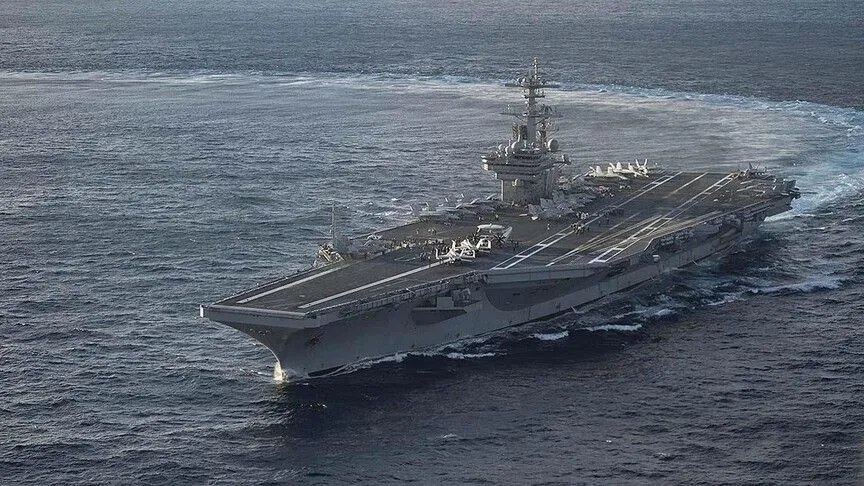
The United States aircraft carrier USS George Washington has left the Middle East after completing a three-month deployment in the region, returning to the operational area of the US Navy’s 7th Fleet in the Indo-Pacific.
The departure comes amid continuing tensions between Washington and Tehran and follows the arrival of another American aircraft carrier, the USS Theodore Roosevelt, in the region. Two US carrier strike groups, including the USS Roosevelt and USS George H.W. Bush, remain deployed in the Middle East.
USS George Washington Returns to US 7th Fleet
According to the US Naval Institute’s news service, USNI News, a US Pacific Fleet spokesperson confirmed on Wednesday, November 18, that the Japan-based aircraft carrier had entered the US 7th Fleet’s area of operations.
The spokesperson did not disclose which escort vessels accompanied the aircraft carrier during its departure.
The USS George Washington Carrier Strike Group entered the US 5th Fleet’s area of responsibility on August 19 to replace the USS Abraham Lincoln, which had previously been deployed in the region.
The carrier had departed its home base in Yokosuka, Japan, in late May for a deployment that initially included operations in the western Pacific.
It remains unclear whether the vessel is heading directly back to Japan or will make intermediate port calls before returning to its homeport.
Two US Aircraft Carrier Strike Groups Remain in the Region
The departure of the USS George Washington coincided with the arrival of the USS Theodore Roosevelt Carrier Strike Group in the Middle East on Sunday.
The USS George H.W. Bush has also been operating in the Arabian Sea since April.
With the George Washington’s departure and the Roosevelt’s arrival, two American aircraft carrier strike groups remain in the region.
The presence of multiple carrier strike groups reflects Washington’s continued military commitment to the Middle East amid the ongoing confrontation with Iran.
The arrival of the George Washington in the region in August had temporarily left the Indo-Pacific without a forward-deployed US aircraft carrier, raising questions about the impact of prolonged Middle East deployments on American naval operations elsewhere.
USS Abraham Lincoln Departs Thailand After Five-Day Port Visit
US-Iran Tensions Continue Despite Diplomatic Efforts
The naval movements come against the backdrop of the ongoing conflict involving the United States, Israel and Iran, which began with joint American-Israeli military strikes on February 28, 2026.
Washington and Tehran signed a memorandum of understanding in June aimed at addressing aspects of their confrontation. However, implementation has stalled amid disagreements over freedom of navigation and maritime security in the Strait of Hormuz.
The strategic waterway is one of the world’s most important energy shipping routes, connecting the Persian Gulf with international markets.
Disruptions to shipping through the strait have raised concerns about global energy supplies, commercial transportation and oil prices.
Despite diplomatic efforts to secure a lasting ceasefire, confrontations between American and Iranian forces have continued intermittently since July.
Strategic Importance of American Aircraft Carriers
US aircraft carrier strike groups play a central role in Washington’s military presence overseas. Each group typically includes an aircraft carrier, guided-missile destroyers, cruisers and other supporting vessels.
These formations provide the United States with substantial air power, surveillance capabilities and operational flexibility without requiring permanent access to military bases in other countries.
The USS George Washington is a Nimitz-class nuclear-powered aircraft carrier based in Japan. Its deployment to the Middle East was part of a wider rotation of American naval forces responding to regional security developments.
Its departure marks a shift in the US naval deployment pattern, although the continued presence of the USS Theodore Roosevelt and USS George H.W. Bush indicates that Washington is maintaining a substantial military presence in the region.
Source: US Naval Institute News (USNI News), Anadolu Agency and The Express Tribune.