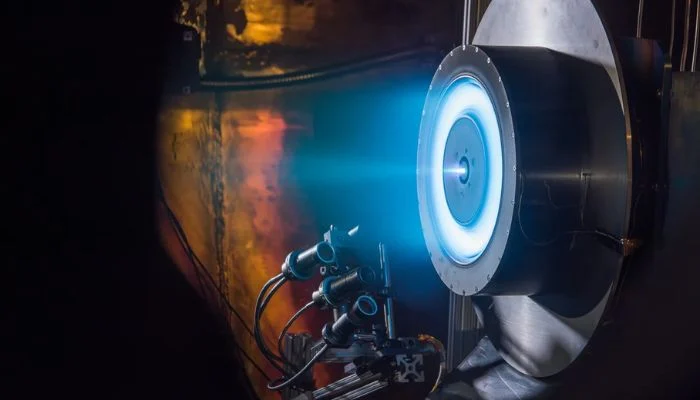
NASA has reported a major step forward in the development of advanced propulsion technology that could one day help astronauts travel more efficiently through deep space.
The US space agency recently tested a lithium-fed magnetoplasmadynamic (MPD) thruster at NASA’s Jet Propulsion Laboratory (JPL) in Southern California. During the test, the experimental electromagnetic engine reached approximately 120 kilowatts of power.
The technology is still at the prototype stage, but researchers believe it could eventually become part of a propulsion system capable of supporting long-duration missions to Mars and other destinations.
How the Lithium Thruster Works
Unlike conventional chemical rockets, which generate thrust through the combustion of propellants, an MPD thruster uses electricity, magnetic fields and plasma.
In NASA’s lithium-fed design, electrical energy is used to convert lithium into plasma. Electric currents and magnetic fields then accelerate that plasma, producing thrust that can propel a spacecraft through space.
NASA says electric propulsion can offer a major efficiency advantage over conventional high-thrust chemical propulsion. Such systems may use 70% to 90% less propellant for comparable propulsion tasks.
However, there is an important trade-off: electric thrusters generally produce much lower thrust than chemical rockets. This makes them unsuitable for launching spacecraft from Earth but potentially valuable once a spacecraft is already in space.
Test Reached 120 Kilowatts
During the recent test, the lithium-fed MPD thruster reached around 120 kW, a substantial power level for an electric propulsion system.
NASA said the test represents an important milestone because the technology is designed to operate at considerably higher power than many existing electric propulsion systems.
The thruster was fired five times, with the temperature of its central electrode exceeding 5,000 degrees Fahrenheit during each firing.
The experiment was conducted inside an 8-metre-long, water-cooled vacuum chamber specifically designed to test high-powered electric thrusters that use metallic vapour.
The controlled environment allowed researchers to examine the performance of the prototype under conditions that simulate the vacuum of space while managing the extreme heat generated during operation.
NASA Wants to Increase Power Further
Researchers are now planning to develop more powerful versions of the lithium-fed MPD system.
The next generation of thrusters is expected to target power levels between 500 kilowatts and 1 megawatt.
NASA Administrator Jared Isaacman described the successful test as an important milestone in the effort to eventually send American astronauts to Mars.
NASA Unveils New Space Telescope to Explore Dark Energy and Distant Worlds
However, the agency acknowledges that substantial engineering challenges remain before the technology could be used on an actual crewed mission.
Mars Mission Would Require Multiple Thrusters
One of the biggest challenges is the enormous amount of power required for a human mission to Mars.
NASA estimates that a single crewed Mars mission using this type of propulsion could require at least 2 megawatts of power. That means several high-powered thrusters would likely need to operate simultaneously.
The propulsion system would also have to function for extremely long periods.
Researchers estimate that multiple thrusters could need to operate for more than 23,000 hours, making durability a critical concern. Components would have to withstand prolonged exposure to intense heat and other demanding operating conditions.
Demonstrating that level of reliability remains one of the major hurdles before the technology can move from laboratory testing to space missions.
Nuclear Power Could Provide the Energy
Because electric propulsion requires large amounts of electrical power, researchers believe nuclear electric propulsion could eventually be paired with lithium-fed MPD thrusters.
A nuclear power source could potentially provide the continuous electricity needed to operate powerful electric thrusters during long-duration missions far from Earth.
NASA is developing the technology through researchers at JPL, in collaboration with Princeton University and NASA’s Glenn Research Center, as part of the agency’s Space Nuclear Propulsion Project.
Development of the lithium-fed MPD thruster has been underway for nearly three years.
A Promising Step, But Mars Is Still Far Away
The latest test confirms that the prototype can reach the targeted power level, but it does not yet demonstrate that the system is ready for a Mars mission.
The researchers still need to address issues including long-term reliability, thermal management, power generation and the ability to operate multiple thrusters together for thousands of hours.
If those challenges can eventually be overcome, high-powered electric propulsion could provide spacecraft with a highly efficient way to travel through deep space.
For now, NASA’s successful 120-kilowatt test represents an important laboratory milestone rather than a flight-ready Mars propulsion system. Nevertheless, the technology could become part of a future propulsion architecture designed to make long-distance human exploration more practical and potentially reduce travel times to the Red Planet.