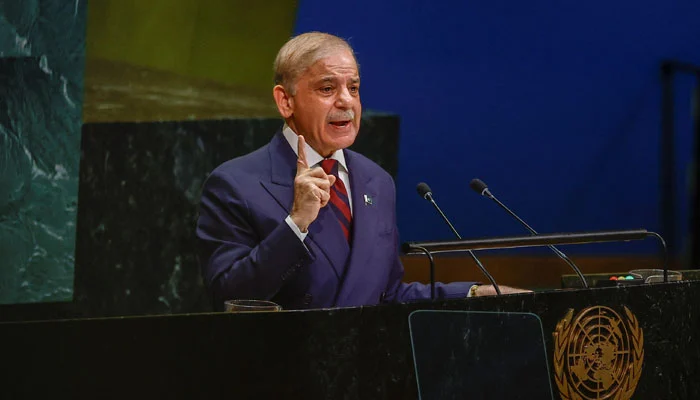
NEW YORK: Prime Minister Shehbaz Sharif used his address to the 81st session of the United Nations General Assembly to outline Pakistan’s position on regional security, water rights, terrorism, Kashmir and the conflict in Gaza.
Speaking at the UN headquarters in New York, the prime minister also called for diplomacy and greater international efforts to prevent further escalation in conflict-hit regions.
Here are five key takeaways from his speech:
1. Hormuz, Bab al-Mandeb must remain open
Shehbaz described the Straits of Hormuz and Bab al-Mandeb as “arteries of the global economy” and called for the vital waterways to remain open.
He said the straits should serve as links between nations rather than becoming “choke points of confrontation”.
“Those waters must carry the promise of prosperity, not the perils of war,” he said, urging diplomacy amid rising regional tensions.
2. Any attempt to block Pakistan’s water an ‘act of war’
The prime minister issued a strong warning over Pakistan’s water rights under the Indus Waters Treaty.
Shehbaz said any attempt to stop, impede or divert Pakistan’s share of river waters would be treated as an “act of war”.
He maintained that India’s decision to hold the treaty in abeyance had “no legal basis whatsoever” and insisted that the agreement remained “valid, binding and fully operative”.
“Water must never be weaponised. Rivers should nourish nations, not divide them,” he said.
3. Kashmir remains a core issue for Pakistan
Addressing the Kashmir dispute, Shehbaz said Pakistan exercised its right to self-defence during the May 2025 conflict with India.
He also credited US President Donald Trump’s intervention with helping prevent a wider confrontation between the two nuclear-armed countries.
The prime minister called for a “just and fair” resolution of the Kashmir dispute, saying Kashmiris had waited for decades for the UN to fulfil its commitment to a free and impartial plebiscite.
“Kashmir has been, and always will be, Pakistan’s jugular vein,” he said.
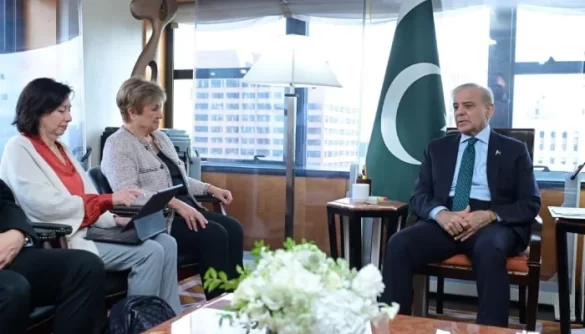
PM Shehbaz, Dar hold diplomatic meetings on UNGA sidelines
4. Pakistan calls for action against militants using Afghan soil
Shehbaz described terrorism as one of the most serious threats to international peace and security.
He said Pakistan had lost nearly 100,000 lives and suffered more than $150 billion in economic losses in its fight against terrorism.
The prime minister accused militant groups, including the Tehreek-e-Taliban Pakistan (TTP) and Balochistan Liberation Army (BLA), of using Afghan territory to carry out attacks against Pakistan.
He urged Afghan authorities to take “verifiable action” to prevent their territory from being used for attacks against Pakistan or other countries.
5. Shehbaz condemns Israeli actions in Gaza
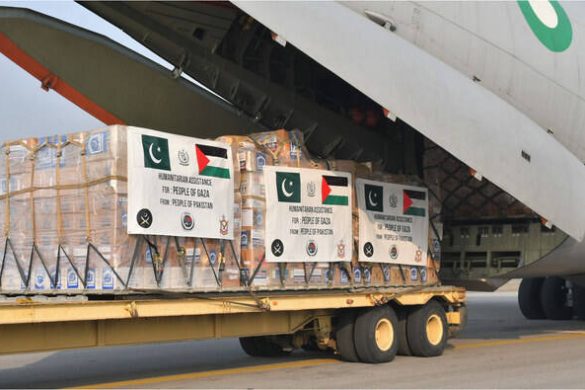
The prime minister condemned Israel’s actions in Gaza and the West Bank, highlighting the deaths and suffering of Palestinian civilians, particularly women and children.
He reiterated Pakistan’s support for an independent, sovereign, viable and contiguous Palestinian state based on the pre-1967 borders, with Al-Quds Al-Sharif as its capital.
Shehbaz also condemned Israeli actions in Lebanon and Syria and called for an immediate end to the violence.
The speech reflected Pakistan’s broader diplomatic priorities at the UN General Assembly, with the prime minister linking regional conflicts, international security, humanitarian concerns and economic stability.