PARIS: French security forces stepped up their presence across the capital on Saturday as authorities prepared for demonstrations that could turn violent, with Interior Minister Laurent Nunez urging police to respond swiftly to troublemakers and looters.
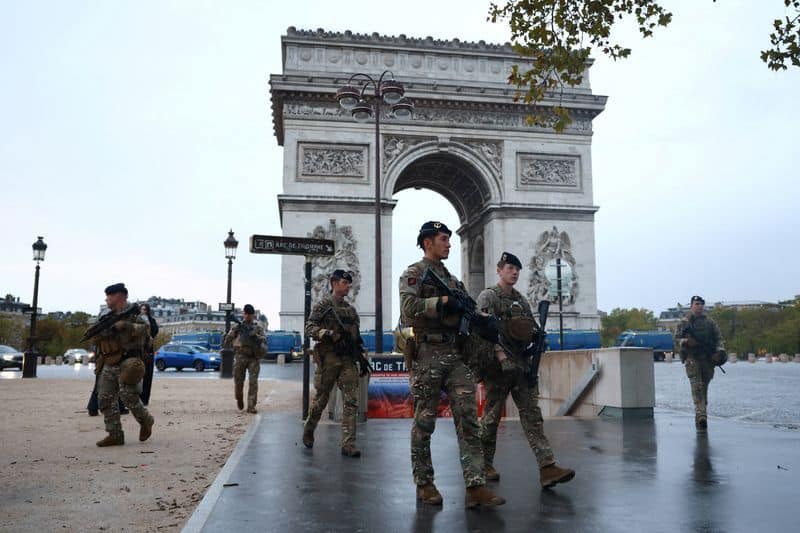
Soldiers from an anti-terrorism military unit patrolled the Champs-Élysées, while police vehicles circulated around the Arc de Triomphe. The heightened security operation aims to protect prominent landmarks and businesses from a repeat of the unrest that affected France the previous weekend.
Nunez has mobilised 70,000 police officers nationwide for Saturday’s demonstrations, 10,000 more than were deployed on October 17, when vandalism and looting raised concerns about the government’s ability to maintain public order.
Anger over the rising cost of living and pressure on public services has brought students, workers and trade unions onto the streets in recent weeks. Authorities have also warned that radical groups and groups of young looters could exploit the demonstrations to cause disorder.
Addressing police officers in Paris, Nunez warned that shops, public institutions and security personnel could become targets.
“We have to be ultra, ultra responsive. We have significant calls for disruption from political groups and quite simply from criminals,” he said. “It is going to be a long day.”
Shops, Museums and Metro Stations Close
Businesses across Paris took precautionary measures ahead of the demonstrations. Many shopkeepers boarded up their storefronts, while luxury retailers strengthened security arrangements.
Business groups urged stores to remain closed after thousands of shops and businesses were reportedly damaged or looted across France during the previous weekend.
Lidiya Shevchenko, a sales assistant at a Graziella Braccialini store in Paris, said she doubted many customers would venture out to browse luxury boutiques during the demonstrations.
“I suppose the mood is just as important when it comes to shopping,” she said.
Several major cultural attractions, including the Louvre, the Musée d’Orsay and the Opera House, were scheduled to close for the day to reduce the risk of damage or disruption.
More than 20 metro stations were also shut as authorities prepared for possible unrest and sought to manage movement through the capital.
Dispute Over Paris Protest Route
Uncertainty surrounded the location of the main Paris demonstration after police sought to redirect organisers away from the city centre towards the southeastern outskirts of the capital.
The Paris police prefecture said the proposed route posed serious risks to public order because it passed through an area with a high concentration of businesses similar to those targeted during the October 17–18 unrest.
The decision angered some left-wing politicians and protest organisers, who argued that the restrictions made it difficult to organise demonstrations.
Jean-Luc Mélenchon, leader of the hard-left France Unbowed party, criticised the authorities in a post on X, accusing them of creating obstacles and imposing unrealistic deadlines on organisations attempting to rearrange their marches.
France Faces Fresh Unrest as Yellow Vests Plan Major Paris March
Demonstrations Restricted Across France
Authorities have imposed restrictions on demonstrations in several parts of the country, although the measures vary by city.
Marseille reversed an earlier ban and authorised a trade union march, while restrictions remained in place for protests in central Lyon. Union rallies were also scheduled to proceed in Strasbourg.
Bans remained in force in several other cities, including Nancy, Metz, Besançon, Belfort, Rouen, Le Havre, Toulon and Limoges.
The restrictions reflect concerns that demonstrations could be exploited by groups seeking to damage property or provoke confrontations with police.
Protest Against France’s Far Right in Orléans
The first authorised march began in the mid-morning in Orléans, approximately 120 kilometres south of Paris. Demonstrators gathered to protest against Marine Le Pen’s far-right National Rally, which was holding a congress in the city over the weekend.
Bally Bagayoko, mayor of Saint-Denis and a member of France Unbowed, said the march was intended to send a message of opposition to the far right.
“We have come to tell the far right, face to face, that we are not afraid,” he said.
The demonstration added a political dimension to a day already marked by heightened security and concerns about potential clashes.
Shooting Adds to Tensions
Tensions were further heightened by a shooting west of Paris on Friday. A gunman suspected of acting out of Islamophobic hatred allegedly killed one person and wounded four others, including a 12-year-old girl.
The incident added to concerns about public safety as authorities prepared for demonstrations across the country.
With 70,000 police officers mobilised, major sites under protection and restrictions imposed on marches in several cities, French authorities faced a major challenge in allowing demonstrations to proceed while preventing further violence and damage.