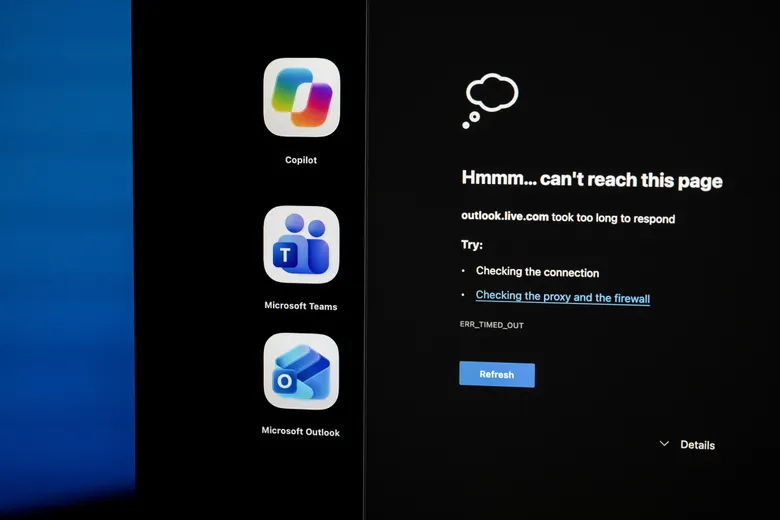
Microsoft has fully restored its Outlook, Teams and other services following a global technical outage that disrupted communications for businesses, government agencies and millions of users for more than 24 hours. The disruption affected essential workplace functions, including email delivery, online meetings and calendar management, prompting organisations across several countries to rely on alternative communication systems.
Microsoft Confirms Full Restoration of Services
Microsoft announced on Saturday, November 14, that services had recovered across its products and that the underlying technical issue had been addressed.
“We have completed our efforts to address the underlying issue of the incident and restored service to the remaining impacted customers and regions,” the company said in a post on X.
The outage affected several Microsoft 365 applications, particularly Outlook and Teams, as well as its Copilot artificial intelligence assistant.
The company had been working to restore server stability and resolve infrastructure problems since the disruption began on Thursday.
What Caused the Microsoft Global Outage?
According to Microsoft, server-related technical problems were responsible for the disruption, particularly issues affecting Exchange Online, the cloud-based platform that supports Outlook email and scheduling services.
The company initially reported unusually high traffic loads across its infrastructure. Further investigations indicated that several servers had unexpectedly become unavailable, placing additional pressure on the remaining systems.
Microsoft also ruled out a cyberattack and said it had found no evidence of malicious activity.
The company further clarified that artificial intelligence was not responsible for the incident.
The outage was among the longest disruptions in Microsoft’s history, raising concerns about the reliability of cloud-based services used by organisations worldwide.
More Than 7.4 Million Outage Reports Recorded
Downdetector, a website that tracks service disruptions through user reports, recorded more than 7.4 million reports worldwide during the incident.
According to its parent company, Ookla, reports peaked at nearly 20,000 per minute, more than 1,500 times the normal level.
The disruption affected users in more than 70 countries and territories, with problems becoming particularly noticeable as businesses and government offices began their working days across Asia and Europe.
Outlook and Teams are among the most widely used workplace applications, serving hundreds of millions of users globally.
The disruption prevented many people from sending emails, accessing calendars and conducting virtual meetings.
Government Agencies and Businesses Affected
The outage affected a wide range of organisations, including government departments, healthcare providers, financial institutions, airlines and international businesses.
In the United Kingdom, the disruption affected services used by the National Health Service and London’s Metropolitan Police.
The NHS said some local services had to rely on alternative arrangements, including paper records, while the Metropolitan Police reported difficulties with certain online crime-reporting services. Emergency response operations were not affected.
Immigration New Zealand also suspended the processing of visa applications during the disruption.
Several major businesses reported operational difficulties. European exchange operator Euronext experienced email problems, while British insurer Aviva activated backup arrangements for earnings calls.
Danish shipping company Maersk warned customers about delayed updates.
Airlines in India, including IndiGo, Akasa Air and Air India, also reported problems with email-based customer support services.
Financial institutions in Taiwan faced difficulties with certain operations, with one company reportedly resorting to fax communications to confirm trades.
Discord outage hits thousands of users across multiple regions
Microsoft Outage Also Affected AI Services
The disruption extended beyond Microsoft’s own applications, affecting external services that rely on Microsoft 365 integrations.
OpenAI and Anthropic reported problems with their Microsoft connectors, which affected certain integrations and tools.
These disruptions highlighted how heavily modern businesses and technology platforms depend on Microsoft’s cloud infrastructure.
Organisations hosting Microsoft services on their own servers were comparatively less affected than those relying entirely on cloud-based services.
Questions Raised Over Dependence on Cloud Technology
The global outage has renewed concerns about the risks of relying heavily on a small number of technology companies for essential business operations.
Experts have warned that when widely used cloud platforms experience major technical failures, the consequences can spread across industries and countries.
The incident also comes after other Microsoft service disruptions this year, including problems affecting its Azure cloud platform.
Although services have now been restored, the outage has highlighted the importance of backup systems, alternative communication channels and stronger infrastructure resilience.
Microsoft has apologised for the disruption, while the incident is expected to prompt further scrutiny of the reliability of cloud-based workplace services.
Source: The Express Tribune, with additional reporting from Reuters, published November 14, 2026.