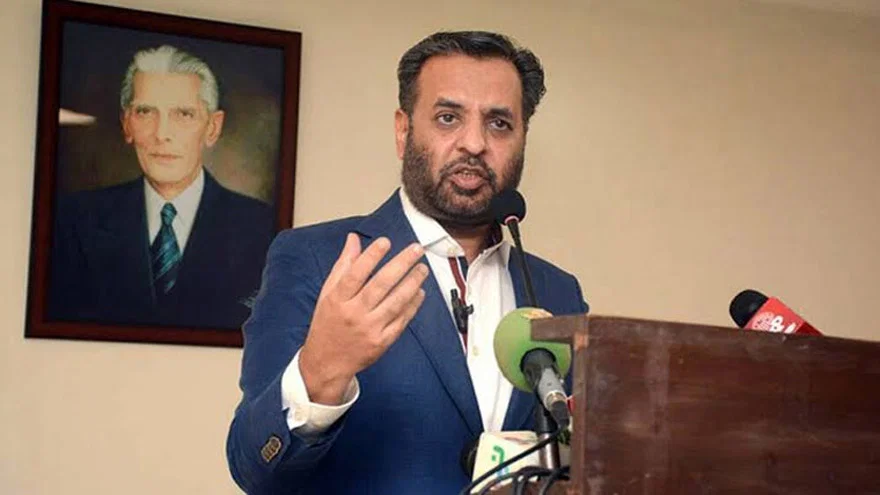
Federal Health Minister Mustafa Kamal has renewed his call for creating smaller provinces in Pakistan, arguing that administrative restructuring has become essential to improve governance and ensure that public resources reach people at the grassroots level. He said the country’s existing provincial structure was failing to deliver sufficient financial and administrative powers to local communities despite receiving substantial funds from the federal government.
Mustafa Kamal Says Existing Governance System Needs Restructuring
Speaking at the inauguration of a regional office of the Allied Health Professionals Council in Karachi on Friday, November 13, Kamal said the creation of smaller provinces was not a matter of personal preference but a national necessity.
“Creation of new provinces is not anyone’s wish but Pakistan’s need,” he said, arguing that establishing additional administrative units had become indispensable for effectively running the country.
The Muttahida Qaumi Movement-Pakistan (MQM-P) leader maintained that Pakistan’s large provincial structures were making effective administration and public service delivery increasingly difficult.
To illustrate his argument, he compared the geographical sizes of Pakistan’s provinces with those of countries around the world.
According to Kamal, Punjab is geographically larger than 180 countries, Sindh exceeds the size of 175 countries, Khyber-Pakhtunkhwa is larger than 162 countries, while Balochistan is bigger than 185 countries.
Rs8.84 Trillion Allocated to Provinces but Funds Not Reaching Villages
The federal minister also questioned how provincial governments were utilising financial resources received through the federal divisible pool.
He said that under the existing National Finance Commission (NFC) distribution arrangement, provinces receive 57.5 per cent of the divisible pool.
Kamal claimed that Pakistan’s four provinces had collectively received Rs8.84 trillion during the current financial year, but the money was not reaching communities at the village level.
He identified the failure to devolve administrative authority and financial resources from provincial governments to lower tiers as one of the country’s biggest governance challenges.
According to the minister, transferring powers and resources closer to local communities is essential for improving public services and addressing regional inequalities.
Kamal Says Karachi Can Help Pakistan Overcome Economic Challenges
Highlighting Karachi’s economic importance, Kamal described the city as Pakistan’s revenue engine and argued that its economic potential remained largely untapped.
He said the International Monetary Fund (IMF) could not independently pull Pakistan out of its economic difficulties, suggesting that Karachi could play a much greater role in strengthening the national economy.
The minister argued that the city needed greater administrative empowerment to realise its potential and contribute more effectively to national development.
Using a family analogy to explain his position on new provinces, he said that building additional rooms when a family grows does not mean breaking up the household.
His remarks reflected MQM-P’s longstanding position that smaller administrative units could improve governance without threatening national unity.
New Provinces Debate Creates Differences Within Ruling Coalition
Kamal’s latest remarks come amid an intensifying political debate over proposals to establish new provinces or administrative units.
Interior Minister Mohsin Naqvi recently renewed his call for a referendum, arguing that people should have the opportunity to decide whether additional provinces are needed.
He has maintained that public opinion should guide the process, while also saying that any initiative would require agreement among the government’s coalition partners.
However, Minister for Parliamentary Affairs Tariq Fazal Chaudhry has stressed that Parliament and provincial assemblies cannot be bypassed or disregarded in the constitutional process of creating new provinces.
The Pakistan Peoples Party (PPP), which governs Sindh, has strongly opposed proposals to divide the province or alter its geographical boundaries.
The Sindh Assembly unanimously passed a resolution on September 3 rejecting any move to divide Sindh.
Meanwhile, MQM-P has supported the creation of smaller provinces and called for a national dialogue on administrative restructuring.
Constitutional Requirements Remain Central to Debate
The proposed creation of new provinces has also raised important constitutional questions.
Under Article 239(4) of Pakistan’s Constitution, any constitutional amendment seeking to alter the limits of a province must be approved by that province’s assembly with at least a two-thirds majority of its total membership.
The amendment must also secure the required two-thirds majority in both houses of Parliament.
Although a referendum could help establish public opinion on the issue, it would not independently replace the constitutional requirements for changing provincial boundaries.
The disagreement between political parties therefore extends beyond the question of whether Pakistan needs smaller provinces to include how such changes should be implemented.
The debate is expected to continue as political leaders consider different approaches to improving governance, decentralising authority and ensuring more equitable distribution of public resources.
Source: The Express Tribune, based on remarks by Federal Health Minister Mustafa Kamal at an event in Karachi on November 13, 2026.