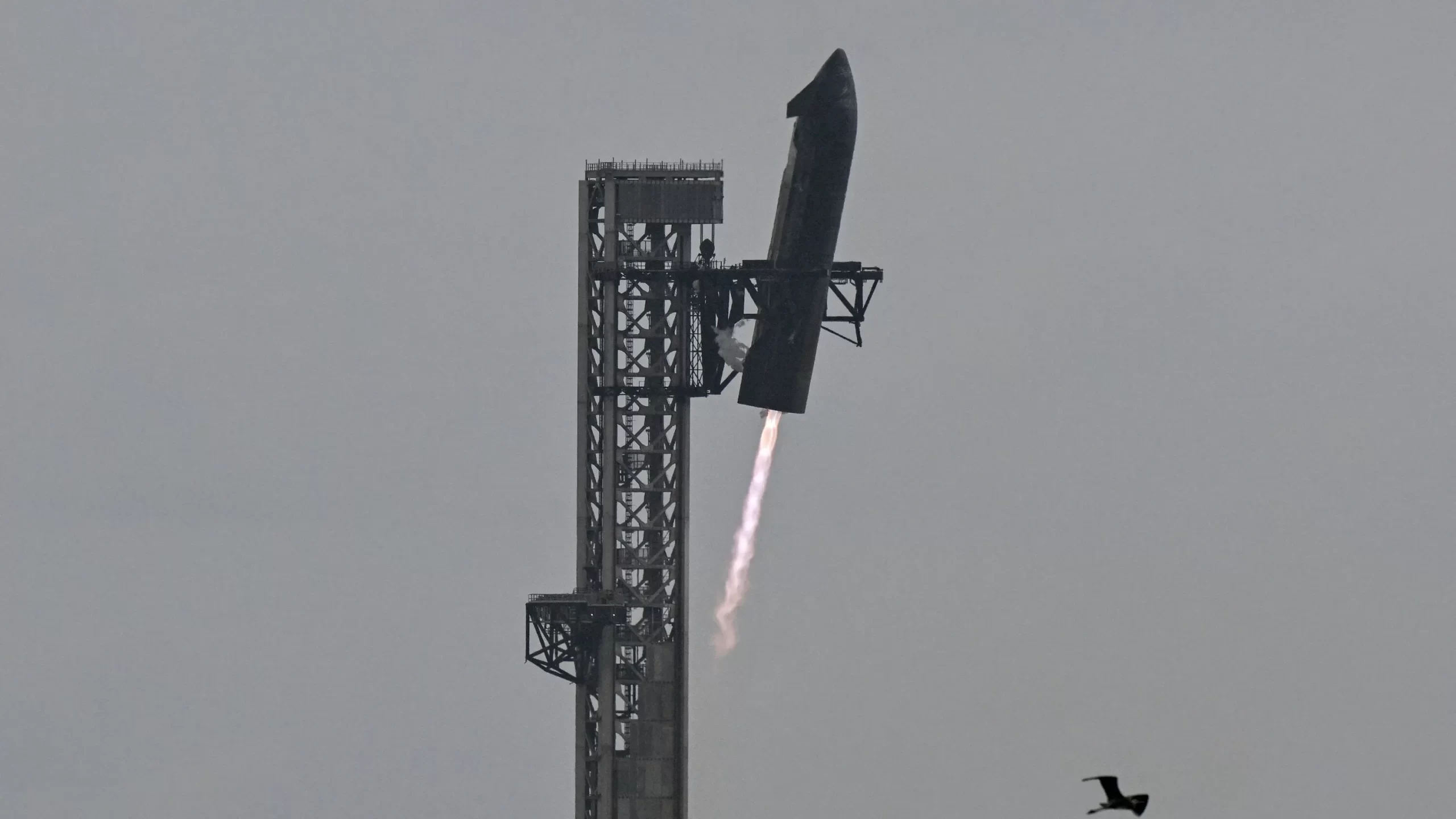
SpaceX has achieved a major milestone in space exploration after its Starship spacecraft successfully returned from orbit and was caught by the giant mechanical arms of its launch tower in Texas. The achievement marks the first successful recovery of Starship’s upper stage following an orbital flight and represents a significant step towards developing fully reusable rockets that could make space travel more affordable.
The spacecraft completed its 15th test flight on Saturday, November 14, 2026, returning to the same launch facility from which it had departed more than 22 hours earlier.
Starship Completes Historic Return from Orbit
The spacecraft, designated Starship 42, launched from SpaceX’s Starbase facility in Texas on Friday, November 13.
During its approximately 22.5-hour mission, Starship completed 14 orbits around Earth at an altitude of approximately 260 kilometres (161 miles).
After deploying 26 Starlink satellites into orbit, the spacecraft began its return journey towards Earth.
As it approached the launch site, Starship re-entered the atmosphere at extremely high speed before reigniting its engines to control its descent. It then manoeuvred into a vertical position and descended towards the launch tower.
The tower’s giant mechanical arms, known as Mechazilla, successfully caught the spacecraft as it returned to the launch pad.
The achievement was widely celebrated by SpaceX engineers and supporters, as it demonstrated that the spacecraft could potentially be recovered and prepared for another flight rather than being discarded after completing its mission.
Super Heavy Booster Fails to Complete Recovery
Despite the successful recovery of Starship, the mission did not achieve all its objectives.
SpaceX had planned to recover both sections of its two-stage rocket system during the same mission.
The Super Heavy booster, which carries Starship away from Earth during launch, failed to return to the launch pad because of a guidance, navigation and control issue detected during its descent.
Instead, it diverted towards the Gulf of Mexico, where it was destroyed before reaching the water.
The setback meant SpaceX recovered only the upper spacecraft, rather than both components of the rocket system.
Nevertheless, Starship’s successful return represented an important engineering achievement in the company’s effort to develop a completely reusable launch vehicle.
Why Reusable Rockets Are Important
Rocket launches are expensive partly because many conventional launch systems discard significant portions of their vehicles after a mission.
SpaceX aims to change this approach by developing a rocket system that can return to Earth, undergo necessary inspections and fly again with limited refurbishment.
The company’s existing Falcon 9 rockets already demonstrate the benefits of reusability, as their first-stage boosters can return to Earth and be launched again. However, their upper stages are discarded after delivering payloads into orbit.
SpaceX Strikes $40 Billion AI Chip Financing Deal With Apollo
Starship is designed to make both stages reusable, potentially reducing launch costs and increasing the frequency of space missions.
SpaceX wants to operate Starship with a turnaround speed comparable to commercial aircraft, although substantial engineering and testing work remains before that goal can be achieved.
Elon Musk’s Ambitions for the Moon and Mars
SpaceX chief executive Elon Musk sees Starship as central to the company’s long-term ambitions, including transporting people to the Moon and eventually establishing a human presence on Mars.
The spacecraft is also expected to support the expansion of the company’s Starlink satellite network and potentially transport equipment for future orbital infrastructure.
NASA has committed approximately $3.2 billion towards a contract worth more than $4 billion for SpaceX to develop a Starship-based lunar landing system under its Artemis programme.
The US space agency aims to use Starship as part of its plans to return astronauts to the Moon, with crewed lunar missions targeted for 2028.
However, several technical challenges remain, including demonstrating the transfer of fuel between spacecraft in orbit. Such technology will be essential for missions requiring Starship to travel beyond Earth’s orbit.
Heat Shield and Reusability Challenges Remain
Although the successful landing represents a major breakthrough, SpaceX still needs to address several technical challenges before Starship can become a regularly reusable spacecraft.
One of the main challenges involves its heat shield, which consists of hundreds of protective tiles designed to withstand the extreme temperatures generated during atmospheric re-entry.
SpaceX is working on improved tile designs that would require little or no refurbishment between flights.
The company must also demonstrate that both the Super Heavy booster and Starship can be successfully recovered during a single mission.
The latest test flight has nevertheless brought SpaceX closer to its ambition of developing a fully reusable rocket system, potentially changing the economics of commercial spaceflight and future missions beyond Earth.
Source: Reuters, with additional information from SpaceX and NASA’s Artemis programme.