Pakistan has strongly rejected India’s unilateral decision to place the Indus Waters Treaty (IWT) in abeyance, warning at the United Nations that using shared water resources as a tool of political pressure threatens regional stability and the livelihoods of more than 240 million people. Islamabad has urged India to respect its international obligations and comply with the 1960 water-sharing agreement.
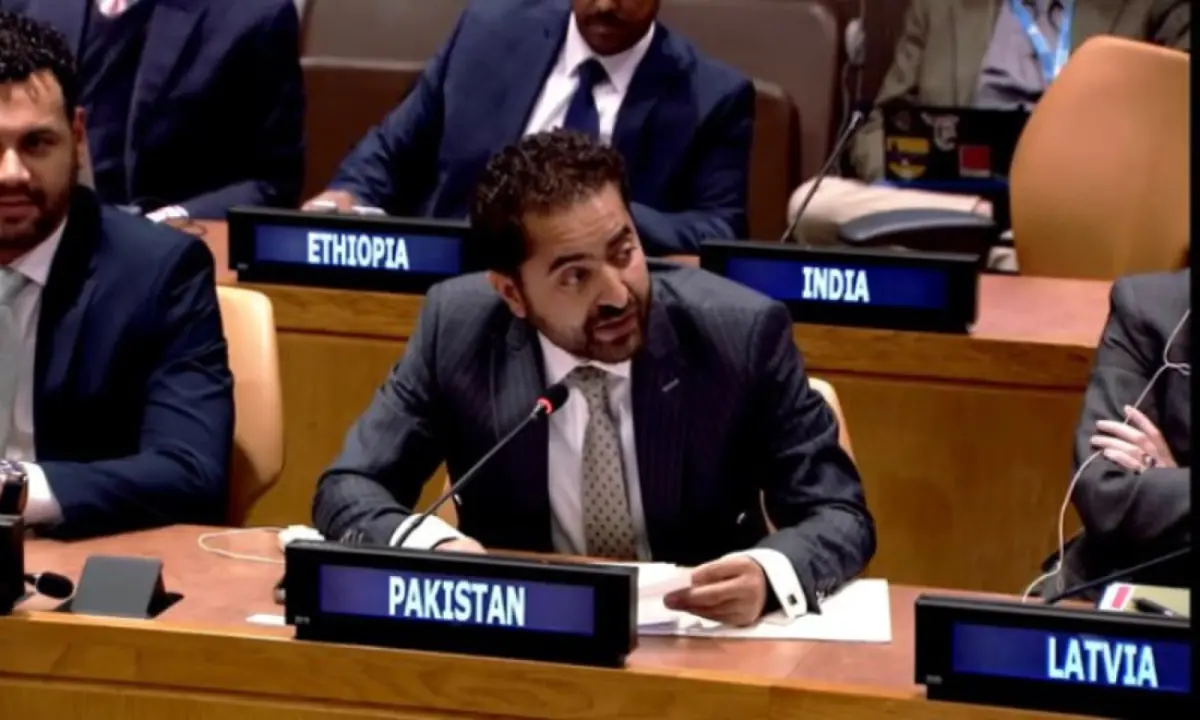
Pakistan’s position was presented by Deputy Permanent Representative to the UN Ambassador Usman Jadoon during an Arria-formula meeting of the UN Security Council on natural resources and conflict prevention.
Pakistan Challenges India’s Decision at UN Security Council
Addressing the meeting, Jadoon said shared natural resources should promote sustainable development, economic prosperity and peaceful cooperation rather than become instruments of political pressure or conflict.
He criticised India’s decision to suspend its participation in the Indus Waters Treaty and its threats to restrict water flows into Pakistan.
The Pakistani envoy maintained that no country should be allowed to use shared natural resources to exert political pressure in violation of international law and binding treaty obligations.
He also referred to the August 31, 2026 award of the Permanent Court of Arbitration, which reaffirmed that the Indus Waters Treaty remained fully in force and that India continued to be bound by its obligations under the agreement.
Jadoon emphasised the importance of peaceful dispute resolution under Article 33 of the UN Charter, particularly when disagreements involve shared resources such as international rivers.
Pakistan Accuses India of Weaponising Water
Pakistan warned that any attempt to use water as a political weapon could have serious consequences for regional peace and security.
During the meeting, the Pakistani delegation highlighted the importance of international cooperation in managing transboundary natural resources and preventing conflicts between neighbouring countries.
Jadoon also expressed solidarity with African countries seeking greater control over their natural resources, pointing to the Democratic Republic of the Congo as an example of how resource wealth can become a source of prolonged conflict.
He outlined three priorities for preventing resource-related disputes: addressing political and governance weaknesses, preventing illicit financial flows through international cooperation, and ensuring developing countries benefit from investment, technology transfer and local processing of their resources.
Pakistan’s Representative Responds to India’s Position
Pakistan also exercised its right of reply after India’s representative defended the use of international mechanisms for managing disputes involving natural resources.
First Secretary Ansar Shah accused India of avoiding the central issue by defending its unilateral decision to place the treaty in abeyance.
Shah argued that the 1960 agreement contained no provision allowing either country to suspend it unilaterally.
He also questioned India’s argument that changing international circumstances justified its position, pointing out that the United Nations Charter itself was older than the Indus Waters Treaty.
The Pakistani representative urged New Delhi to respect international law and fulfil its obligations under existing agreements.
He also rejected remarks by the Indian delegation concerning Pakistan’s domestic affairs, describing them as irrelevant to the discussion about the treaty.
India’s representative, Ambassador Harish Parvathaneni, had earlier defended international cooperation mechanisms for managing natural-resource disputes, citing the Kimberley Process, which was established to prevent conflict diamonds from entering legitimate markets.
Hague Court Orders India to Uphold Indus Waters Treaty With Pakistan
Permanent Court of Arbitration Upholds Treaty Status
Pakistan’s argument at the UN follows an important legal development in the ongoing dispute.
On August 31, 2026, the Permanent Court of Arbitration in The Hague reaffirmed that the Indus Waters Treaty remained in force despite India’s decision to place it in abeyance.
The court rejected the grounds advanced by India to justify unilateral suspension or termination of the agreement.
It also issued interim measures concerning India’s Ratle Hydroelectric Project on the Chenab River, restricting certain construction activities until 90 days after the neutral expert’s decision on the project’s compliance.
India rejected the arbitration proceedings, maintaining that the tribunal had no jurisdiction over its sovereign decisions.
New Delhi has continued to defend its April 2025 decision to suspend participation in the treaty following the deadly Pahalgam attack in Indian-administered Kashmir.
Why the Indus Waters Treaty Matters to Pakistan
Signed in September 1960 with the World Bank’s assistance, the Indus Waters Treaty governs the distribution of water from the Indus river system between Pakistan and India.
Under the agreement, the eastern rivers — Ravi, Beas and Sutlej — were allocated primarily to India, while Pakistan received rights over the western rivers — Indus, Jhelum and Chenab, subject to specified uses by India.
The treaty is particularly important for Pakistan because its agricultural sector, irrigation network and rural economy depend heavily on water from the Indus basin.
According to estimates cited in the reporting, Pakistan receives approximately 80 per cent of the water in the river system. Any significant disruption could affect agricultural production, food security and the livelihoods of millions of people.
The latest diplomatic exchange at the United Nations highlights the growing disagreement between Islamabad and New Delhi over the future of the water-sharing agreement, which has remained a cornerstone of bilateral relations for more than six decades.
Source: The Express Tribune and Dawn, with reference to statements by Pakistan’s Permanent Mission to the United Nations.