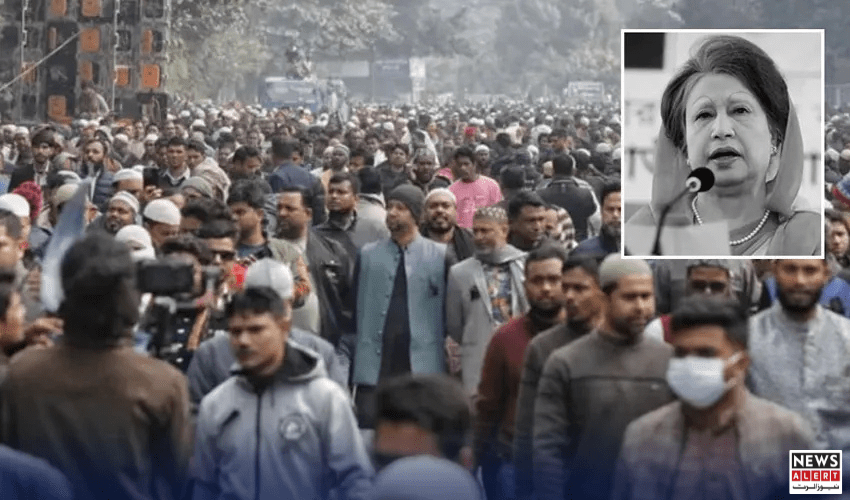
Bangladesh came together in mourning as former prime minister Khaleda Zia was laid to rest in Dhaka. Thousands of people gathered to attend her funeral prayers, reflecting her lasting influence on the country’s political and social life.
Also Read: Khaleda Zia, Former Prime Minister of Bangladesh, Dies at 80
The ceremony marked the end of an era for Bangladesh, as citizens remembered a leader who shaped national politics for decades.
Funeral Prayers Draw Massive Crowds in Dhaka
Authorities held Khaleda Zia’s funeral prayers on Miah Manik Avenue, directly in front of the National Parliament House. The location carried deep political symbolism, as it stands at the centre of state power.
From early morning, large crowds began to assemble. Political leaders, diplomats, party workers, and ordinary citizens joined the prayers. Many supporters travelled from different parts of the country, despite tight security arrangements.
Organisers managed the crowd calmly, while volunteers helped mourners find space. As a result, the event remained peaceful and orderly throughout.
Senior Leaders and Foreign Representatives Present
Bangladesh’s Chief Adviser, Dr Muhammad Yunus, attended the funeral, highlighting its national importance. In addition, leaders from various political backgrounds stood side by side during the prayers.
Pakistan sent an official delegation led by National Assembly Speaker Sardar Ayaz Sadiq. Acting on the instructions of Prime Minister Shehbaz Sharif, he conveyed condolences to Khaleda Zia’s family. He expressed sympathy on behalf of the Pakistani government and people.
Meanwhile, diplomatic observers noted that her passing resonated beyond Bangladesh. Over the years, Khaleda Zia maintained active engagement with South Asian leaders and regional forums.
From Tragedy to Power: Khaleda Zia’s Political Rise
Khaleda Zia passed away at the age of 80 after a long period of illness. Her political journey began after the assassination of her husband, President Ziaur Rahman, in 1981. Soon after, she assumed leadership of the Bangladesh Nationalist Party, known as the BNP.
In 1991, she led Bangladesh back to parliamentary democracy after years of military rule. She served her first term as prime minister until 1996. Later, she returned to office from 2001 to 2006.
During her years in power, Bangladesh experienced economic growth alongside political instability. On one hand, supporters praised her for strengthening democratic institutions. On the other hand, critics highlighted governance challenges and corruption allegations.
Nevertheless, her rivalry with Sheikh Hasina defined national politics for more than three decades. This intense competition shaped elections, street movements, and public debate across the country.
Burial Beside Ziaur Rahman
After the funeral prayers, Khaleda Zia was buried beside her husband, former president Ziaur Rahman. His mausoleum remains a symbolic site for BNP supporters and party leaders.
Family members, senior party figures, and close aides attended the burial. Many supporters expressed visible grief, while party flags flew at half-mast nearby.
Through this burial, the couple’s political legacy once again came into public focus.
Sports Matches Postponed Nationwide
As a sign of respect, authorities postponed matches of the Bangladesh Professional League. Sports officials announced the decision soon after her death.
Also Read: Bangladesh Premier League Matches Postponed Following Death of Former Prime Minister Khaleda Zia
Cricket plays a central role in Bangladeshi culture. Therefore, the postponement reflected the scale of national mourning and public sentiment.
A Lasting Legacy in Bangladesh’s History
Khaleda Zia’s death has prompted widespread reflection across Bangladesh. For many, she symbolised resilience and determination in a male-dominated political landscape. At the same time, critics continue to debate her political choices and leadership style.
However, few deny her historical importance. As Bangladesh’s first woman prime minister, she broke barriers and inspired generations of women in politics.
Ultimately, her funeral served not only as a farewell but also as a reminder of her lasting impact. With her passing, Bangladesh has closed a defining chapter in its political story.