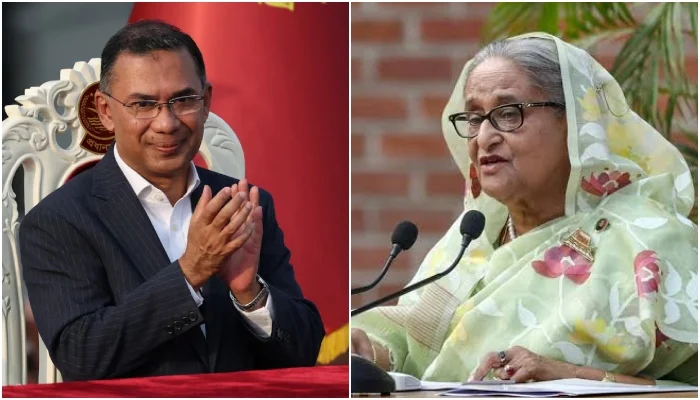
DHAKA: Bangladesh has said Prime Minister Tarique Rahman will not travel to India until New Delhi expedites the extradition of former prime minister Sheikh Hasina, who fled to India following the political upheaval that toppled her government in 2024.
Relations between Bangladesh and India have remained strained since the deadly anti-government protests that led to Hasina’s departure. She has remained in India since leaving Bangladesh, while authorities in Dhaka have repeatedly sought her extradition.
The latest statement indicates that the issue remains a major obstacle in efforts to improve relations between the two neighbouring countries.
Dhaka Wants Hasina Extradited
Bangladesh Foreign Ministry official AKM Shahidul Karim told reporters on Sunday that speculation over a possible visit by Rahman to India next week should not be taken as confirmation that such a trip would take place.
He said an appropriate environment needed to be created before the Bangladeshi prime minister could visit India.
“To this end, we have urged the Indian authorities to expedite their efforts to extradite Sheikh Hasina and other fugitives,” Karim said.
Bangladesh has maintained that Hasina should be returned to the country to face legal proceedings. She has been convicted of crimes against humanity and faces the death penalty in Bangladesh.
India, meanwhile, has said that Dhaka’s extradition request remains “under examination”, without announcing a decision on whether Hasina will be sent back.
Rahman’s India Visit Remains Uncertain
Rahman assumed office in February and has already travelled to Malaysia and China. His decision not to make India his first foreign destination broke with a longstanding diplomatic tradition among Bangladeshi leaders.
Recent diplomatic contacts between the two countries had nevertheless raised hopes that relations could improve.
India’s High Commissioner to Bangladesh, Dinesh Trivedi, met Rahman last week. The meeting fuelled speculation that discussions were underway regarding a possible visit by the Bangladeshi leader.
Karim confirmed that officials from both countries had been communicating in recent weeks about the possibility of Rahman travelling to India.
However, he said the issue had been complicated by Hasina’s continued public statements and media appearances from India.
Ex-Bangladesh captain Shakib’s home attacked after Hasina event
Dhaka Criticises Hasina’s Media Appearances
Karim said the diplomatic process had been affected by what he described as Hasina’s “open media interactions”, despite her conviction in Bangladesh.
The Bangladeshi government has been particularly critical of statements made by the former premier since her departure.
Hasina, who previously enjoyed a reputation as a pro-democracy leader but was increasingly criticised by opponents for what they described as authoritarian policies during her 15-year rule, has continued to comment publicly on Bangladesh’s political situation.
Earlier this month, she said she intended to return to Bangladesh in December, even if doing so resulted in imprisonment.
Her future remains one of the most sensitive issues in Bangladesh-India relations.
Bangladesh Signals ‘Bangladesh First’ Policy
The dispute over Hasina’s extradition comes as Rahman’s government seeks to define its broader foreign policy.
Karim said Bangladesh would pursue a “Bangladesh First” approach based on national sovereignty and the principle of non-interference.
At the same time, Dhaka says it wants to maintain mutually beneficial relations with India as well as other countries.
The government therefore faces the challenge of balancing its demand for Hasina’s extradition with the importance of maintaining diplomatic and economic ties with its powerful neighbour.
For now, however, Dhaka has made its position clear: an improvement in the political environment, including progress on the extradition request, is being presented as an important condition for a potential India visit by Prime Minister Tarique Rahman.