Canada could become the European Union’s first “associate member” under a proposal that would bring the country closer to the 27-member bloc without granting it full membership.
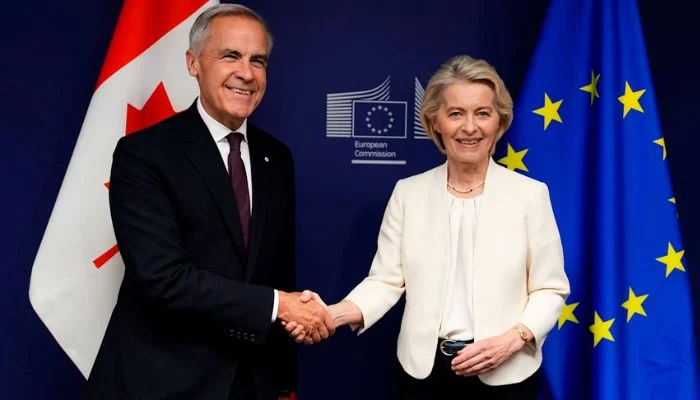
European Commission President Ursula von der Leyen floated the idea on Wednesday during Canadian Prime Minister Mark Carney’s visit to Strasbourg.
“I would like to work with you on opening the door for Canada being the first associate member of the EU,” von der Leyen told Carney.
However, the proposed status does not currently exist under EU treaties, meaning Brussels and Ottawa would need to establish the framework for such a relationship.
What would associate membership mean?
Canada cannot become a conventional EU member under the bloc’s existing rules, which reserve full membership for European states.
An associate arrangement could instead allow Canada to deepen cooperation with the EU in areas including defence, artificial intelligence, energy, manufacturing and critical minerals.
Canada already has a free-trade agreement with the EU known as the Comprehensive Economic and Trade Agreement (CETA). Associate membership could potentially provide broader economic cooperation beyond the existing agreement.
One possibility would be greater access for Canadian companies to parts of the EU’s Single Market.
US-Canada Trade Feud Escalates as Washington Targets Beverages, Bikes and Dairy
However, deeper access could require Canada to comply with relevant EU rules and standards. Unlike full EU members such as France and Germany, Canada would not automatically have a vote in setting those rules.
The proposal also would not give Canadians the same freedom of movement enjoyed by EU citizens. There is currently no indication that associate membership would provide Canadians with an automatic right to live and work throughout the bloc.
Why does Canada want closer ties?
The proposal comes as Canada’s relationship with its largest trading partner, the United States, has become more strained amid President Donald Trump’s tariffs and repeated threats concerning Canadian sovereignty.
Carney has sought to reduce Canada’s economic dependence on the US and has set a goal of doubling trade with countries outside the United States over the next decade.
He has described Canada’s desired relationship with Europe as a “unique alliance.”
The proposal remains at an early stage and would require the backing of all 27 EU member states before any such arrangement could be established.
For Brussels and Ottawa, the process would therefore involve negotiating a new framework covering the scope of Canada’s participation, access to EU markets, regulatory obligations and cooperation across strategic sectors.