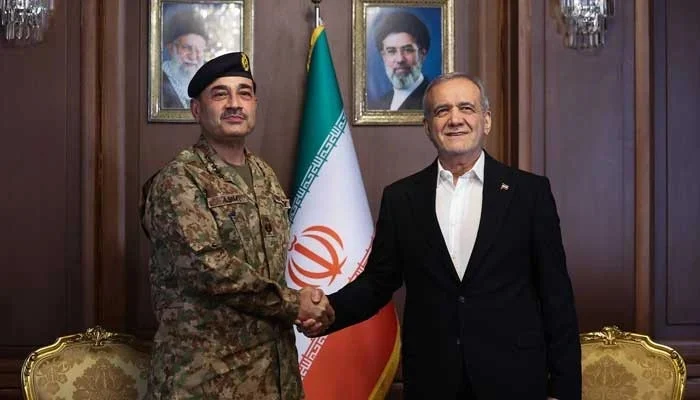
Chief of Defence Forces (CDF) and Chief of Army Staff Field Marshal Asim Munir is due to visit Tehran on Monday as tensions escalate between the United States and Iran over a new round of planned economic sanctions.
The visit comes at a sensitive time, with Washington preparing what US Treasury Secretary Scott Bessent has described as “the greatest financial offensive ever marshalled” against Iran. In response, Tehran has warned that continued economic pressure could lead to a halt in oil exports from the Gulf region.
Iranian authorities said Field Marshal Munir’s visit would form part of wider efforts aimed at restoring peace and security in the region. According to Pakistani government sources, he is expected to discuss recent developments, including US President Donald Trump’s warning of tougher sanctions against Iran.
Pakistan’s Role in Iran-US Peace Efforts
The Shehbaz Sharif-led government has been involved in diplomatic efforts to reduce tensions between Washington and Tehran.
According to the report, Pakistan helped broker a two-week ceasefire on April 8 that brought an end to six weeks of fighting. Islamabad has since continued to relay messages between the two sides.
Two Pakistani government sources confirmed Munir’s planned visit to Reuters. One source said Iran and Pakistan remained in direct contact.
Another source said discussions in Tehran would focus on the latest developments in the conflict, Trump’s warning of tougher sanctions and efforts to preserve peace under Islamabad’s memorandum of understanding.
The talks are also expected to include regional developments following the Pakistan-Turkiye-Saudi Arabia Agreement, as well as issues related to the Houthis.
US Prepares New Financial Measures
US Treasury Secretary Scott Bessent is scheduled to hold a press conference at 2pm EDT, or 1800 GMT, on Monday, where further details of the planned measures against Iran are expected.
Bessent said the United States was preparing a major financial campaign against Tehran. Without outlining the exact steps, he indicated that Washington could also target countries that continue to engage with Iran’s economy and financial system.
Iran has faced extensive economic sanctions since the 1979 Islamic Revolution. The country’s economy was already under significant pressure before the latest conflict, with high inflation, a weakening currency, energy shortages and deep structural economic problems.
Iranian officials have warned that additional sanctions could worsen the economic situation, increase hardship for ordinary people and create further internal pressure.
Iran Threatens to Halt Oil Exports
Iran has responded to the prospect of tougher sanctions with increasingly strong warnings.
Mohsen Rezaei, secretary of Iran’s Supreme National Security Council, said Tehran could retaliate economically if the US continued what he described as an economic war.
He warned that if the pressure continued, “not a single drop” of oil would be exported through the Strait of Hormuz or from anywhere in the Persian Gulf.
Rezaei also said Iran would view any country that participated in or supported America’s economic campaign against the Iranian people as an act of war.
The Strait of Hormuz is one of the world’s most strategically important shipping routes, and any prolonged disruption to oil shipments could have major consequences for global energy markets.
CENTCOM Says 660 Million Barrels of Oil Moved Through Strait of Hormuz Since May
China Calls for Diplomacy
Bessent has previously urged China to cooperate with Washington, noting that China receives a significant share of its oil imports from the Gulf region.
A spokesperson for China’s embassy in Washington responded by saying that sanctions and pressure would not help resolve the crisis and called instead for a diplomatic solution.
China’s position is significant because Beijing remains an important economic partner for Iran and a major consumer of energy from the Gulf.
Regional Conflict Continues to Raise Concerns
The visit also comes after months of conflict that has caused widespread casualties and displacement across the region.
According to the report, US and Israeli military strikes against Iran have caused significant damage to the country’s conventional military capabilities and infrastructure. Thousands of people, mainly in Iran and Lebanon, have been killed since the conflict began.
Despite the damage, Iran has retained missile and drone capabilities that could potentially be used against Gulf states and commercial shipping. The security situation around the Strait of Hormuz has therefore remained a major concern, with disruptions to maritime traffic contributing to pressure on global fuel prices.
The exact status of Iran’s nuclear programme also remains unclear.
Pakistan’s Diplomatic Role Under Focus
With no official face-to-face talks currently taking place between the United States and Iran, other countries have attempted to encourage dialogue.
Pakistan, Qatar and Turkiye have all been involved in efforts to promote diplomacy and reduce the risk of a wider regional conflict.
Field Marshal Asim Munir’s visit to Tehran is therefore being closely watched as Pakistan continues its diplomatic engagement with both sides. With the US preparing new sanctions and Iran threatening to escalate its response, the outcome of these discussions could be important for wider efforts to prevent further instability in the region.