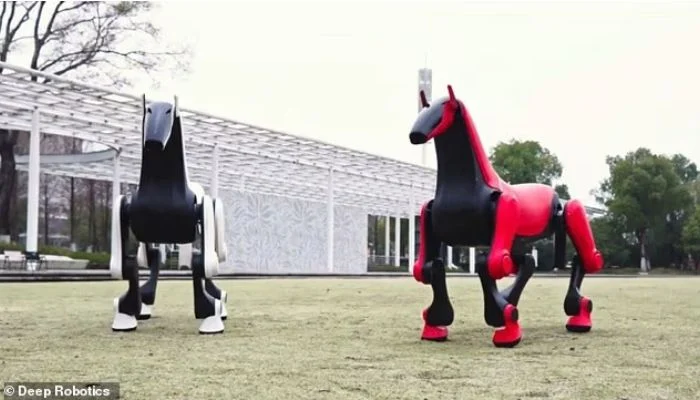
China has unveiled a futuristic robotic vehicle that allows people to actually ride it, offering a glimpse of what personal transportation could look like in the future.
The machine, known as the Qiji X1 All-Terrain Intelligent Mount, was showcased by Chinese startup DaxAI at the 2026 World Robot Conference in Beijing. Demonstration footage from the event showed visitors climbing onto the four-legged machine and riding it across the exhibition floor.
Unlike a conventional vehicle, the Qiji X1 uses a four-legged robotic design inspired by technologies found in motorcycles and quadruped robots. Its movements are noticeably more mechanical than those of a real horse, but the demonstration showed that the machine is capable of carrying adult passengers while moving under its own power.
Can carry up to 300 kilograms
According to the information presented about the robotic vehicle, the Qiji X1 can carry a payload of up to 300 kilograms. It can reportedly reach speeds of around 10 kilometres per hour, making it considerably slower than most conventional road vehicles but potentially useful in environments where speed is less important than mobility.
One of its most notable features is its ability to operate on difficult surfaces. The robot is designed to navigate terrain such as gravel, mud and steep slopes, areas where ordinary wheeled vehicles can struggle.
The four-legged design could allow the machine to maintain contact with uneven ground and move across surfaces that would be challenging for conventional transportation systems.
If you saw DaxAI’s giant robot horse in person, you’d be blown away by how massive it is.
The Qiji is officially on sale now: RMB 289K (~$43K) for the X1 and RMB 359K (~$53K) for the wheel-legged XS.
A rideable robot horse is already wild. The fact that you can actually buy one… https://t.co/vFsrnGKAVV pic.twitter.com/ojHIjNnms0
— RoboHub🤖 (@XRoboHub) August 20, 2026
More than just a futuristic attraction
Although the robot horse may initially appear to be a novelty designed to attract attention, its developers see potential practical applications for the technology.
Possible uses include off-road transportation, carrying heavy equipment and supporting emergency rescue operations. A machine capable of carrying people or supplies across difficult terrain could potentially be useful in areas affected by natural disasters or where conventional vehicles cannot easily operate.
London Set to Launch First Robotaxi Service Within Months
The technology also reflects a broader shift in China’s robotics industry. Companies are increasingly developing robots designed to function outside controlled factory environments, with an emphasis on machines that can move through the physical world and interact with challenging surroundings.
Could rideable robots become commercially available?
The public demonstration has raised interest in whether rideable robotic vehicles could eventually become a practical form of transportation.
According to a post shared by RoboHub on X, the Qiji is reportedly already being offered for sale, with the X1 listed at around 289,000 yuan (approximately $43,000) and a wheel-legged XS version at about 359,000 yuan (approximately $53,000). However, availability and commercial rollout details may vary, and potential buyers would need to confirm the manufacturer’s current sales information.
For now, the Qiji X1 remains a striking example of how rapidly robotics technology is advancing. While a robot horse is unlikely to replace conventional cars or motorcycles anytime soon, its ability to carry human riders and travel across difficult terrain shows that machines once associated mainly with science fiction are increasingly becoming real-world prototypes.