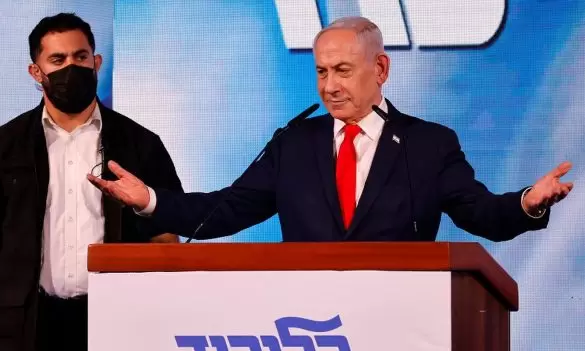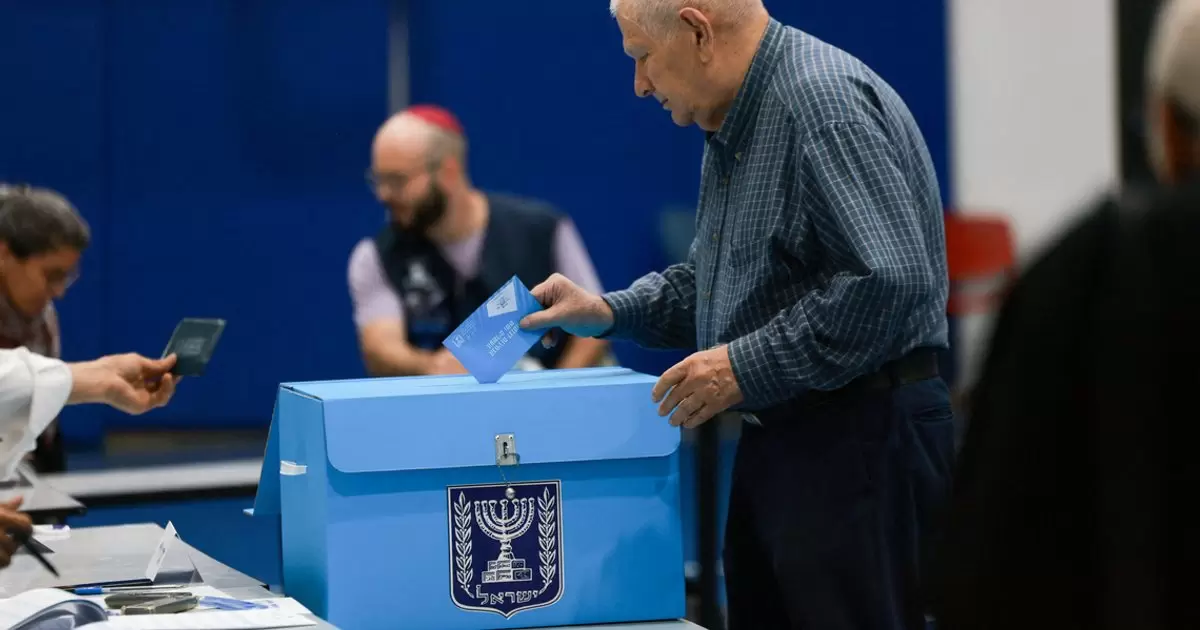
Israeli voters headed to polling stations at the fastest rate in nearly half a century on Tuesday, making the election a major test of Prime Minister Benjamin Netanyahu’s leadership after years of conflict and political controversy.
Long queues formed outside polling stations as voters weighed the consequences of the October 7, 2023, attacks and the wars that followed in Gaza, Lebanon and Iran. For many, the election represented an opportunity to judge the government’s security record and determine the country’s political direction.
Netanyahu has defended his leadership, presenting himself as the leader best equipped to confront Israel’s adversaries. However, his right-wing coalition has faced growing criticism at home and abroad over its policies and handling of the conflict.
Record Turnout Signals High-Stakes Election
Israel’s Central Elections Committee reported that 31.5% of eligible voters had cast their ballots within the first five hours after polling stations opened at 7am local time.
The turnout represented the fastest start to an Israeli election since 1977, when a historic vote brought the right to power for the first time in the country’s history.
Polling stations were scheduled to close at 10pm local time.
Netanyahu urged his supporters to vote, warning that turnout was strong among opposition supporters and Israeli citizens of Arab heritage, who make up around one-fifth of the population.
“This is a fateful moment,” he told supporters, calling on them to head to polling stations.
The election is the first since the Hamas-led attacks of October 7, 2023, which killed around 1,200 people in Israel and saw 251 people taken hostage, according to the figures cited in the report.
Netanyahu Faces Challenge From Gadi Eisenkot
Netanyahu’s main challenger, Gadi Eisenkot, is a former military chief of staff who has positioned himself as a security-focused alternative to the incumbent prime minister.
Eisenkot is seeking support from centrist and right-wing parties, alongside remaining left-wing political groups, to assemble a parliamentary majority capable of replacing Netanyahu.
Opinion polls indicated a close contest between Netanyahu’s Likud party and the rival alliance led by Eisenkot, leaving neither side with a clear path to forming a government.
Netanyahu has served as Israel’s longest-serving prime minister, with a total of 19 years in office. His political resilience and the country’s fragmented parliamentary system have repeatedly complicated efforts by opponents to remove him from power.
If neither candidate can form a governing coalition in the 120-seat Knesset, Netanyahu could remain as caretaker prime minister until another election is held.
October 7 Security Failures Dominate Debate
For many opposition supporters, accountability for the security failures surrounding the October 7 attacks is a central election issue.
Opposition groups have pledged to establish a national inquiry into the events, while Netanyahu’s government has resisted calls for such an investigation.
During a visit to Kibbutz Nir Oz in southern Israel, one of the communities targeted in the attacks, Eisenkot expressed confidence that the election could mark a turning point for the country.
He was accompanied to the polling station by Gadi Mozes, who was among those kidnapped during the Hamas-led assault.
Eisenkot has also criticised Israel’s military campaign in Gaza, arguing that Hamas remains in power despite the extensive destruction caused by the war.
He has pledged to dismantle Hamas’s military and governing capabilities in Gaza within 18 months of forming a government.
However, Netanyahu’s supporters reject the argument that the prime minister bears responsibility for the security failures.
Nof Gabay, an 18-year-old Likud supporter, described Netanyahu as the right leader for Israel and defended his handling of the war.
The contrasting views highlight the deep divisions among Israeli voters over the government’s wartime record.
Gaza War and Regional Conflicts Shape Voters’ Choices
The election follows an extended period of military conflict involving Israel, Hamas, Hezbollah in Lebanon and Iran.
Israel’s military campaign has devastated large parts of Gaza. Gaza health authorities have reported more than 74,000 Palestinian deaths, according to the figures cited in the report.
A US-brokered ceasefire has been in place for about a year, but negotiations over Hamas disarmament and an Israeli withdrawal have stalled. Israel continues to control around two-thirds of the enclave, according to the report.
Israel has also inflicted heavy losses on Hezbollah in Lebanon and exchanged strikes with Iran, including a 12-day air campaign in 2025 and a joint US-Israeli war against Iran in 2026.
Eisenkot has argued that Israel must prevent Iran from developing a military nuclear capability, either through military action or a diplomatic arrangement backed by the United States.
Iran has rejected allegations that it is pursuing nuclear weapons.
The overlapping conflicts have intensified public debate about Israel’s security strategy, its international standing and the long-term consequences of Netanyahu’s policies.
Nearly 5,000 Palestinians Displaced as Israeli Offensive Continues in Hebron
Arab Voters Could Influence Coalition Formation
Turnout among Israel’s Arab minority could play a significant role in determining the election outcome.
Arab citizens of Israel, who are Palestinian by heritage, were reportedly voting in unusually high numbers, according to Arab political candidate Ahmed Tibi.
Netanyahu has repeatedly warned his supporters about high Arab turnout, using campaign messaging designed to mobilise his right-wing base.
Eisenkot, however, has ruled out forming a partnership with Arab parties, citing differences in political values.
Despite that position, some possible coalition scenarios could involve Arab parties supporting a minority government led by Eisenkot to prevent Netanyahu from returning to power.
Such an arrangement would reflect the complex negotiations often required to form a government in Israel’s parliamentary system.
Netanyahu’s Coalition Faces Additional Challenges
Netanyahu’s right-wing coalition includes far-right and ultra-Orthodox parties whose positions have generated significant controversy.
Far-right politician Itamar Ben-Gvir, a member of the governing coalition, predicted that Netanyahu would remain prime minister and that his own party would continue to serve as an important right-wing partner.
Eisenkot has criticised Netanyahu’s coalition partners and opposed violence by Jewish settlers against Palestinians in the occupied West Bank. Such violence has increased since 2023 and contributed to tensions between Israel and Western countries.
The opposition leader previously joined Netanyahu’s war cabinet after the October 7 attacks but resigned eight months later, criticising the prime minister’s leadership.
Netanyahu is also facing corruption charges that he denies, adding another dimension to the political debate over his future.
Voters Divided Over Israel’s Future
For some voters, the election is an opportunity to change the country’s leadership and address the damage caused by years of conflict.
Mali Hajaj, an Education Ministry employee supporting Eisenkot, said establishing a national inquiry into the October 7 attacks was among the most important priorities.
Other voters continue to support Netanyahu, arguing that his experience and approach to national security make him the strongest candidate.
The outcome will depend not only on the parties’ performance at the ballot box but also on their ability to negotiate alliances and secure a majority in parliament.
Israeli political analyst Amotz Asa-El of the Shalom Hartman Institute predicted that neither side would achieve a decisive victory, suggesting the result could leave the country facing another round of difficult coalition negotiations.
With turnout unusually high and public opinion sharply divided, the election could determine whether Netanyahu extends his long political career or whether opposition forces manage to form a new government.