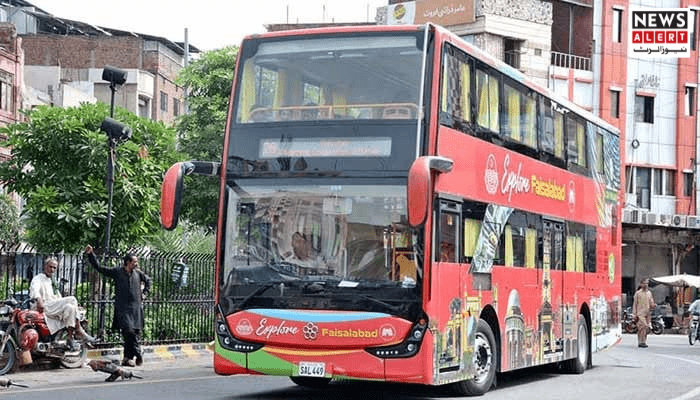
Karachi welcomed double-decker buses on Tuesday after nearly half a century, marking a milestone for Pakistan’s largest city. In addition, authorities inaugurated the service as part of a broader effort to modernise public transport and ease road congestion.
The launch comes amid persistent transport challenges in Karachi, a city of over 20 million. Meanwhile, limited public options, heavy traffic, and rising fuel costs have made affordable mass transit a key public demand.
Pilot Service Runs on Shahrah-e-Faisal Route
The government launched five double-decker buses on a trial basis. Initially, they will operate on the busy Shahrah-e-Faisal to Malir Cantt route. Officials said they would test operations on the first day, and the public could start using the service from the next day.
Furthermore, the authorities chose this route due to its high commuter volume and wide road infrastructure. They aim to measure passenger demand, traffic flow, and operational feasibility before expanding the service.
Double-decker buses were common in Karachi during the 1960s and early 1970s. However, authorities retired them due to maintenance challenges and changing urban needs.
Fare Structure and Government Support
Sindh’s Senior Minister for Information and Transport, Sharjeel Inam Memon, announced that fares for the new buses will match the existing People’s Bus Service. Additionally, the provincial government will subsidise part of the fare to keep travel affordable for daily commuters, especially low- and middle-income residents.
Transport experts say such subsidies remain vital in Karachi, where many residents rely on buses and informal transport. Consequently, maintaining affordability could encourage more commuters to switch to public transport.
Citywide Expansion Planned by 2026
Minister Memon linked the pilot’s success to plans for a citywide rollout by 2026. If successful, authorities will introduce double-decker buses across Karachi.
The expansion forms part of a larger infrastructure initiative worth over nine billion rupees. Specifically, it includes road improvements, bus corridors, and supporting facilities to accommodate modern transport systems. Officials believe high-capacity buses could reduce smaller vehicles on major roads, thereby easing congestion and lowering emissions.
EV Buses and Pink Scooties Announced
Alongside the double-decker launch, the government unveiled plans for electric vehicle (EV) buses on new routes. Moreover, authorities promised pink scooties for women, available specifically for female licence holders, to improve mobility and independence.
In fact, similar schemes in other cities increased women’s participation in education and the workforce, analysts note.
A Step Toward Modern Urban Mobility
Transport analysts say the return of double-decker buses carries both practical and symbolic value. On one hand, they can transport more passengers without occupying extra road space; on the other, they signal renewed attention to Karachi’s neglected urban transport sector.
Experts caution that successful implementation will require sustained investment, careful maintenance, and well-planned routes. Otherwise, past projects’ inconsistent funding and weak execution could hinder results.
For now, the pilot service has generated cautious optimism. Many commuters hope it will bring a more reliable, affordable, and dignified public transport system to a city long in need of one.