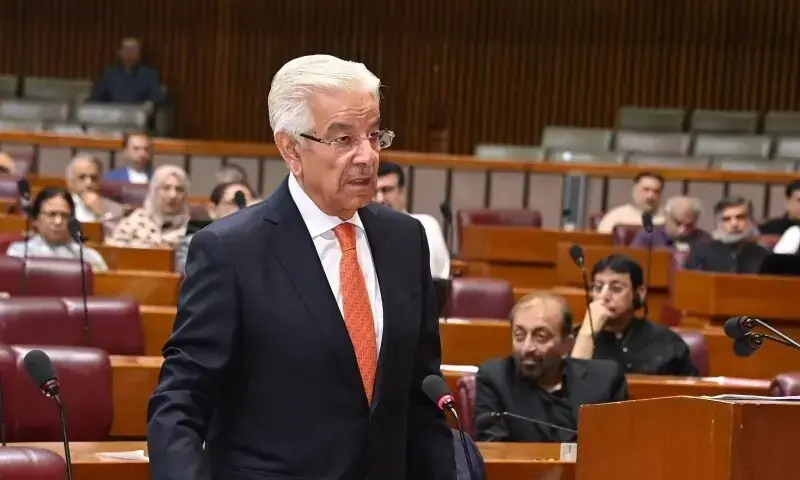
ISLAMABAD: Defence Minister Khawaja Asif on Thursday strongly criticised Jamiat Ulema-e-Islam-Fazl (JUI-F) chief Maulana Fazlur Rehman over his remarks about Asif’s absence from recent talks in Tehran, insisting that no defence agreement was under negotiation during the discussions.
“No defence agreement was being negotiated in Tehran,” Asif told the National Assembly, explaining that his presence at the talks was therefore unnecessary.
His remarks came a day after Fazlur Rehman criticised the government during a National Assembly session, questioning its role in discussions concerning the Makkah defence pact in Tehran while Prime Minister Shehbaz Sharif and the defence minister remained in Pakistan.
Asif Defends His Role in Regional Diplomacy
Addressing the assembly, Asif said Field Marshal Asim Munir, Chief of Defence Forces and Chief of Army Staff, had played a role in promoting reconciliation and regional peace following Pakistan’s military success in a conflict over the past year or so.
The defence minister maintained that he had participated in both defence agreements but had no direct role in the Tehran discussions.
He thanked Fazlur Rehman for expressing concern about his absence but described the criticism as misplaced.
Minister Questions Fazlur Rehman’s Political Record
Asif subsequently turned his attention to Fazlur Rehman’s political career, accusing the JUI-F chief of overlooking his own history of cooperation with successive governments while criticising political opponents.
The defence minister said Fazlur Rehman had remained associated with different political administrations and had benefited from political arrangements over the years.
He referred to the JUI-F chief’s tenure as opposition leader and his participation in governments formed under previous constitutional and political arrangements.
Asif also recalled Fazlur Rehman’s role in the formation of earlier coalition governments, including administrations in which the two politicians had been allies.
He argued that political leaders should acknowledge their own past decisions before questioning the conduct of others.
Asif Refers to His Own Political Past
During his speech, Asif said he was frequently reminded of a speech he delivered in 2004 whenever he expressed support for Rawalpindi, an apparent reference to the military establishment.
He said he did not believe in concealing his political history while criticising others and maintained that he had publicly apologised for his earlier political positions.
“I am the only politician who has apologised for his past,” he claimed.
Fazlur Rehman Faces Criticism Over Opposition to Governor’s Rule in K-P
The minister also criticised Fazlur Rehman’s role during the period of the Legal Framework Order (LFO), arguing that the JUI-F chief had participated in the political system while simultaneously serving as opposition leader.
Questions Raised Over Kashmir Committee Tenure
Asif also questioned Fazlur Rehman’s performance during his decade-long tenure as chairman of the parliamentary Kashmir Committee.
“What achievements did he accomplish as chairman of the Kashmir Committee?” the defence minister asked.
He accused the JUI-F chief of enjoying official privileges without delivering meaningful results, describing his tenure as little more than a “free ride”.
Asif further criticised Fazlur Rehman’s political legacy and questioned his party’s historical position on Pakistan’s independence.
He argued that political honours and positions previously granted to Fazlur Rehman and his allies had come from governments in which the JUI-F leader himself had participated.
The defence minister also responded to Fazlur Rehman’s remarks about shame and modesty, urging him to reflect on his own political record.
Heated Exchange in National Assembly
Asif’s speech prompted strong protests from JUI-F lawmakers, who repeatedly interrupted him as the exchange grew increasingly heated.
The defence minister warned opposition members against provoking him into making further disclosures about their political conduct.
“They have turned religion and politics into a source of income. If I start revealing what they did during the PDM government, I will tell everything,” he said.
The exchange highlighted tensions between the government and the JUI-F leadership, with the dispute over the Tehran talks developing into a broader confrontation over the political records of both sides.