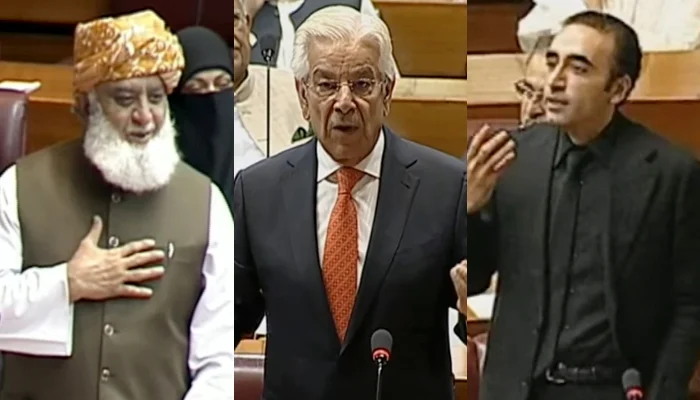
A heated debate unfolded in Pakistan’s National Assembly on Wednesday as opposition leaders and coalition partners criticised the federal government’s handling of the ongoing unrest in Azad Jammu and Kashmir (AJK). The political tensions come amid protests over electoral issues that have resulted in multiple deaths, including law enforcement personnel, and injuries to dozens of people.
Lawmakers from both the opposition and the ruling coalition called for dialogue and restraint, while government representatives defended their position and accused protest organisers of attempting to disrupt the upcoming elections.
National Assembly Discusses AJK Situation
The issue dominated proceedings in the National Assembly, where criticism was directed at remarks attributed to Defence Minister Khawaja Asif regarding residents of AJK.
Speaking during the session, Maulana Fazlur Rehman urged the government to respond to the situation with patience rather than emotion.
He argued that inflammatory statements from government figures could worsen tensions at a time when efforts should be focused on reconciliation and dialogue.
According to Fazlur Rehman, the government had received a charter of demands from the Awami Action Committee, but no formal response had yet been communicated. He stressed that political disagreements should not be addressed through force and urged authorities to engage with protesters through negotiations.
Background to the Protests
The unrest began ahead of a strike call issued for June 9 by the Awami Action Committee. Protesters oppose the reservation of 12 seats in the AJK Legislative Assembly for refugees displaced from Indian-administered Jammu and Kashmir and currently residing in Pakistan.
The issue has become a major point of political contention ahead of the July 27 elections for the 45-member AJK Legislative Assembly.
Supporters of the protests argue that the seat allocation requires reconsideration, while government officials maintain that the arrangement is rooted in constitutional and legal provisions.
Bilawal Bhutto Targets Government Ministers
Pakistan Peoples Party (PPP) Chairman Bilawal Bhutto Zardari also criticised certain members of the federal cabinet during his speech in the Assembly.
Bilawal questioned remarks reportedly made about the identity of Rawalakot residents and argued that some ministers were complicating the situation rather than helping resolve it.
He said that instead of calming tensions, one minister had intensified the controversy and called on Prime Minister Shehbaz Sharif to exercise greater control over his cabinet members.
Bilawal further suggested that Fazlur Rehman should be given space to play a mediating role in resolving the dispute, citing his influence and engagement with stakeholders involved in the matter.
Bilawal Says Provinces Will Not Be Asked for More Sacrifices Beyond Defence Contribution
Government Defends Its Position
Responding on behalf of the government, Rana Sanaullah rejected allegations that authorities were ignoring public concerns.
He stated that many demands previously raised by protest groups had already been addressed and highlighted government measures aimed at supporting AJK residents, including electricity subsidies and financial assistance to address energy-related issues.
According to Sanaullah, residents of AJK continue to receive electricity at heavily subsidised rates compared with consumers in other parts of Pakistan. He also pointed to wheat subsidies and other support measures provided by the government.
Dispute Over Refugee Seats
Sanaullah argued that the controversy surrounding the 12 refugee seats is a constitutional matter that cannot be resolved through protests alone.
He said a six-member committee had been established to review the issue and provide recommendations to the AJK government. According to him, several proposals, including participation in an All-Parties Conference, had been offered but were not accepted by protest organisers.
The government maintains that the reserved seats ensure representation for refugees displaced from Indian-administered Kashmir and that removing those seats would undermine their political rights.
Calls for Mediation and Political Resolution
Despite the sharp exchanges in Parliament, there appeared to be broad agreement on the need for dialogue.
Fazlur Rehman welcomed the postponement of a planned protest march towards Muzaffarabad and reiterated his willingness to help mediate between the parties. Bilawal also supported a negotiated settlement and encouraged the government to engage constructively with stakeholders.
Sanaullah acknowledged that Fazlur Rehman’s views on Kashmir carry significant weight and stated that the government would welcome any role he chooses to play in facilitating discussions.
Uncertainty Ahead of Elections
With AJK elections scheduled for July 27, the political dispute continues to dominate debate both inside and outside Parliament. While the government insists that constitutional mechanisms should determine the future of the refugee seats, protesters remain dissatisfied and continue to demand changes.
As tensions persist, political leaders across party lines are increasingly calling for dialogue, compromise, and restraint to prevent further escalation and ensure a peaceful electoral process in Azad Jammu and Kashmir.