Government unveils export-focused strategy, tax relief measures and technology-driven reforms following Budget 2026-27
Finance Minister Defends Budget 2026-27
Pakistan’s Finance Minister Muhammad Aurangzeb has said that the country’s economy is transitioning from a phase of stabilisation to sustainable growth, highlighting export promotion, tax reforms and investment incentives as key pillars of the federal budget for the fiscal year 2026-27.
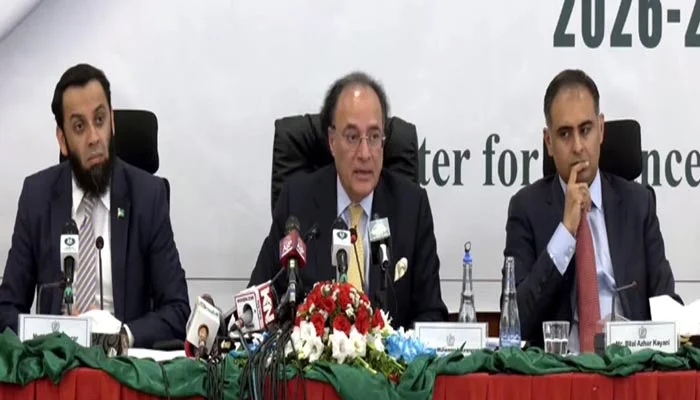
Addressing a post-budget press conference in Islamabad alongside Attaullah Tarar, Minister of State for Finance Bilal Azhar Kayani and Federal Board of Revenue Chairman Rashid Mahmood Langrial, Aurangzeb said the government had utilized available fiscal space to support economic expansion while maintaining financial discipline.
“The economy is moving in the right direction. Our next objective is to move from economic stability towards growth,” he stated.
Export-Led Growth at the Centre of Economic Strategy
According to the finance minister, export-led growth remains the central theme of the new budget. He said the government has introduced a series of measures aimed at improving competitiveness and creating a supportive environment for exporters.
One of the major announcements was an additional subsidy package worth Rs70 billion, enabling exporters to obtain financing at a reduced rate of 4.5 percent. The government believes this step will improve liquidity, lower production costs and strengthen Pakistan’s export sector.
Aurangzeb also revealed that the super tax imposed on businesses earning more than Rs500 million has been abolished. He further announced that exporters would receive complete relief from the super tax following directives from Prime Minister Shehbaz Sharif.
In addition, the advance tax has been removed to further encourage industrial production and exports.
“These reforms are intended to support businesses, incentivise investment and create a tax framework that promotes growth rather than restricting it,” he said.
Technology-Driven Tax Reforms
A significant component of the government’s strategy involves modernising tax administration.
Aurangzeb said Pakistan is moving towards an AI-powered and largely automated tax collection system that minimizes human interaction and improves transparency. The proposed system would build upon digital reforms already implemented in customs operations.
The government hopes that automation, artificial intelligence and digital monitoring will broaden the tax base, improve compliance and increase revenue collection without placing additional burdens on existing taxpayers.
Relief for Salaried Individuals
The budget includes several measures aimed at providing relief to salaried employees.
The lowest income tax slab has been reduced from 5 percent to 1 percent, while the tax rate for another income bracket has been lowered from 15 percent to 13 percent.
According to Minister of State Bilal Azhar Kayani, individuals earning up to Rs600,000 annually will continue to pay no income tax. Those earning between Rs600,000 and Rs1.2 million annually will now pay only 1 percent tax.
He explained that a person earning Rs100,000 per month would now pay only Rs500 in monthly income tax, while someone earning Rs200,000 per month would pay Rs13,500.
The government says these measures are intended to reduce pressure on middle-income households amid rising living costs.
Support for Agriculture Sector
The agriculture sector also received significant attention in the budget.
The finance minister announced that customs duty, additional customs duty and regulatory duty on imported agricultural machinery have all been reduced to zero. The move aims to encourage mechanisation and improve productivity in the farming sector.
Aurangzeb noted that agricultural credit has grown by 15 percent, with total financing exceeding Rs2 trillion. He also assured that small farmers would not be required to mortgage their homes in order to obtain agricultural loans or support under government schemes.
Under the Prime Minister’s Youth Programme, Rs262 billion has been allocated, including Rs125 billion specifically earmarked for agricultural development.
Construction, IT and Housing Incentives
The government has also reduced taxes for the construction sector in an effort to stimulate investment and economic activity.
Meanwhile, the Final Tax Regime (FTR) for the IT industry and freelancers has been retained, providing continuity and predictability for one of Pakistan’s fastest-growing sectors.
Housing finance initiatives have also been included in the budget framework, with officials saying the measures are designed to help low and middle-income families access affordable home financing.
Energy Challenges and Provincial Cooperation
Aurangzeb acknowledged that global energy market uncertainty remains a concern, particularly amid ongoing regional tensions and rising international oil prices.
He said Pakistan’s oil import bill increased significantly earlier this year, but government interventions helped reduce the financial impact. According to the finance minister, sufficient fiscal buffers have been incorporated into the budget to absorb potential future shocks.
The minister also thanked provincial governments for supporting national priorities and expressed confidence that cooperation between the federation and provinces would continue over the next three years.
Greater Role for Public-Private Partnerships
Looking ahead, Aurangzeb stressed the need to expand the use of Public-Private Partnerships (PPP) in development projects.
He revealed that approximately $12 billion is available for development initiatives but argued that future infrastructure and development schemes should increasingly rely on private-sector participation where commercially viable.
Citing development projects in Thar as a successful example, he said governments should focus public spending on projects that cannot attract private investment while encouraging the private sector to play a larger role in economic development.
Government Projects Growth Through Exports and Investment
The post-budget briefing highlighted the government’s belief that Pakistan has entered a new phase of economic management focused on exports, industrial expansion, digital reforms and investment-led growth.
Officials maintain that measures introduced in the 2026-27 budget will help strengthen economic activity, create employment opportunities and improve long-term fiscal sustainability, while providing targeted relief to salaried workers, farmers, exporters and businesses.