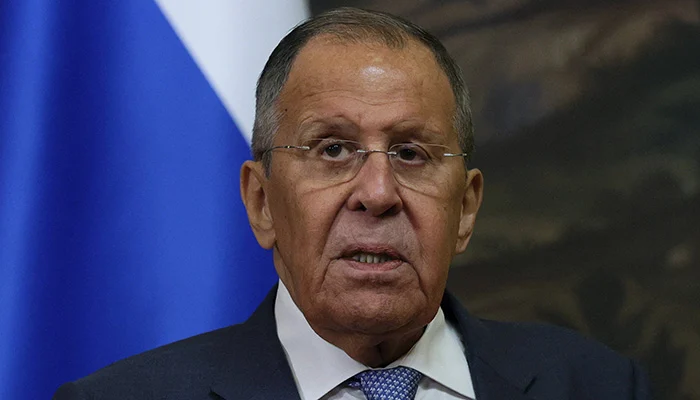
Russian Foreign Minister Sergey Lavrov has backed the possible inclusion of Iran in a broader regional security framework linked to the Makkah Joint Defence Pact, arguing that Tehran’s participation could contribute to greater stability in the Gulf.
Lavrov made the remarks while speaking to students and faculty at the Moscow State Institute of International Relations (MGIMO), where he outlined Russia’s long-standing proposal for a collective Gulf security arrangement involving Arab states and Iran.
His comments came after Pakistan, Saudi Arabia and Turkiye signed the Makkah Joint Defence Pact on August 7, establishing a framework for collective security and defence cooperation.
Russia proposes broader Gulf security framework
Lavrov said Moscow had first proposed more than two decades ago that Gulf countries, including Iran and Arab states, hold discussions aimed at developing a regional security concept.
He said Russia’s approach was based on bringing countries together despite their differences, allowing them to discuss disputes and identify confidence-building measures.
“Recognising that relations between them are complex, we proceeded from the assumption that we would facilitate meetings, discussions of mutual grievances, and agreement on certain confidence-building measures,” Lavrov said.
He added that Russia believed such discussions could be easier to organise if regional and international organisations were involved, including the Arab League, the Organisation of Islamic Cooperation and the five permanent members of the United Nations Security Council.
According to Lavrov, the objective was not to establish outside control over the region but to create a platform where regional countries could address their differences through dialogue.
Lavrov backs Iran’s possible participation
Discussing the Makkah pact, Lavrov noted that its proponents had indicated the framework could potentially remain open to countries beyond the three original signatories.
He said Egypt had already been mentioned as a possible participant and suggested that Algeria’s involvement could also have a positive impact if Algiers expressed interest.
Lavrov argued that reaching an agreement on the terms of Iran’s participation could represent a practical step towards the broader regional security model Russia has advocated for years.
“Agreeing on the terms for Iran’s participation” could be among the most practical steps towards achieving that objective, he said.
At the same time, Lavrov stressed that Russia would not seek a dominant position in any regional security arrangement.
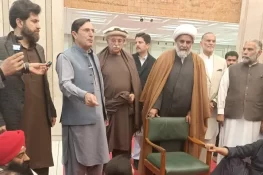
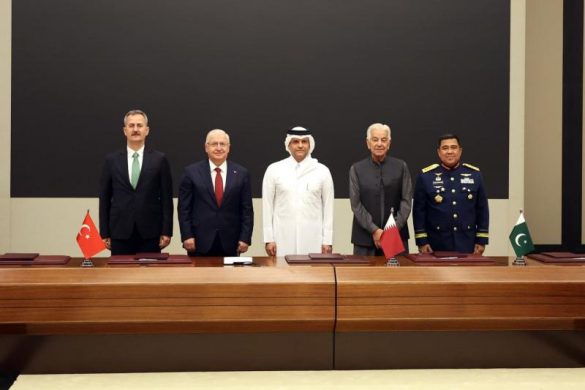
Pakistan, Saudi Arabia and Turkiye Hold First Makkah Defence Pact Meeting
Makkah pact aims to strengthen defence cooperation
The Makkah Joint Defence Pact was signed in the Saudi city of Makkah by Pakistan, Saudi Arabia and Turkiye on August 7.
The agreement provides for closer cooperation on collective security and defence, while a Strategic Political and Defence Committee was established under the pact. The committee held its inaugural meeting in Istanbul on August 31.
The agreement was signed amid heightened tensions in the Middle East following the conflict that began on February 28, when the United States and Israel launched joint strikes against Iran.
Pakistan and Saudi Arabia had also previously signed a mutual defence agreement under which aggression against either country would be treated as an attack on both.
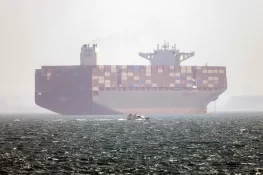
The latest regional developments have increased concerns over security, maritime traffic and the wider stability of the Gulf, particularly around the strategically important Strait of Hormuz.
Iran-Saudi rapprochement changes regional dynamics
Lavrov also pointed to the restoration of diplomatic relations between Iran and Saudi Arabia, which followed a Chinese-brokered initiative.
He said Moscow had actively encouraged the improvement in relations between Tehran and Riyadh, highlighting it as an example of how regional tensions could be reduced through diplomacy.
Russia has repeatedly advocated a regional security mechanism that includes both Iran and Arab Gulf states, arguing that long-term stability cannot be achieved by excluding major regional powers.
Lavrov’s comments suggest Moscow sees the Makkah pact as a potential foundation for a wider arrangement, rather than a framework limited to its three founding members.
Pakistan says pact is defensive
Pakistan has stressed that the Makkah agreement is defensive in nature and is not directed against any particular country.
On August 9, Deputy Prime Minister and Foreign Minister Ishaq Dar said the pact remained open to countries willing to uphold its core principles.
Dar said the agreement was intended to promote regional peace, stability and prosperity through mutual respect, cooperation and peaceful means.
The three founding countries bring significant military and strategic weight to the framework. Turkiye has NATO’s second-largest military, Saudi Arabia is a major Gulf power and energy exporter, while Pakistan is the only nuclear-armed Muslim-majority country.
With regional tensions remaining high, Russia’s call to include Iran could test whether the Makkah framework can evolve into a broader security mechanism involving rival and neighbouring states.
For now, however, Iran’s potential participation remains a proposal, and any expansion of the pact would require agreement among its existing members and prospective participants.