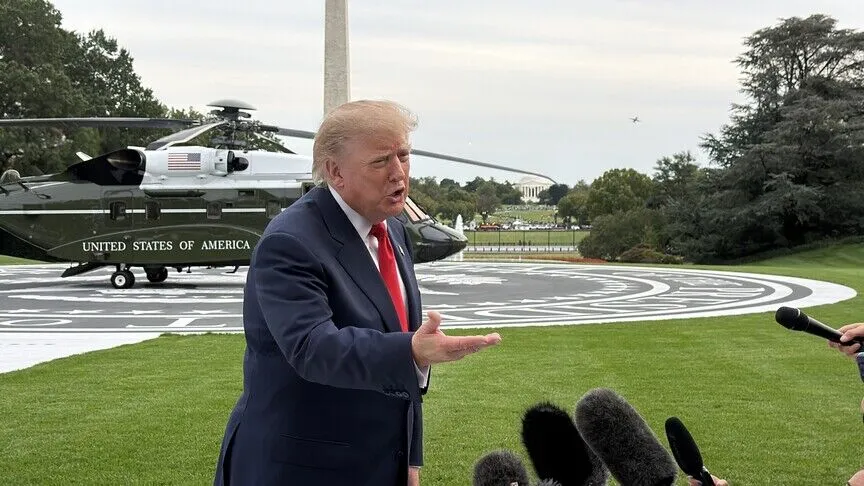
US President Donald Trump has said Washington could take further action against Iran, describing the country as being in a deteriorating military and economic position while declining to provide details about any potential US response.
Speaking to reporters on Friday, Trump was asked why possible action against Iran might be delayed until after the November 3 midterm elections rather than taken immediately.
“We may. We will see,” he said.
Trump claimed that Iran was “failing badly” and described its military capabilities and economy as severely weakened. He also alleged that the country was facing inflation of 300%, although he did not provide supporting figures or explain the basis for the claim.
The president did not outline what steps Washington might take or give a timeline for any possible action.
Trump announces Russian diesel supply agreement
In a separate development, Trump said Russia had agreed to supply additional diesel to global markets, including the United States, in an effort to ease pressure on fuel prices.
Trump said he had held a “highly successful” discussion with Russian President Vladimir Putin, during which they agreed that Russia would immediately supply more than 300,000 metric tons of diesel, equivalent to approximately 2.25 million barrels.
He added that Russia would provide another 500,000 tons in November, followed by a further 1 million tons and potentially additional supplies, depending on the condition of Russian diesel refineries.
The announcement came as diesel prices remained elevated, increasing pressure on American farmers, truckers and other businesses that rely heavily on the fuel.
The US Treasury Department subsequently issued a licence allowing imports of Russian diesel until April 7.
Ukraine criticises Washington’s decision
The decision to ease restrictions on Russian fuel drew criticism from Ukrainian President Volodymyr Zelenskiy, who described it as a weak move by Washington’s partners.
Zelenskiy argued that providing Russia with additional revenue would not help end the war in Ukraine and warned that Moscow could use the proceeds to sustain its military campaign.
The agreement also faced criticism from US lawmakers. Republican Representative Don Bacon argued that Washington should enforce recently approved sanctions against Russia rather than relax restrictions on its energy exports.
The United States imposed sanctions on Russian oil companies in October 2025 over Moscow’s war against Ukraine, which began in February 2022.
Additional Russian diesel exports could provide Moscow with revenue at a time when Ukraine has targeted Russian energy infrastructure, including refineries.
Analysts question impact on fuel prices
Energy analysts expressed doubts that the reported agreement would be sufficient to bring about a sustained reduction in diesel prices.
Oil market researcher Rory Johnston described the deal as having little overall impact, arguing that the announced volumes were relatively small compared with Russia’s usual diesel exports when its refineries are operating normally.
Jim Mitchell, an analyst at Wood Mackenzie, said the additional supplies could provide another source of fuel for a market already facing tight conditions, but were unlikely to resolve the broader supply problem.
Diesel prices have climbed sharply amid disruptions linked to the conflict involving Iran and the continuing war in Ukraine. The fuel is essential for freight transport, agriculture and heating, making price increases a concern for businesses and consumers.
According to the AAA motorist group, the average US diesel price reached $6.28 per gallon on Thursday.
Diesel futures fall after announcement
Diesel futures fell by almost 5% following news of the reported agreement and were trading at $4.64 per gallon.
The decline came after earlier efforts by the Trump administration to increase fuel availability, including urging allies to release emergency reserves and expanding access to tax-exempt red-dyed diesel, which is normally used in agricultural equipment.
Trump said reducing costs for American consumers and businesses remained a priority.
“Lower prices for Americans, especially our Great Farmers, Ranchers, and Truckers, is my Greatest Priority,” he said.
However, analysts cautioned that the reported Russian supply agreement alone might not be enough to keep prices down, particularly if geopolitical tensions continue to disrupt global energy markets.