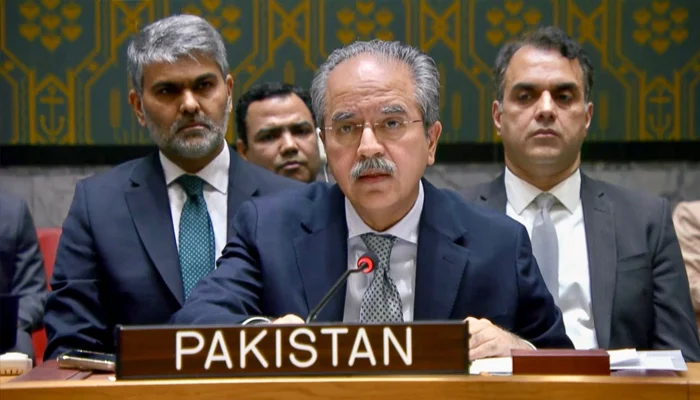
Pakistan has raised alarm at the United Nations Security Council (UNSC) over the escalating military confrontation in the Middle East following joint US-Israeli strikes on Iran, warning that continued hostilities could threaten the stability of the entire region.
Pakistan’s Stance at the UNSC
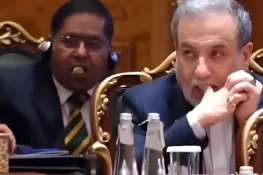
Speaking at an emergency session of the 15-member Council, convened at the request of France, China, Russia, Bahrain, and Colombia, Pakistan’s Permanent Representative to the UN, Asim Iftikhar Ahmad, said:
“We are deeply alarmed at the risk of regional conflagration. The joint strikes and retaliatory actions could undermine security across the Middle East with far-reaching consequences.”
He emphasized that the attacks, which he described as violations of international law, occurred at a time when renewed diplomatic efforts were underway to resolve disputes peacefully.
Ambassador Ahmad also condemned Iran’s missile strikes targeting Gulf states, including Saudi Arabia, Bahrain, Jordan, Kuwait, Qatar, and the UAE, expressing Pakistan’s solidarity with these nations and urging all sides to exercise maximum restraint. He specifically highlighted Oman’s role as a mediator facilitating indirect talks between Washington and Tehran.
Humanitarian Concerns
The Pakistani envoy expressed condolences for civilians affected by the violence, including a Pakistani national killed in the UAE. He stressed the urgent need for all parties to avoid actions that could compromise the security and territorial integrity of regional countries.
“Diplomacy has once again been derailed in the middle of ongoing negotiations, further eroding fragile trust. Immediate de-escalation and resumption of dialogue are critical to achieve a peaceful resolution,” he said.
Pakistan condemns the initiation of unwarranted attacks against the Islamic Republic of Iran, in violation of international law. Yet again, these attacks come at a time when renewed diplomatic efforts were underway to reach a peaceful and negotiated solution. Such a course of… pic.twitter.com/LtG70ffu76
— Permanent Mission of Pakistan to the UN (@PakistanUN_NY) February 28, 2026
Ambassador Ahmad reiterated Pakistan’s commitment to close coordination with neighboring and allied countries, emphasizing that dialogue and diplomacy must remain the guiding principles for resolving conflicts in a volatile region.
UN Secretary-General’s Warning
Opening the debate, UN Secretary-General António Guterres stressed the importance of adhering to the UN Charter, which prohibits threats or use of force against the territorial integrity or political independence of states.
He condemned the large-scale US and Israeli attacks on Iran, as well as Iran’s subsequent retaliatory strikes, which affected Bahrain, Iraq, Jordan, Kuwait, Qatar, Saudi Arabia, and the UAE. Guterres described the situation as a “grave threat to international peace and security” and called for an immediate halt to hostilities.
According to the UN chief, around 20 Iranian cities — including Tehran, Isfahan, Qom, Shahriar, and Tabriz — were reportedly targeted, with large explosions in Tehran’s districts housing key state facilities. Reports indicate at least 85 casualties from the airstrikes, with additional injuries in Israel and the occupied West Bank. Indirect impacts were reported in Lebanon and Syria, while most Gulf states intercepted incoming missiles.
Guterres expressed regret that the latest US-Israel strikes came just after the third round of indirect US-Iran talks mediated by Oman, emphasizing that diplomacy must be prioritized to prevent further escalation, particularly regarding Iran’s nuclear program.
The Urgent Call
Both Pakistan and the UN Secretary-General underscored the need for immediate de-escalation, cessation of hostilities, and a swift return to negotiations. The situation remains highly fluid, and continued military action could have severe consequences for regional and global security.