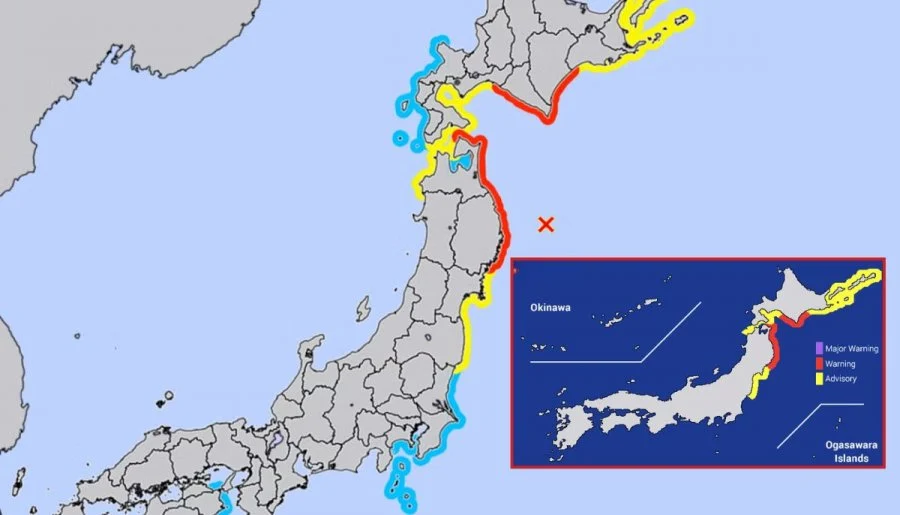
Japan has issued tsunami warnings after a powerful 7.4-magnitude earthquake struck off the northeastern coast near the Sanriku region on April 20, 2026. Authorities warned that tsunami waves of up to 3 meters could reach parts of the coastline following the tremor.
Strong Earthquake Hits Offshore Region
According to the Japan Meteorological Agency (JMA), the earthquake occurred at around 4:53 p.m. local time. Its epicenter was located offshore at a depth of approximately 10 kilometers, near latitude 39.8°N and longitude 143.2°E.
The quake was initially measured at magnitude 7.4, though some international monitoring agencies, including the European-Mediterranean Seismological Centre, reported a slightly lower estimate of 7.3.
Intensity Felt Across Wide Areas
The tremor registered at “upper 5” on Japan’s seismic intensity scale, where level 7 is the strongest. This level indicates very strong shaking, making it difficult for many people to stand without support. In such conditions, unsecured furniture may fall, and structural stress is common in buildings not designed for high seismic activity.
Japan’s advanced seismic monitoring system immediately issued tsunami alerts for coastal areas, urging residents to move to higher ground and stay away from the shoreline.
Tsunami Warning and Coastal Alerts
Authorities warned that tsunami waves of up to 3 meters could reach certain coastal zones. Emergency alerts were broadcast across affected regions, with evacuation advisories issued in vulnerable areas along the northeastern coast.
Japan, which lies on the Pacific “Ring of Fire,” is highly prone to earthquakes and tsunamis. The country maintains one of the most advanced early-warning systems in the world, which allows rapid response even within seconds of seismic activity.
Strong 6.2-Magnitude Earthquake Strikes Indonesia’s Sulawesi Island
Transport and Infrastructure Disruptions
Following the quake, Japan’s high-speed rail service, including the Tohoku Shinkansen line, temporarily suspended operations between Tokyo and Shin-Anmori as a precautionary measure.
Utility companies also began immediate safety checks. Tokyo Electric Power Company started inspections at its Fukushima Daiichi and Fukushima Daini nuclear plants to ensure no damage or radiation risks had occurred. Similarly, Tohoku Electric Power Company initiated system checks at the Onagawa nuclear facility in Aomori Prefecture.
Safety Measures Underway
So far, there have been no immediate reports of major damage or casualties, but authorities continue to assess the situation. Emergency services remain on alert as aftershocks are possible in the coming hours or days.
Japan’s disaster response agencies have urged residents in affected areas to stay informed through official channels and follow evacuation instructions if necessary.
Ongoing Monitoring
Seismologists are continuing to monitor the region closely. While tsunami warnings remain in place in some areas, authorities will reassess risks as new data becomes available.
For now, Japan remains on high alert as the situation develops along its northeastern coastline.