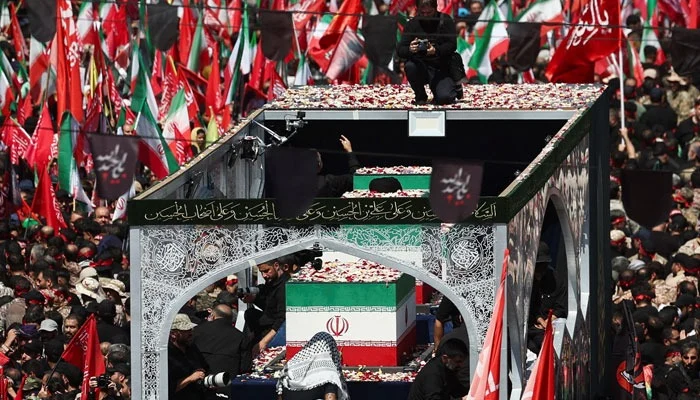
The funeral procession for Iran’s late Supreme Leader Ayatollah Ali Khamenei began in Tehran on Monday, with authorities preparing for crowds that could rival some of the largest public gatherings in the country’s modern history.
The ceremonies come at a pivotal moment for Iran, as the country seeks to demonstrate stability and national unity after weeks of conflict involving Israel and the United States. Attention also remains focused on the country’s new leadership and the political transition following Khamenei’s death.
Funeral Procession Begins After Two Days of Public Mourning
According to Iranian state television, Khamenei’s body was placed in state for two days at Tehran’s Grand Mosalla religious complex, where thousands of mourners gathered to pay their respects.
On Monday, the funeral procession began from Imam Hussein Square in eastern Tehran, with large crowds lining the route. State media reported that mourners carried portraits of the late leader and chanted slogans during the procession. The ceremonies are expected to continue over several days across multiple cities.
Authorities Tighten Security Following Lessons from 1989
Iranian officials have introduced extensive crowd-control measures to prevent a repeat of the tragic scenes witnessed during the 1989 funeral of Ayatollah Ruhollah Khomeini.
That funeral reportedly attracted millions of mourners, but overwhelming crowd surges led to multiple fatalities and thousands of injuries. The situation became so chaotic that authorities ultimately had to transport Khomeini’s body by helicopter before burial.
To reduce the risk of similar incidents, large concrete barriers were installed around Khamenei’s coffin during the public viewing, while security personnel have been deployed throughout the procession route.
Ceremonies to Continue in Iran and Iraq
The funeral events will continue beyond Tehran over the coming days.
Following Monday’s procession, similar ceremonies are scheduled in the religious city of Qom on Tuesday. On Wednesday, commemorative events will take place in the Iraqi holy cities of Najaf and Karbala, before Khamenei is laid to rest in his hometown of Mashhad on Thursday.
PM Shehbaz Sharif to Attend Ayatollah Ali Khamenei’s Funeral in Iran, Foreign Office Says
The multi-city program reflects both Khamenei’s religious standing and the broader regional significance of the funeral.
Senior Officials Attend as Attention Remains on New Leadership
Several senior Iranian officials attended the funeral ceremonies, including Parliament Speaker Mohammad Bagher Ghalibaf, Revolutionary Guards Commander Ahmad Vahidi, and Quds Force commander Esmail Qaani.
Three of Khamenei’s sons also made a rare public appearance. However, his successor, Mojtaba Khamenei, was notably absent from the public ceremonies. Iranian officials have said he was injured in the airstrikes that killed his father, although no further details about his condition have been released.
The absence of the new Supreme Leader has continued to attract attention as Iran enters a new political chapter.
Funeral Carries Political and Symbolic Significance
Beyond honoring the country’s longest-serving Supreme Leader, the funeral has become an opportunity for Iranian authorities to emphasize national solidarity following recent conflict and domestic unrest.
Officials hope the large public turnout will demonstrate support for the country’s leadership at a time of heightened regional tensions. During the ceremonies, some mourners called for justice and retaliation over Khamenei’s assassination, reflecting the strong emotions surrounding his death.
Ayatollah Ali Khamenei led Iran for more than three decades, shaping the country’s domestic policies, foreign relations, and regional strategy. His funeral is expected to be one of the most significant public events in Iran in decades, drawing attention not only for its scale but also for what it may signal about the country’s future political direction.