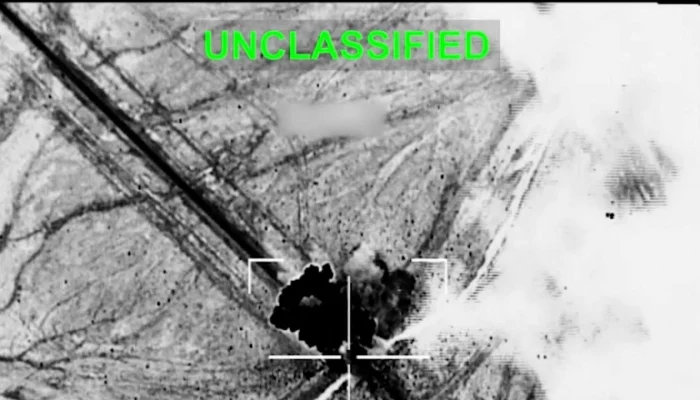
WASHINGTON/TEHRAN: Hostilities between the United States and Iran intensified on Saturday, marking the seventh consecutive night of military operations since a fragile ceasefire agreement collapsed last week.
According to the US military, fresh strikes targeted Iranian military sites, including logistics infrastructure, surveillance facilities, underground weapons storage locations and maritime capabilities.
The latest escalation comes one week after efforts to maintain a ceasefire broke down, raising fears that the conflict could expand further across the Middle East.
US Says Military Sites Were Targeted
In a statement, the US Central Command (CENTCOM) said American forces carried out coordinated operations using fighter aircraft, drones, warships and other military assets.
CENTCOM said the attacks focused on military objectives, including surveillance systems, logistics infrastructure, underground weapons storage facilities and assets linked to Iran’s maritime operations.
The command also stated that more than 50,000 US military personnel remain deployed across the Middle East and are prepared to respond to any further developments.
Iran Reports Damage to Civilian Infrastructure
Iranian media reported that missiles struck power facilities and desalination pumps in the southern city of Jask, citing a local official.
According to the reports, damage to the desalination facilities disrupted drinking water supplies to several nearby villages.
Separately, Iranian state media reported explosions or strikes in several locations, including Hormozgan Province, Sirik, Ahvaz, Yazd, Jask and Khorramabad.
State television said strikes in Hormozgan Province resulted in three fatalities and eight injuries, while two bridges and a road tunnel were reportedly damaged.
Reuters said it could not independently verify the claims made by either side regarding the reported damage.
Pakistan Urges US and Iran to Resume Talks Under Islamabad MoU, Says Foreign Office
Maritime Tensions Continue in Strait of Hormuz
The conflict has also extended to maritime operations in the Strait of Hormuz, one of the world’s most important energy shipping routes through which roughly one-fifth of global oil supplies pass.
The United States said it continued enforcing a naval blockade and reported that its forces redirected four commercial vessels, disabled one ship and boarded another during maritime operations.
Iran’s Islamic Revolutionary Guard Corps (IRGC), meanwhile, said it had intercepted four vessels that allegedly violated its navigation rules in the Strait of Hormuz using a combination of missile and drone operations.
Iranian media also reported that two oil tankers caught fire after travelling through what it described as a mined route south of the strait. The US military rejected that report, calling it false.
In a separate incident, armed men reportedly seized another vessel near Yemen, increasing concerns over shipping security around the entrance to the Red Sea, another vital international trade corridor.
Iran Warns Energy Exports Could Be Affected
Iranian state television quoted the Revolutionary Guards as saying that until what it described as US “aggression” ends, normal exports of oil, gas and chemical fertilisers from the region would not be possible.
Meanwhile, Mohsen Rezaei, an adviser to Iran’s Supreme Leader, warned against any further escalation by the United States or attempts to seize Iranian territory.
UN Voices Concern Over Civilian Infrastructure
The United Nations expressed concern over the growing impact of the conflict on civilian infrastructure.
A spokesperson for UN Secretary-General António Guterres said the Secretary-General was particularly concerned about attacks affecting civilian facilities in Iran and elsewhere in the region.
The statement underscored the importance of protecting civilian infrastructure during armed conflicts in accordance with international humanitarian law.
Oil Prices Rise Amid Escalating Conflict
The continued fighting has also affected global energy markets.
Oil prices rose by more than 4% on Friday, reaching their highest level in over a month as investors reacted to concerns that prolonged instability around the Strait of Hormuz could disrupt global energy supplies.
Analysts note that any sustained interruption to shipping through the strategic waterway could have significant consequences for international oil markets, inflation and global trade.
Risk of Wider Regional Conflict Remains
The collapse of the ceasefire agreement has heightened concerns that the confrontation between the United States and Iran could escalate into a broader regional conflict.
US President Donald Trump has previously warned of the possibility of wider military action against Iranian infrastructure, while American officials have indicated that operations in southern Iran are intended to preserve multiple military options.
Despite continued military exchanges, diplomatic efforts by regional and international actors to encourage de-escalation remain ongoing, although no breakthrough has yet been announced.