ISLAMABAD: Every morning before dawn, taxi driver Ahmed Ali begins his shift on the streets of Islamabad. Like many commercial drivers across Pakistan, a significant portion of his daily earnings is consumed by fuel expenses before he can start earning for his family’s needs.
“I spend nearly six hours a day just earning enough to pay for petrol. Only after that do I start earning for my family,” says Ahmed, who has been driving a taxi in the capital for the past 15 years.
His experience reflects a broader challenge facing thousands of taxi drivers, ride-hailing operators and motorcycle riders nationwide. With fuel prices remaining high, transportation costs continue to erode drivers’ incomes, prompting growing interest in electric vehicles (EVs) as a potentially more economical alternative.
Government Banking on Electric Mobility
To address rising fuel imports and environmental concerns, the federal government introduced the National Electric Vehicle (NEV) Policy 2025–30, which aims to accelerate the adoption of electric vehicles across Pakistan.
The policy seeks to reduce the country’s dependence on imported petroleum products, lower greenhouse gas emissions, encourage local manufacturing of EVs and expand charging infrastructure nationwide. It also includes financial incentives designed to make electric vehicles more accessible to consumers.
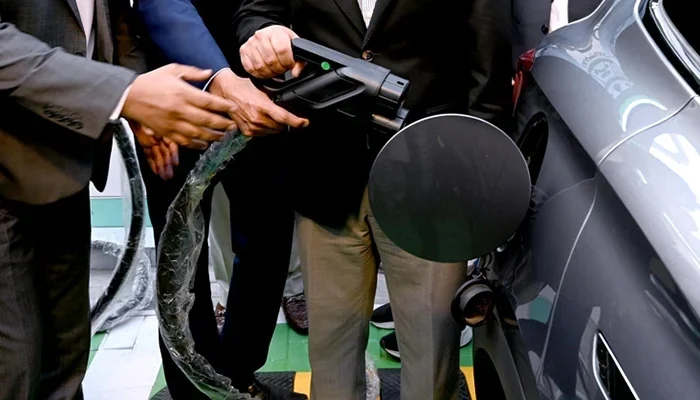
Islamabad has emerged as one of the first cities where these plans are beginning to materialise. The Capital Development Authority (CDA) has initiated efforts to expand public charging facilities, while electric buses have already started operating on several routes in the capital.
Urban planners believe Islamabad’s relatively short commuting distances and planned road network make it well suited for large-scale EV adoption.
Lower Running Costs Offer Long-Term Savings
Energy experts argue that although electric vehicles require a higher initial investment, they can significantly reduce operating costs over time, particularly for commercial drivers who travel long distances every day.
According to Ahtasam Ahmad, Energy Finance and Climate Tech Lead at Islamabad-based consultancy Renewables First, the financial benefits of EVs become apparent over the vehicle’s lifespan rather than at the time of purchase.
He explains that electric motorcycles typically cost 50% to 80% more than conventional petrol-powered bikes. However, their operating expenses are considerably lower.
An electric two-wheeler costs approximately Rs1.5 to Rs2 per kilometre to operate, compared with around Rs6 per kilometre for a petrol motorcycle.
For commercial riders covering high daily mileage, these savings can gradually offset the higher purchase price. Ahmad estimates that riders switching to electric motorcycles could save between Rs5,000 and Rs8,000 per month, depending on their daily travel distance.
High Upfront Costs Still a Major Barrier
Despite the long-term financial advantages, many commercial drivers remain hesitant to make the switch.
For drivers already struggling with rising living costs, purchasing an electric vehicle remains financially challenging. Many say the higher upfront price places EVs beyond their immediate reach, even if the running costs are lower.
In addition to affordability, drivers continue to express concerns about battery performance, charging availability, maintenance costs and financing options.
BYD to Introduce 5-Minute EV Charging Technology in the UK, Marking Major Shift in Electric Mobility
One ride-hailing driver questioned how practical electric vehicles would be during long working hours.
“If my battery runs low while I’m working, where will I recharge it, and how long will it take?” he asked.
Charging Infrastructure Remains Critical
Experts believe that expanding charging infrastructure will be essential for the success of Pakistan’s electric mobility ambitions.
Ahmad notes that “range anxiety”—the fear of running out of battery power before reaching a charging station—remains one of the biggest obstacles to wider EV adoption.
He also points out that many electric motorcycles currently available in Pakistan use graphene-coated lead-acid batteries, which are generally less reliable than newer lithium-based battery technologies.
Furthermore, Pakistan’s EV servicing network is still developing. Technicians require specialised training, and maintenance for electric vehicles can currently be more expensive than servicing conventional motorcycles in some cases.
Can Pakistan’s Power Grid Support More EVs?
Another frequently raised concern is whether Pakistan’s electricity system can accommodate a growing number of electric vehicles.
Energy experts say the issue is less about electricity generation and more about ensuring an efficient charging network.
According to Abdur Rehman, Manager of Power Markets, Pakistan currently has sufficient electricity generation capacity to support near-term EV adoption.
He noted that national electricity generation declined from 154 terawatt-hours (TWh) in FY2022 to 135 TWh in FY2025, partly due to the rapid expansion of rooftop solar systems. As a result, increased EV charging could create productive electricity demand and improve the utilisation of existing power-sector infrastructure.
However, he stressed that Pakistan needs coordinated planning to strengthen local electricity distribution networks and expand charging facilities.
Coordinated Planning Key to Successful Transition
Experts agree that Pakistan’s transition to electric mobility will depend on more than simply making electric vehicles available.
A practical EV ecosystem requires reliable home, workplace and public charging stations, supportive financing mechanisms, consumer awareness and a skilled maintenance network.
They also recommend introducing time-of-use electricity tariffs and smart charging systems that encourage EV owners to charge their vehicles during off-peak hours or when solar power generation is at its highest.
While Islamabad’s early initiatives represent an important step toward cleaner transportation, specialists believe the long-term success of Pakistan’s EV strategy will ultimately depend on whether electric vehicles become affordable, convenient and practical for the commercial drivers who stand to benefit the most.