NEW DELHI: Indian activists have launched a legal challenge against Prime Minister Narendra Modi’s government over the use of AI-powered surveillance during one of the country’s largest youth protests in decades, arguing that facial recognition technology was deployed without adequate legal safeguards.
The case, currently before the Delhi High Court, could become a landmark test of the Indian government’s surveillance powers, even after nationwide demonstrations over examination paper leaks concluded with the resignation of Education Minister Dharmendra Pradhan.
Facial recognition at protest sparks legal battle
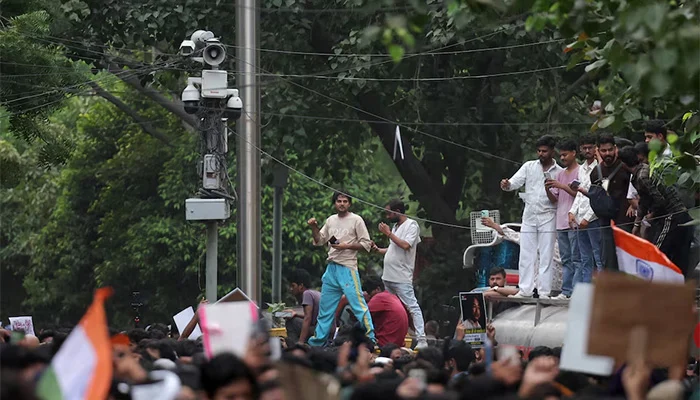
The controversy began after demonstrators shared images of a Delhi Police mobile surveillance van equipped with AI-powered cameras mounted on a telescopic mast, providing a 360-degree view of the protest site at Jantar Mantar.
Student activist Aishe Ghosh has petitioned the Delhi High Court to declare the mass surveillance unconstitutional. She is seeking orders for authorities to destroy any personal data collected during the demonstrations and establish clear legal guidelines governing the use of surveillance technology during public protests.
Although the protests ended following Pradhan’s resignation, Ghosh has continued pursuing the case, arguing that the broader constitutional issues remain unresolved.
Privacy concerns over surveillance technology
India currently has no specific law regulating police use of facial recognition technology, according to digital rights activists.
The government, however, maintains that surveillance measures were lawful and necessary to preserve public order.
During a court hearing, Solicitor General Tushar Mehta defended the police action, arguing that privacy expectations at a public gathering were limited and that surveillance served a legitimate state interest.
At a subsequent hearing, lawyers representing Ghosh argued that the use of intrusive AI surveillance on peaceful protesters was disproportionate and requested greater transparency regarding government surveillance policies. The court is expected to continue hearing the matter.
Digital rights groups demand accountability
The Internet Freedom Foundation, a New Delhi-based digital rights organisation, has urged Delhi Police to delete any biometric data collected during the demonstrations.
Delhi Police has denied restricting anyone’s freedoms through facial recognition technology, stating on social media that such systems were not used to curb lawful protest activity.
Legal experts say India urgently needs a legal framework governing AI surveillance.
Technology law specialist Akash Karmakar said surveillance measures should remain proportionate even when authorities cite national security concerns, adding that accountability should apply equally to both protesters and law enforcement officials.
Police also collected protesters’ social media details
Reuters reported that police officers were also seen recording the Instagram usernames of protesters entering the demonstration site.
According to Inspector Sunil Kumar, the information was collected to prevent individuals with criminal backgrounds from entering the protest area.
The surveillance vehicle, branded “Ikshana”—Hindi for “vision”—was reportedly developed in partnership with Indian CCTV manufacturer CP Plus.
When a Reuters journalist approached the vehicle, one computer display reportedly highlighted his face with a green box alongside a “face accuracy” score. A police officer later explained that the AI system helped identify individuals with criminal records while also estimating crowd sizes.
The case is expected to shape the future legal framework for facial recognition technology and AI-powered surveillance during public demonstrations in India.