Typhoon Dolphin has caused severe weather across eastern China, bringing intense rainfall, flooding and widespread disruption to transportation. Although the storm weakened after making landfall, authorities continued to warn residents about the risk of further flooding and landslides.
The typhoon made landfall in Zhejiang province on Sunday before weakening to a tropical storm. However, the reduction in wind strength did not immediately end the threat, as large amounts of rain continued to fall across several parts of eastern China.
Shanghai Hit by Torrential Rain
Shanghai was among the areas significantly affected by the storm.
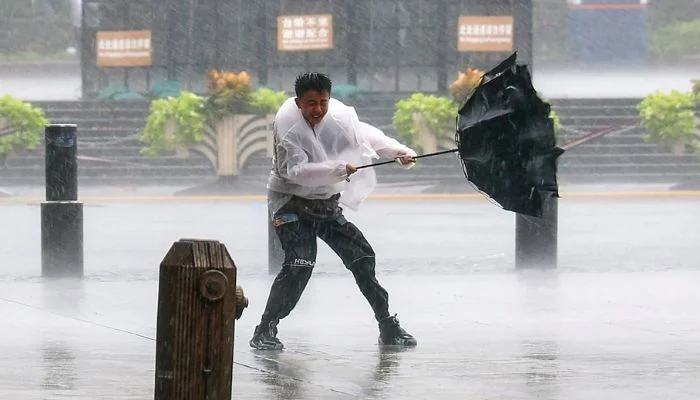
Reports indicated that parts of the city experienced exceptionally heavy rainfall within a 24-hour period, with some locations receiving nearly 400 millimetres of rain.
The intense downpours overwhelmed roads and drainage systems in several areas, leaving streets flooded and disrupting normal life.
In some suburbs, floodwater reportedly reached knee level, forcing residents to navigate through submerged streets. The flooding also created difficulties for motorists and pedestrians as authorities worked to manage the effects of the storm.
Because of the severity of the conditions, authorities evacuated more than 200,000 people in Shanghai.
More Than One Million Evacuated
The impact extended well beyond Shanghai.
Authorities across eastern China reportedly evacuated more than one million people in total as the storm approached and rainfall intensified.
Large-scale evacuations were carried out in Zhejiang and Fujian provinces, particularly in areas considered vulnerable to flooding, landslides and other storm-related hazards.
The evacuations were part of broader emergency measures aimed at protecting residents as the typhoon moved inland.
Although Dolphin weakened after making landfall, officials remained concerned because the storm continued to carry significant amounts of moisture capable of producing heavy rainfall.
Flights, Trains and Subways Disrupted
The typhoon also caused major disruptions to China’s transportation network.
Around 943 flights were cancelled in Shanghai on Monday, affecting both domestic and international travel.
Rail and urban transportation services were also affected. Train services and subway operations in parts of Shanghai were delayed or suspended because of the dangerous weather conditions.
Typhoon Dolphin Makes Landfall in China After Mass Flight Cancellations and Evacuations
Such disruptions are particularly significant in Shanghai, one of China’s largest cities and a major international transport and economic hub.
Authorities prioritised passenger safety as flooding and heavy rainfall made travel increasingly difficult.
Flooding and Landslide Risks Remain
Officials continued to warn that the danger had not completely passed even after Typhoon Dolphin lost its typhoon status.
Heavy rainfall was forecast across several provinces, including Anhui, Jiangsu, Shandong, Hubei and Henan.
The continued rainfall raised concerns about rapidly rising rivers, flash flooding and landslides, particularly in low-lying and mountainous areas.
Authorities have therefore maintained emergency measures and urged residents in vulnerable locations to follow evacuation and safety instructions.
The weakening of a tropical cyclone does not necessarily mean that its rainfall threat ends immediately. In some cases, a storm can continue producing significant precipitation after its strongest winds have diminished.
Effects Extended Beyond China
The weather system associated with Typhoon Dolphin also affected areas outside mainland China.
In the Philippines, weather linked to the storm contributed to increased monsoonal rainfall, adding to concerns about flooding and difficult weather conditions in some areas.
For eastern China, however, the immediate focus remains on managing floodwaters and monitoring rivers as the storm system moves farther inland.
While Typhoon Dolphin has weakened considerably since making landfall, the combination of saturated ground, swollen rivers and continued heavy rainfall means that flooding and landslide risks remain serious.
Authorities are continuing to monitor conditions closely as the weather system moves across the region.