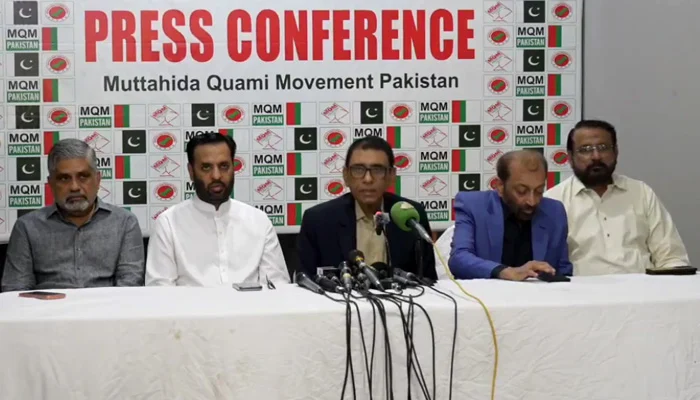
KARACHI: Muttahida Qaumi Movement-Pakistan (MQM-P) Chairman Khalid Maqbool Siddiqui has called for a national dialogue on the creation of new provinces, arguing that Pakistan’s existing administrative structure no longer adequately reflects the country’s growing population and governance requirements.
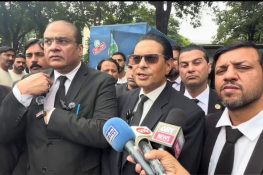
Speaking at a press conference in Karachi on Sunday alongside senior party leaders Dr Farooq Sattar and Mustafa Kamal, Siddiqui urged political parties to set aside partisan differences and develop a consensus-based framework for administrative reforms.
His remarks come amid renewed debate over whether Pakistan needs additional provinces or administrative units to improve governance and public service delivery.
MQM-P Seeks Consensus on New Provinces
Siddiqui said the question of creating new provinces should be discussed through an inclusive national dialogue rather than becoming a source of political confrontation.
He argued that Pakistan’s existing provinces were largely shaped by linguistic and historical considerations and have since grown into very large administrative units. Meanwhile, the country’s population has increased substantially over the decades.
Although successive governments have created numerous districts and other local administrative divisions, Siddiqui said the broader question of provincial reorganisation has largely remained unresolved.
He maintained that administrative boundaries should take population size, governance requirements and the delivery of public services into account.
According to the MQM-P chairman, Sindh is among the regions where the demand for additional administrative units has been particularly prominent.
Party May Approach Supreme Court
Siddiqui rejected the argument that discussing the creation of new provinces should be considered controversial or disloyal.
He pointed out that Pakistan’s Constitution provides a legal and constitutional mechanism for changing provincial boundaries and creating new provinces.
The MQM-P leader also referred to the 18th Constitutional Amendment, saying his party had supported the reforms because it wanted the benefits of democracy and decentralisation to reach people throughout the country.
However, he argued that meaningful decentralisation could not be achieved without strengthening administrative structures at the provincial level.
Siddiqui said MQM-P had already introduced a constitutional bill concerning the issue, which remains before a parliamentary standing committee. He added that the party had previously sought judicial intervention when progress on the matter stalled and could approach the Supreme Court again if necessary.
MQM-P Says Reform Is Not Ethnic
Mustafa Kamal said the creation of additional administrative units should not be viewed as an attempt to target any ethnic group, including Sindhis.
Instead, he argued that smaller and more decentralised administrative structures could bring government closer to citizens, improve representation and strengthen accountability.
Farooq Sattar similarly described the creation of additional administrative units as increasingly important for Pakistan’s stability and cohesion.
He argued that bringing governance closer to ordinary citizens could increase public participation, improve service delivery and allow local leadership to emerge from the communities it represents.
Government Has No Current Plan
Despite growing political discussion, the federal government has not endorsed a formal plan to create new provinces.
Pakistan Peoples Party (PPP), which governs Sindh and is an important coalition partner of the ruling Pakistan Muslim League-Nawaz (PML-N), has strongly opposed the creation of new provinces.
Interior Minister Mohsin Naqvi, whose earlier comments helped revive the debate, later clarified his position. He said he was part of the government and would not issue a “charge sheet” against his own administration.
Naqvi explained that his reference to a “collapsed” governance structure was about the gradual erosion of administrative and institutional capacity over roughly eight decades, rather than an assessment of the current government’s performance.
Prime Minister’s Adviser on Political Affairs Rana Sanaullah also said a day earlier that the government had not prepared any plan for creating new provinces.
Speaking on Geo News programme Naya Pakistan, Sanaullah noted that various proposals were being discussed publicly, with some suggesting 12 provinces, others 20, and some advocating even more.
He also questioned whether there was sufficient public demand for such a major restructuring. According to him, apart from the longstanding demand for a Hazara province, there was limited evidence of a broad grassroots movement across the country.
Support From Other Political Parties
The proposal has nevertheless received support from some political groups.
Istehkam-e-Pakistan Party (IPP) President Abdul Aleem Khan backed the creation of new provinces, describing it as a national issue that should not be sacrificed for political considerations. He also supported demands for separate South Punjab and Bahawalpur provinces.
Pakistan Tehreek-e-Insaf (PTI) Chairman Barrister Gohar Ali Khan has also supported the broader idea of creating additional administrative units.
However, he stressed that any such reform must be based on political consensus and carried out strictly through the constitutional process. This would require the requisite two-thirds majority in the relevant assemblies.
The renewed debate therefore remains at an early stage. While MQM-P is calling for a national framework and broader political dialogue, opposition from major political forces and the constitutional requirements involved mean that any restructuring of Pakistan’s provinces would require extensive political negotiations and parliamentary approval.