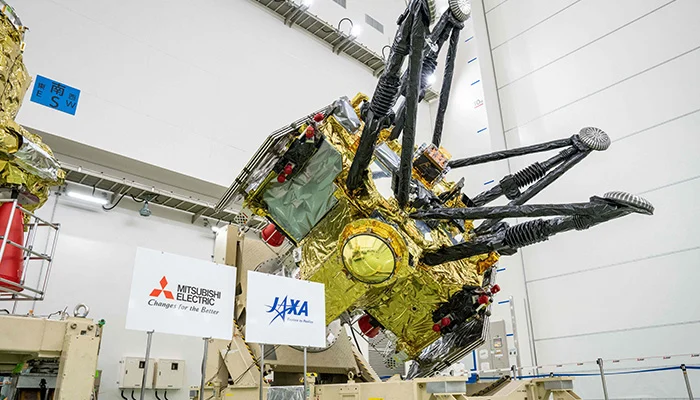
Japanese scientists are preparing to launch a major space mission to the moons of Mars, with hopes that samples collected from Phobos could provide important clues about the origins of the Solar System and the conditions that eventually made life possible on Earth.
The unmanned Martian Moons eXploration (MMX) mission, led by the Japan Aerospace Exploration Agency (JAXA), is expected to launch from the Tanegashima Space Center in the coming months.
The spacecraft is designed to spend around three years operating around Mars. During the mission, it will attempt to land on Phobos, collect at least 10 grams (0.35 ounces) of surface material and then return the samples to Earth.
The mission will also study Deimos, Mars’ second moon, although the spacecraft is not expected to land there.
Scientists Hope Phobos Holds Ancient Clues
One of the main objectives of MMX is to investigate how Mars and its two moons formed.
Scientists have proposed several theories about the origins of Phobos and Deimos. One possibility is the giant impact hypothesis, which suggests that the moons formed from material produced after a large celestial body collided with Mars.
Another theory proposes that the moons may actually be asteroids originating in the outer Solar System that were later captured by Mars’ gravity.
Determining which explanation is correct could provide scientists with a better understanding of the early Solar System.
JAXA says the research could also help explain how habitable environments developed on the rocky planets closest to the Sun — Mercury, Venus, Earth and Mars.
Could Mars’ Moons Hold Ingredients for Life?
Researchers are particularly interested in whether Phobos and Deimos contain material that originated in the outer Solar System.
Patrick Michel, a French astrophysicist working on the mission’s IDEFIX rover, said MMX could help scientists understand how water, volatile substances and organic compounds were transported from the outer Solar System toward the inner rocky planets.
Such materials are considered important in understanding the development of habitable environments.
If Phobos and Deimos preserve remnants of these ancient processes, samples from the moons could offer clues about how the materials necessary for life were delivered to rocky planets.
However, scientists are not suggesting that the mission will directly discover life. Instead, its goal is to better understand the movement of chemical and other materials that may have contributed to the conditions in which life eventually emerged.
Preparing for Future Human Missions to Mars
JAXA also sees MMX as an important technological step toward future human exploration of Mars.
The agency plans to investigate whether Phobos could eventually serve as a kind of natural space station for missions traveling to and from Mars.
Developing technologies capable of operating around and landing on Phobos could therefore provide experience relevant to future crewed missions to the Red Planet.
The spacecraft is being developed through an international collaboration involving France’s National Centre for Space Studies (CNES), the German Aerospace Center (DLR), NASA, the European Space Agency and research institutions and companies.
NASA Tests Powerful New Thruster That Could Help Get Humans to Mars Faster
Landing on Phobos Presents Major Challenges
One of the most difficult engineering challenges is landing safely on Phobos because the moon has extremely weak gravity.
Akinari Uehara, an engineer at Mitsubishi Electric, said the spacecraft’s landing legs have been designed to absorb the impact and prevent the probe from falling over after touchdown.
Japan has already gained valuable experience from previous difficult space missions.
In 2024, JAXA’s Smart Lander for Investigating Moon (SLIM) — nicknamed the “Moon Sniper” — tipped over after landing on the Moon. Despite the unusual landing position, the spacecraft continued transmitting data and survived several lunar nights.
Japan also has extensive experience in retrieving material from small celestial bodies. Its Hayabusa-2 mission returned 5.4 grams of rock and dust from the asteroid Ryugu to Earth in 2020.
China Also Racing to Return Mars Samples
Japan is not the only country pursuing Mars sample-return ambitions.
NASA’s Perseverance rover has been collecting and storing samples on Mars since landing on the planet in 2021. Those samples are intended for eventual return to Earth, although the original US Mars Sample Return plans have faced major changes and uncertainty.
China is also developing the Tianwen-3 mission, which is expected to launch around 2028 with the goal of bringing Martian samples back to Earth around 2031.
China has already demonstrated its ability to land and operate a rover on Mars. Its Tianwen-1 mission successfully placed the Zhurong rover on the Martian surface in 2021.
If both missions remain on schedule, China could potentially return Martian samples around the same time as Japan’s MMX mission brings material from Phobos back to Earth.
For Japan, however, MMX offers something different: rather than directly sampling Mars, it could provide an unprecedented look at the history of the Red Planet and its moons — and perhaps help scientists understand how the ingredients for life travelled through the early Solar System.