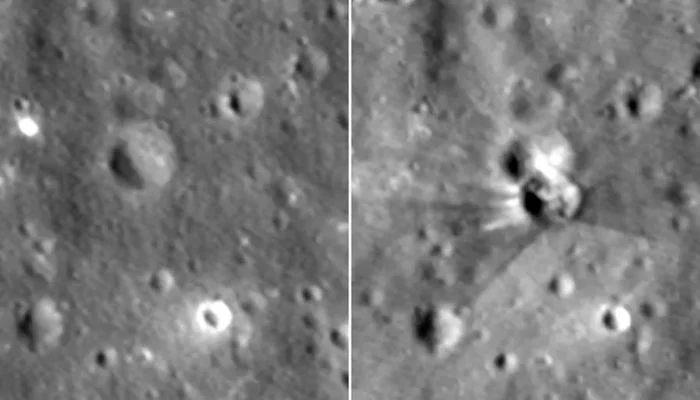
A discarded SpaceX Falcon 9 rocket stage that had been drifting through space for more than a year has crashed into the Moon, creating a new crater roughly 60 feet (18 metres) wide.
NASA’s Lunar Reconnaissance Orbiter (LRO) has now photographed the impact site, giving scientists a detailed look at the newly formed feature on the lunar surface.
The impact occurred on August 5, when the rocket’s upper stage struck the Moon at an estimated speed of about 5,400 mph (8,700 km/h). The rocket section weighed approximately 8,800 pounds and had been travelling through space since its launch in January 2025.
NASA Captures Before-and-After Images
NASA’s Lunar Reconnaissance Orbiter photographed the area between August 11 and 12, allowing researchers to compare the lunar surface before and after the collision.
Scientists estimate that the resulting crater is approximately 60 feet (18 metres) across and less than 10 feet deep.
The images show a fresh depression surrounded by streaks of material extending outward from the impact point. Such patterns can provide scientists with information about the force and direction of an impact as well as the material disturbed during the collision.
The impact occurred near the Einstein crater on the Moon’s far side, an area that is difficult to observe directly from Earth.
How the Falcon 9 Upper Stage Reached the Moon
The rocket stage was part of a Falcon 9 mission launched in January 2025 to carry Firefly Aerospace’s Blue Ghost 1 lunar mission.
Falcon 9 rockets consist of multiple stages. While the first stage is designed to return to Earth and be reused, the upper stage remains in space after completing its primary mission.
In this case, the discarded upper stage spent more than a year travelling through space. Its trajectory was gradually influenced by gravitational forces and solar radiation, eventually bringing it into the Moon’s vicinity.
The spacecraft’s path ultimately resulted in an unintended collision with the lunar surface.
Elon Musk Brings SpaceX Team to Overhaul xAI, Emphasizes Respect for Candidates
What the New Crater Reveals
The newly released images show both bright and dark material around the crater.
NASA said the darker material came from the Moon’s weathered upper layers, while brighter streaks consist of material excavated from deeper beneath the surface during the impact.
The distribution of this material could help researchers understand how high-speed impacts alter the lunar landscape.
South Korea’s Danuri lunar orbiter captured the first images of the impact site shortly after the crash. NASA’s LRO subsequently photographed the location from multiple angles, providing additional information for scientists studying the newly created crater.
No Threat to Earth
Although the event was dramatic on a planetary scale, the impact posed no danger to Earth.
However, scientists say the incident highlights an emerging issue as lunar exploration becomes increasingly active.
More countries and private companies are planning missions to the Moon, including robotic spacecraft, landers and other equipment. As the number of lunar missions grows, discarded rocket stages and spacecraft could potentially create risks for future lunar infrastructure.
These objects could become hazards for lunar bases, scientific instruments and astronauts operating on or around the Moon.
An Unexpected Scientific Opportunity
Despite the potential long-term concerns, the accidental collision also offers scientists a useful opportunity.
Because the impact was observed by lunar spacecraft, researchers can study how a known object of a particular size and mass affects the Moon’s surface at high speed. The resulting crater and debris pattern may provide additional information about the Moon’s soil and subsurface structure.
The event therefore serves as both a reminder of the challenges associated with increasing lunar activity and an unexpected natural experiment for planetary scientists.
As exploration of the Moon accelerates, understanding how spacecraft debris interacts with its surface could become increasingly important for planning safe and sustainable future missions.