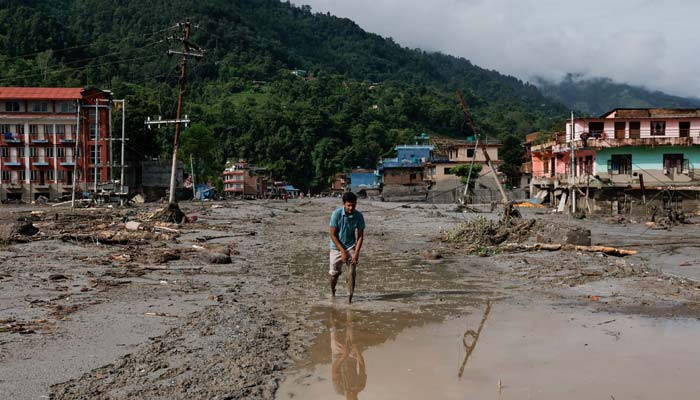
TRISHULI: Rescue teams in Nepal continued searching for survivors on Thursday after catastrophic floods and mudslides killed at least 162 people, while hundreds of tourists, including more than 400 foreign nationals, remained missing.
The disaster struck a Himalayan region near Nepal’s border with China’s Tibet, where a massive surge of mud, rocks and water swept through towns and valleys. Authorities fear the death toll could rise significantly as search operations continue and more bodies are recovered.
Hundreds of Tourists Still Missing
According to Nepalese tourism officials, 579 tourists remained missing, including more than 400 foreign nationals. The affected region is popular among trekkers and pilgrims, adding to the scale and complexity of the rescue operation.
Among the missing foreign visitors were reportedly 47 US citizens, 34 Australians, 33 Britons and 24 Canadians.
However, Chinese authorities also reported hundreds missing in Tibet’s Gyirong county, with state broadcaster CCTV giving a separate figure that included foreign nationals. It was not immediately clear whether the figures released by Nepal and China overlapped.
Police spokesperson Abi Narayan Kafle said authorities expected the number of fatalities to increase as rescue operations resumed in areas that had previously been difficult to access.
Helicopters Search for Survivors and Deliver Aid
Helicopters have been deployed to search for stranded survivors and transport emergency supplies to some of the worst-hit areas.
According to Nepal Army spokesperson Raja Ram Basnet, helicopters are delivering tents, food and other emergency supplies, including assistance provided by neighbouring India.
Meanwhile, helicopters have also been used to evacuate survivors trapped by floodwaters and landslides. Many roads have been destroyed, making air operations essential for reaching isolated communities.
The United States said it was sending a disaster response adviser and providing $500,000 in assistance, while the United Nations said its teams and partners were mobilising supplies and personnel to support affected communities.
Survivors Describe Terrifying Moments
Survivors have described scenes of widespread devastation as enormous amounts of mud and water swept through homes and settlements.
One survivor, 68-year-old Keshav Prasad Baral, said he saw a huge wall of mud rapidly approaching his home. He attempted to take his wife to safety, but she was swept away.
India Monsoon Death Toll Crosses 100 as Floods and Landslides Devastate Several States
Another survivor said he managed to save his life by clinging to a mango tree while watching the house where he had been working disappear beneath the flood.
Across affected areas, homes, roads, vehicles and electricity infrastructure have been destroyed. Damage to hydropower facilities has also caused power outages, leaving rescue teams to operate under extremely difficult conditions.
Glacier and Rock Collapse May Have Triggered Disaster
Initial reports suggested that seismic activity in the region may have triggered the disaster.
Nepalese officials initially believed that an earthquake could have caused part of a glacier to collapse. However, the US Geological Survey later said the event initially reported as a magnitude 4.4 earthquake was actually seismic energy generated by the collapse of glacial rock and ice.
The collapse was followed by a massive debris flow that sent mud, rocks and water rushing downstream.
Satellite imagery reviewed by disaster management authorities indicated that a landslide involving ice and rock triggered a debris-filled flood in the Lhende River, northeast of the Nepal-China Rasuwagadhi border crossing.
Pilgrims Among the Victims
Many of those affected were travelling on pilgrimage to Kailash Mansarovar, a high-altitude site in Tibet that holds deep religious significance for Hindus, Buddhists and other communities.
Mount Kailash is regarded by Hindus as the abode of Lord Shiva, while nearby Lake Mansarovar is also considered sacred.
The disaster has therefore affected not only local communities but also large numbers of international travellers.
Border Region Cut Off
The mudslide also caused major destruction on the Chinese side of the border.
China’s Xinhua news agency reported that roads, communications and power links were disrupted around the Gyirong border region. A drone assessment reportedly found that roads leading to the border crossing had been completely destroyed.
In Nepal, residents from affected districts gathered at an army rescue centre seeking information about missing relatives. With electricity supplies disrupted, police recorded details of missing persons using mobile phone lights.
Authorities are continuing search and rescue operations, but damaged roads, communication failures and difficult Himalayan terrain are expected to slow efforts to reach all affected areas.