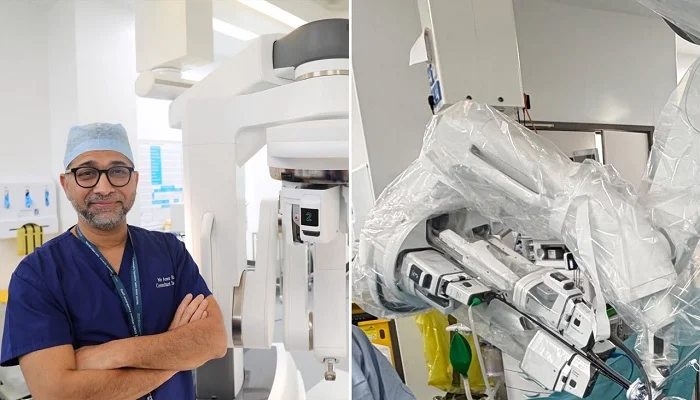
LONDON: British-Pakistani consultant gynaecologist and robotic surgeon Dr Amer Raza has set a new record in the UK after pioneering single-port robotic gynaecological surgery and leading a programme that has now completed more than 400 procedures using the technology.
Dr Raza, a graduate of Nishtar Medical College in Multan, leads the Endometriosis and Robotic Surgery programme at Cromwell Hospital in London. His team has expanded the use of single-port robotic surgery from routine benign gynaecological procedures to some of the most complex forms of endometriosis surgery.
Single-port robotic surgery
Unlike conventional multi-port robotic surgery, which generally requires several abdominal incisions, single-port technology allows a camera and multiple robotic instruments to be introduced through a single abdominal entry point.
Dr Raza said the programme has also developed into a training and observation centre for surgeons interested in advanced robotic gynaecological surgery.
More than 100 surgeons and consultants from the UK, Europe, the United States and other countries have visited the centre to observe complex procedures and exchange expertise.
“Surgeons and consultants travel to London to observe us carrying out complex single-port robotic operations, exchange experience and learn how the technology can be applied to some of the most challenging cases in gynaecological surgery,” Dr Raza said.
Recognition for robotic surgery and endometriosis care
Dr Raza has also received two Master Surgeon accreditations in Robotic Surgery and Advanced Endometriosis Care from the US-based Surgical Review Corporation.
The accreditations followed an external review of his surgical practice, patient outcomes, complications, governance and standards of care. According to Dr Raza, he is the only consultant in Europe to hold both accreditations.
The latest milestone comes three years after he led another record-setting achievement using the da Vinci Surgical System for patients with endometriosis.
At Chelsea and Westminster Hospital in London, his team performed 12 major gynaecological operations in a single day as part of a programme that completed the highest number of complex gynaecological procedures over a two-day period.
FDA recalls chlorthalidone blood pressure tablets over dissolution failure
Focus on complex endometriosis
Dr Raza said endometriosis can cause severe pelvic and menstrual pain and can significantly affect fertility and quality of life.
In complex cases, the condition can affect the bowel, bladder, urinary tract, nerves and diaphragm in addition to the pelvic organs.
“Our work covers some of the most difficult forms of endometriosis, including complex disease affecting the bowel, urinary tract and diaphragm, as well as robotic hysterectomy, myomectomy and other advanced gynaecological procedures,” he said.
He stressed that treating complex endometriosis requires a broader approach than surgery alone.
“I believe that complex endometriosis cannot be treated by one surgeon alone,” Dr Raza said, adding that diagnosis, recovery, pain management, fertility, psychological wellbeing and long-term support should form part of comprehensive care.
Maintaining ties with Pakistan
Dr Raza, who was originally trained in Pakistan, has worked in the UK for more than 25 years and specialises in advanced endometriosis treatment, minimally invasive surgery and robotic surgery.
Despite spending most of his career in Britain, he continues to maintain professional links with Pakistan and wants advances in robotic surgery, artificial intelligence, surgical education and women’s healthcare to be shared internationally.
“I regularly travel to Pakistan to help patients and new doctors,” he said.
“Pakistan gave me education, identity and resources to be able to make an impact in the UK healthcare system. I will be working with partners in Pakistan to transfer the same technology and procedures to Pakistan, where there is a serious need for upgraded medical care.”
Dr Raza said he also aims to train the next generation of surgeons, raise awareness of endometriosis and other neglected women’s health conditions, and strengthen collaboration between medical professionals in Pakistan, the UK and internationally.
He said innovation has value when it improves patient care, while medical knowledge becomes more valuable when it is shared.