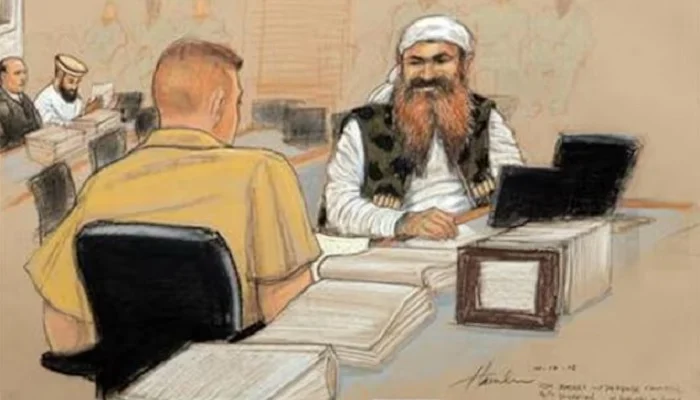
A US military judge has rejected confessions made by Khalid Sheikh Mohammed, the man accused of masterminding the September 11, 2001, terrorist attacks, ruling that statements he gave to FBI agents were not voluntary and cannot be used at trial.
The decision represents a significant setback for prosecutors in a case that has been tied up in legal disputes for nearly two decades. The judge’s ruling focuses on the circumstances surrounding Mohammed’s detention and interrogation while he was held in CIA custody.
Judge Rules FBI Statements Were Tainted
US Air Force Lieutenant Colonel Michael Schrama ruled that statements Mohammed made to FBI agents in 2007 were affected by the coercive treatment he had previously experienced while in CIA custody.
According to the ruling, the harsh treatment continued to influence the later interrogations, meaning the statements could not be considered genuinely voluntary.
Mohammed was captured in Pakistan in 2003 and subsequently held at secret CIA detention facilities before being transferred to Guantanamo Bay in 2006. During his CIA detention, he was subjected to harsh interrogation techniques, including repeated waterboarding.
The prosecution had regarded his later statements to FBI investigators as important evidence. However, defense lawyers have long argued that the earlier treatment compromised the reliability and legal admissibility of statements made afterward.
Trial Set for June 2028
Mohammed and three co-defendants are currently scheduled to go on trial on June 5, 2028, before a military commission at the US detention facility in Guantanamo Bay, Cuba.
Judge Schrama rejected prosecutors’ proposal to begin the proceedings in January 2027, saying there was insufficient time to resolve outstanding pretrial evidentiary and legal issues.
The trial is expected to begin with the selection of military personnel who will serve as the panel, effectively acting as the jury. Opening statements are scheduled to follow about 30 days after the panel is seated. Prosecutors will then present their evidence, followed by the defense, before the case moves into a sentencing phase.
Four Defendants Face 9/11 Charges
Mohammed is facing trial alongside Walid Muhammad Salih Mubarak bin ‘Atash, Mustafa Ahmed Adam al Hawsawi and Ali Abdul Aziz Ali.
The four men are accused of conspiring to carry out the September 11 attacks, in which nearly 3,000 people were killed.
Trial of Alleged 9/11 Mastermind Khalid Sheikh Mohammed Set for June 2028
The attacks involved the hijacking of four passenger aircraft. Two planes were flown into New York’s World Trade Center, another struck the Pentagon, while a fourth crashed in Pennsylvania after passengers attempted to regain control of the aircraft.
Mohammed has been described by US authorities as the alleged mastermind of the attacks.
Previous Plea Deals Also Collapsed
The latest ruling is not the first major legal setback to affect the case.
In 2024, Mohammed and two of his co-defendants agreed to plead guilty under agreements that would have spared them the death penalty. The agreements were initially approved by the official overseeing the Pentagon’s Guantanamo military commissions.
However, then-US Defense Secretary Lloyd Austin later revoked the agreements following political criticism. A US appeals court subsequently blocked the defendants from pleading guilty under those deals.
The proceedings have repeatedly been delayed by disputes over evidence, interrogation practices and the treatment of defendants during US detention.
What the Ruling Means for the Case
The exclusion of Mohammed’s FBI statements could make the prosecution’s case more difficult, particularly if prosecutors consider the testimony important to proving the charges.
The government could challenge Judge Schrama’s ruling, potentially creating another round of legal proceedings before the trial can move forward.
For families of the September 11 victims, the latest development is another setback in a case that has remained unresolved for decades. Many relatives have waited years for a final judicial determination of responsibility and punishment.
The Guantanamo detention facility was established in 2002 under President George W. Bush’s administration to hold foreign militant suspects captured following the 9/11 attacks. The military commission system created for those cases has faced years of controversy and legal challenges.
With the trial now scheduled for 2028 and major evidentiary issues still being contested, the latest ruling could further complicate efforts to bring the long-running 9/11 case to a conclusion.