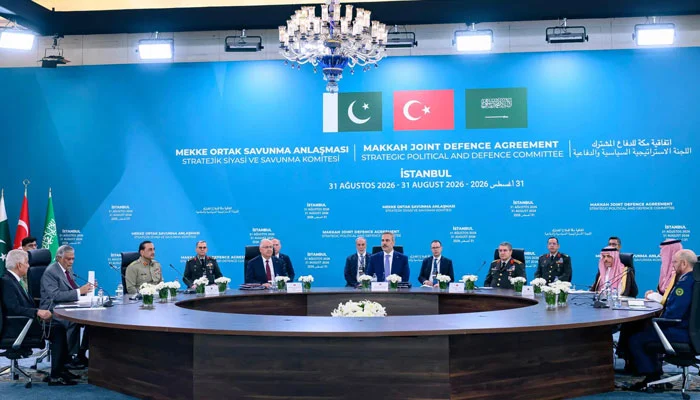
Pakistan, Saudi Arabia and Turkiye held the inaugural meeting of a Strategic Political and Defence Committee in Istanbul on Monday, marking the first formal gathering under the Makkah Joint Defence Agreement.
The high-level trilateral meeting brought together senior political and military officials from the three countries as they discussed ways to strengthen collective defence capabilities, improve coordination between their armed forces and address growing regional and global security challenges.
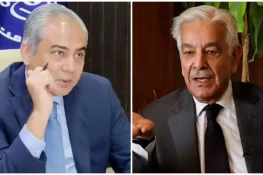
Pakistan was represented by Deputy Prime Minister and Foreign Minister Ishaq Dar, Defence Minister Khawaja Asif, and Chief of Army Staff and Chief of Defence Forces Field Marshal Syed Asim Munir.
Foreign and defence ministers as well as chiefs of general staff from Saudi Arabia and Turkiye also attended the meeting.
Pact focuses on collective deterrence
The Makkah Joint Defence Agreement was signed on August 7 and established a framework for closer defence cooperation among Pakistan, Saudi Arabia and Turkiye.
A central feature of the agreement is collective deterrence. Under the pact, an armed attack against any one of the three countries is to be regarded as an attack against all three, creating a mutual defence commitment broadly comparable in principle to NATO’s collective defence provision.
The agreement came amid heightened tensions across the Middle East following the outbreak of the war involving Iran, the United States and Israel.
For Pakistan, participation in the arrangement also reflects its longstanding relations with both Saudi Arabia and Turkiye, as well as its stated interest in promoting regional peace and stability.
Turkiye says roadmap being prepared for new members
Speaking at a press conference after the first session, Turkish Foreign Minister Hakan Fidan said work was underway on a roadmap that could allow other countries to participate in the joint defence framework.
Fidan said the meeting was intended to contribute to regional peace, stability and prosperity. He added that the discussions would help determine the responsibilities shared by the three countries against the backdrop of increasing regional and international tensions.
Pakistan Says Makkah Defence Pact Open to Countries Supporting Its Principles
However, the immediate focus remains on establishing the mechanisms required to make the agreement operational.
Counterterrorism and defence industry cooperation
According to Fidan, the three countries discussed a broad range of security issues, including global and regional developments and ways to improve their respective defence capabilities.
Joint efforts against terrorism are also part of the agenda, alongside greater coordination among the armed forces of Pakistan, Saudi Arabia and Turkiye.
The countries are additionally expected to examine cooperation in the defence industry, including joint production, research and development. Such collaboration could provide a framework for sharing expertise and developing defence-related capabilities.
Secretariat and coordination mechanisms under discussion
Another key issue is the creation of an institutional structure to oversee the agreement’s activities.
Fidan said the meeting would consider a framework for establishing a secretariat, along with other mechanisms needed to coordinate and guide joint initiatives.
The first meeting therefore represents an important step towards translating the defence agreement into practical cooperation. Further discussions are expected to clarify the roles and responsibilities of the three countries and establish the mechanisms through which future defence and security initiatives will be coordinated.
As regional tensions continue to shape security calculations, Islamabad, Riyadh and Ankara are seeking to strengthen their strategic coordination while presenting the new framework as an effort aimed at collective security, stability and regional peace.