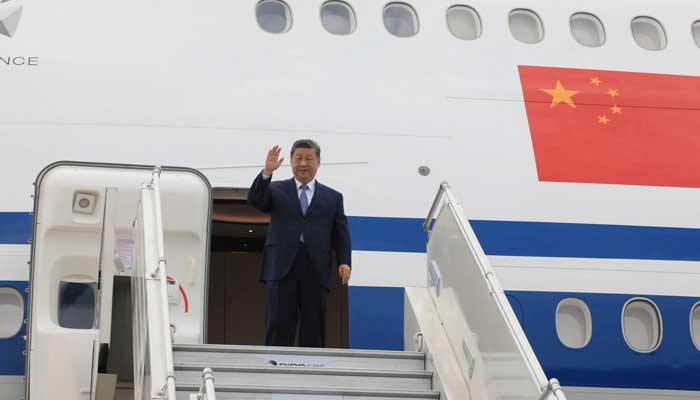
Chinese President Xi Jinping arrived in New Delhi on Saturday to attend the BRICS summit, with wars in the Middle East and Ukraine, trade tensions and global energy security dominating the agenda of the expanded grouping.
Xi’s visit is also being closely watched because it marks his first trip to India since 2019 and the most significant step so far in a cautious improvement in relations between the two nuclear-armed neighbours.
He received a red-carpet welcome in New Delhi, including an honour guard and performances by traditional dancers.
Xi and Modi set for talks
Xi is scheduled to hold face-to-face talks with Indian Prime Minister Narendra Modi later on Saturday, according to India’s foreign ministry.
The visit comes six years after a deadly military confrontation along the disputed Himalayan border in 2020. Relations between Beijing and New Delhi have since shown signs of gradual improvement, including the restoration of flights, visa services and high-level diplomatic contacts.
China said on Friday that it was ready to work with India by strengthening communication, expanding cooperation and properly managing differences.
However, the underlying territorial dispute remains unresolved. Both countries continue to maintain large military deployments along their roughly 3,500-kilometre border in the high-altitude region.
China-India relations also remain complicated by a widening trade imbalance and broader strategic competition.
China-India expert Pradeep Taneja of the University of Melbourne said both countries were seeking an “early and substantial harvest” on the border issue, while warning that continued military deployments could undermine efforts to strengthen economic and people-to-people ties.
Wars put BRICS unity under pressure
The two-day BRICS summit is taking place as conflicts in the Middle East and Ukraine, along with trade uncertainty and energy security concerns, test the cohesion of the 11-member group.
India has sought to manage the energy crisis linked to the US-Iran conflict partly by turning to Russia, despite Moscow’s ongoing war in Ukraine and pressure from Washington and other Western countries.
Russian President Vladimir Putin, one of India’s key strategic partners, met Modi in New Delhi on Friday.
Indian Parliamentary Panel Seeks Apology from Meta Over Temporary Removal of PM Modi’s Video
Iranian President Masoud Pezeshkian also attended the summit and said pressure on Tehran had reached a “critical and dangerous stage” following what he described as military aggression by the United States and Israel.
Modi and Pezeshkian also held talks.
India maintains relations with both Iran and Israel while also attempting to preserve its strategic relationship with the United States, making the regional conflict particularly sensitive for New Delhi.
BRICS faces internal divisions
BRICS was established in 2009 as a platform for major emerging economies seeking greater influence in international institutions traditionally dominated by Western powers.
Modi told leaders that BRICS countries account for about half of the world’s population, 40% of global GDP and more than a quarter of global trade.
The bloc now includes Iran, Saudi Arabia and the United Arab Emirates, despite their differing positions on the Middle East conflict.
UAE President Mohamed bin Zayed Al Nahyan, Saudi Foreign Minister Prince Faisal bin Farhan and Egyptian President Abdel Fattah al-Sisi are also due to attend the summit.
Brazil is being represented by Foreign Minister Mauro Vieira as President Luiz Inacio Lula da Silva campaigns ahead of October elections.
BRICS foreign ministers failed to reach agreement on a joint statement when they met in New Delhi in May, highlighting the divisions within the expanded group.
Harsh V Pant of India’s Observer Research Foundation said the Gulf conflict was likely to become the central dividing line at the summit.
He argued that the expansion of BRICS, once viewed as a major achievement, could now become a constraint because of the sharply different positions among its members.