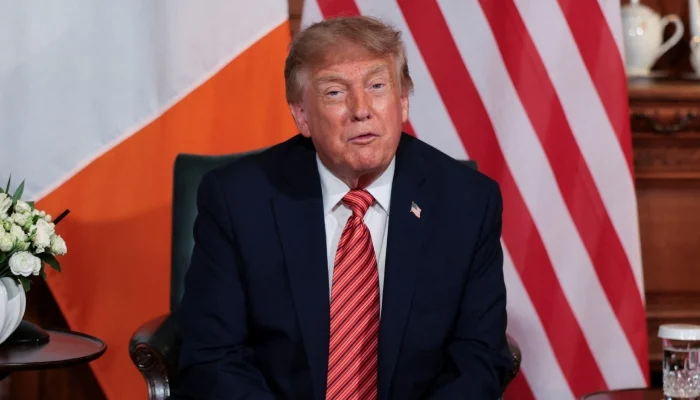
US President Donald Trump said Saturday that Yemen’s Houthi fighters had contacted Washington and asked the United States not to intervene against them as tensions continue to rise across the Middle East.
“The Houthis called us and they don’t want to fight with us,” Trump told reporters during a visit to Dublin, Ireland.
“They don’t want us to go after them,” he added, saying he expected the situation in the region to be resolved.
Trump also said he had spoken with Saudi Crown Prince Mohammed bin Salman, whom he described as a friend.
Saudi seeks US support against Houthis
Trump’s comments came amid escalating attacks involving the Iran-aligned Houthis and Saudi Arabia.
According to US outlet Axios, the Saudi crown prince called Trump twice on Thursday to request US strikes against the Houthis, but Trump declined the request.
The Houthis have also carried out attacks on Saudi oil infrastructure this week, including a major drone and missile assault.
More than 70 people were reportedly injured on Tuesday after Houthi attacks targeted several Saudi cities, further increasing concerns over regional stability.
Saudi pipeline shut after aerial attack
Saudi Arabia, the world’s largest crude oil exporter, has temporarily shut its East-West oil pipeline after the vital infrastructure came under aerial attack.
The attack reportedly originated in Iraq, according to Baghdad and Riyadh. Iraq subsequently dismissed a military commander on Saturday following the incident.
The 1,200-kilometre pipeline crosses the Arabian Peninsula and provides Saudi Arabia with an alternative route for transporting oil without relying on the Strait of Hormuz.
Yemen’s Houthis reach strategic island at mouth of vital shipping lane
The waterway has seen a sharp decline in tanker traffic amid the ongoing US-Iran conflict and disruptions to regional shipping.
Saudi Arabia’s Energy Ministry said the pipeline was closed as a precautionary measure.
The pipeline had been transporting between 4 million and 5 million barrels of oil per day in recent months, according to shipping trackers and analysts. That volume represents roughly 4% to 5% of global oil supply.
Houthis expand control along Red Sea
The latest developments come after Houthi forces reportedly expanded their control along Yemen’s Red Sea coast and seized several strategically important islands.
The developments have heightened concerns over shipping routes connecting Europe and Asia and added further pressure to an already volatile regional energy market.
Saudi Arabia has increasingly relied on alternative routes for its oil exports after disruptions to shipping through the Gulf and the Strait of Hormuz.
Trump has repeatedly indicated that Washington does not want to become further involved in the conflict with the Houthis, while regional governments continue to assess the growing security and economic risks posed by attacks on vital infrastructure and shipping routes.