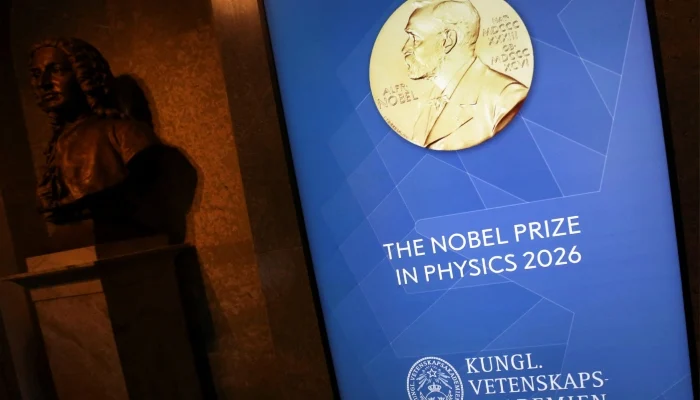
Research in particle physics, astrophysics, advanced materials and the development of an “invisibility cloak” are among the scientific achievements being discussed ahead of the 2026 Nobel Prize in Physics.
The physics prize is due to be announced Tuesday in Stockholm, marking the second award of this year’s Nobel season following Monday’s Medicine Prize.
The Medicine Nobel went to US psychiatrist and neurologist Karl Deisseroth and German scientists Peter Hegemann and Georg Nagel for pioneering work in optogenetics, a field that uses light to control nerve activity.
Invisibility cloak research among contenders
One of the most frequently discussed possibilities for the Physics Nobel is research into metamaterials.
British physicist John B. Pendry has long been associated with the theoretical foundations behind “invisibility cloaks”, which use specially engineered materials to manipulate electromagnetic waves and potentially bend light around an object.
Science producer Camilla Widebeck of Swedish public broadcaster Sveriges Radio said Pendry could potentially share the prize with American physicist David Smith, noting that metamaterials have developed into a broad field of research since major breakthroughs about two decades ago.
Italian-American physicist Federico Capasso is another possible contender. He is widely recognised for contributions to the development of the quantum cascade laser.
Twistronics and advanced materials
Another area attracting attention is “twistronics”, which involves stacking two extremely thin material layers and twisting them relative to each other. The technique can produce unusual electronic properties, including superconductivity under certain conditions.
Spain’s Pablo Jarillo-Herrero, Canada’s Allan MacDonald and Israel’s Rafi Bistritzer have been recognised previously for their work in the field, including the 2020 Wolf Prize in Physics.
Romanian-born US researcher Eva Andrei has also been mentioned among possible contenders, although some experts believe Nobel recognition for twistronics could still be several years away.
The speculation comes 16 years after the Nobel Committee honoured research into graphene, a one-atom-thick layer of carbon arranged in a honeycomb structure.
Nobel Prize in Economics 2025 Awarded to Experts from the U.S., France, and Canada
Particle physics and quantum research
Particle and nuclear physics are also considered strong possibilities for this year’s award.
Research firm Clarivate has highlighted Japanese scientist Chihaya Adachi and Americans Stephen R. Forrest and Mark E. Thompson for their work on highly efficient organic light-emitting diodes, or OLEDs.
The technology has helped improve display quality in smartphones, televisions and computers while reducing energy consumption.
Clarivate has also identified Swiss-British researcher Nicola Spaldin for theoretical work on magnetoelectric multiferroics and Chinese physicist Qikun Xue for experimental research into the quantum anomalous Hall effect.
Another possibility is recognition for CERN’s ATHENA and ALPHA collaborations, which successfully trapped cold antihydrogen atoms and studied their properties. American physicist Jeffrey Hangst, a founder of both collaborations, could potentially be among the laureates.
Astrophysics also in the spotlight
Experts have also pointed to astrophysics as an area that could receive renewed attention from the Nobel Committee.
British astrophysicist Martin Rees, who previously served as Britain’s Astronomer Royal, has been mentioned among possible candidates.
Research linked to the James Webb Space Telescope and studies of galaxy formation have also attracted speculation. Among the scientists associated with galaxy formation research are Mexican-British cosmologist Carlos Frenk, Argentinian astrophysicist Julio Navarro and British scientist Simon White.
Last year’s Physics Nobel was awarded to John Clarke, Michel Devoret and John Martinis for experiments demonstrating quantum mechanical effects in electrical circuits, work that contributed to advances in quantum technology.
The Physics Nobel will be followed by the Chemistry Prize on Wednesday, the Literature Prize on Thursday and the Peace Prize on Friday. The Economics Prize will conclude this year’s Nobel season on October 12.