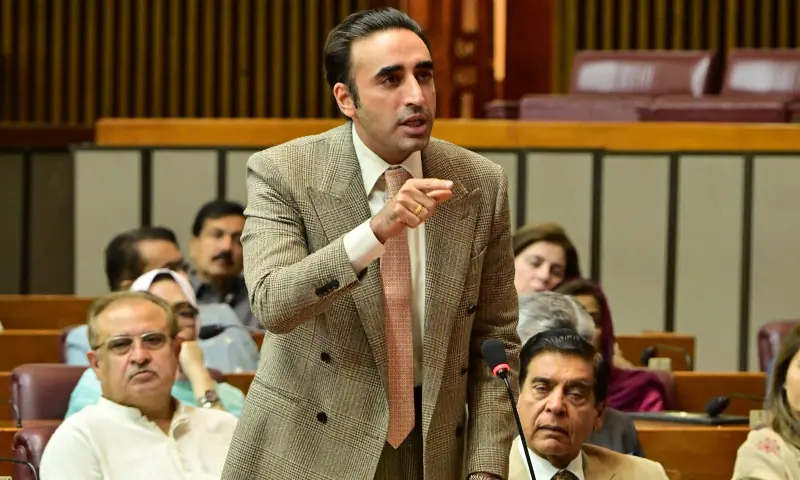
Pakistan Peoples Party (PPP) Chairman Bilawal Bhutto-Zardari has offered to approach Prime Minister Shehbaz Sharif to seek an end to the emergency in Khyber-Pakhtunkhwa if Pakistan Tehreek-e-Insaf (PTI) agrees to political dialogue and helps create conditions that remove the need for the measure.
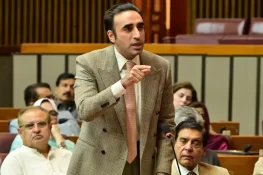
Addressing the National Assembly on Wednesday, Bilawal urged PTI and other opposition parties to engage with the government on counterterrorism and national security. He said political negotiations could help resolve the issues cited by the federal government as justification for imposing emergency in the province.
“Even today, I invite you to come and hold talks with the government and political parties and create conditions in which there will be no need for this emergency in K-P,” Bilawal said.
He added that if such conditions were established, he would personally request the prime minister to end the emergency.
Bilawal Accuses PTI of Political Missteps
Bilawal defended the federal government’s decision, arguing that the administration had made efforts to engage the opposition before taking the constitutional step.
He maintained that PTI had the right to oppose the emergency but could not ignore its own role in creating the political and constitutional circumstances that led to the decision.
The PPP chairman accused PTI of carrying out what he described as a “political suicide attack” on its own provincial government. He argued that the party’s provincial leadership had failed to provide sufficient grounds for the federal government, President Asif Ali Zardari or the PPP to oppose the intervention.
Bilawal said the PPP had initially favoured political engagement before the government resorted to what he called a “constitutional atom bomb”. According to him, the objective had been to address concerns over cooperation between the provincial and federal governments in counterterrorism operations.
Bilawal Details Previous Negotiations
The PPP chairman said two representatives of his party, including its parliamentary leader in the Senate, had participated in a committee tasked with negotiations involving the opposition.
He recalled receiving reports that the talks were progressing towards an agreement on measures to address terrorism in K-P.
According to Bilawal, the proposed understanding included identifying areas most severely affected by terrorism and developing an agreement under which the federal government, the provincial government and the K-P chief minister would coordinate their counterterrorism efforts.
He said he had viewed the progress as an opportunity for the government and opposition to cooperate on an issue of national importance.
However, Bilawal argued that the political process had failed to prevent the situation from escalating into a constitutional confrontation.
PTI Challenges Emergency and Governor’s Rule in K-P High Court
Emergency Cannot Provide a Permanent Solution
Bilawal acknowledged that emergency measures alone could not eliminate terrorism and said a broader national strategy was required.
He described K-P as one of the provinces most severely affected by militancy and referred to tensions with Afghanistan as an additional security challenge.
The PPP chairman also criticised the provincial leadership’s approach to cooperation with the federal government, arguing that political disagreements should not obstruct efforts to combat terrorist groups.
He said the fight against terrorism required coordination across Pakistan and urged opposition parties to participate in developing a joint strategy.
Bilawal maintained that the emergency should not continue indefinitely and that political engagement remained necessary to create conditions for its withdrawal.
Bilawal Raises Regional Security Concerns
During his address, Bilawal also discussed Pakistan’s wider security challenges, including tensions with India and militant activity attributed by Pakistani officials to groups operating in the region.
He referred to India’s Operation Sindoor and repeated allegations that India was supporting terrorist activity in Pakistan through the Tehreek-e-Taliban Pakistan and separatist militant organisations. India has rejected accusations of sponsoring terrorism in Pakistan.
Bilawal also referred to Pakistan’s diplomatic efforts concerning regional tensions, including those involving Iran and the United States.
He argued that Pakistan could not afford prolonged internal political confrontation while facing external security challenges. The PPP chairman urged political parties to work together on issues that he described as essential to national security.
PPP Calls for Parliamentary Cooperation
Bilawal thanked Prime Minister Shehbaz Sharif and his team for accepting the PPP’s proposal to establish a parliamentary committee on electoral reforms.
He argued that the committee would be ineffective if it included only members of the ruling coalition, stressing that opposition participation was essential to building consensus.
Referring to the National Action Plan, Bilawal recalled how political parties from the government and opposition had previously worked together on counterterrorism policy.
He proposed a similar parliamentary mechanism to address terrorism and national security, with representation from both sides of the House.
The PPP chairman said political disagreements should not prevent Parliament from providing a platform for consultation and practical solutions.
Dialogue Remains a Possible Route to Ending Emergency
Bilawal reiterated that the PPP was prepared to work with PTI and other opposition parties to develop a political framework for addressing the security situation in K-P.
He maintained that the federal government’s decision had been taken in response to prevailing circumstances but argued that negotiations could help remove the justification for continuing emergency.
His offer places political dialogue at the centre of the debate over the province’s administration and counterterrorism policy.
Whether the emergency can be withdrawn will depend, according to Bilawal’s proposal, on whether the government and opposition can reach an understanding on security cooperation and the province’s political future.